A perfectly grilled steak can still leave guests wondering what else is for dinner. A platter of sausages might feed everyone comfortably but feel more like an informal snack than a complete outdoor meal. Meanwhile, a beautifully cooked whole chicken can become a serving headache if nobody has planned when to carve it.
The difference is rarely the quality of the grilling. It is how the main dish works with the rest of the menu, the available grill space, and the way guests actually eat outdoors.
For a satisfying BBQ, start with the complete plate: a generous protein, a substantial starch or bread, something fresh or vegetable-based, and a sauce or dressing that brings the elements together. Then consider whether the main can be cooked, rested, portioned and served without keeping everyone waiting.
For ten guests, chicken thighs, sausages and make-ahead slow-cooked meats often offer more flexibility than individually timed steaks or burgers. The best choice, however, depends on whether the priority is presentation, speed, variety or spending time with guests.
How to choose a grilled main that makes dinner work
- Build the complete plate before choosing the centrepiece: protein, starch, vegetables and a complementary sauce.
- Match the main to grill capacity and serving rhythm. Choose food that can be prepared ahead when feeding a crowd.
- Plan resting, carving and safe hot holding so second helpings remain appealing without constant cooking.
- Why Do Some Grilled Mains Feel Underwhelming Even When They Taste Good?
- How to Choose a Grilled Main That Fits Your Side Dishes Without Last-Minute Stress?
- Burgers, Sausages, or Chicken: Which Feeds 10 People With the Least Grill Bottleneck?
- The High-Maintenance Main Mistake That Makes You Miss Your Own BBQ
- When Should You Slice and Hold Grilled Mains So They Stay Hot for Second Helpings?
- How to Build a BBQ Menu That Lets You Sit Down for at Least 30 Minutes
- How to Keep Food Hot Outdoors Using Foil, Coolers, and Smart Serving Order?
- How to Serve an Outdoor Meal So Food Stays Hot Even if Guests Eat in Waves?
Why Do Some Grilled Mains Feel Underwhelming Even When They Taste Good?
A grilled main feels underwhelming when it tastes good individually but fails to create a balanced, satisfying plate. This usually happens because substantial sides are missing, portions appear small, or food arrives at different times. A complete BBQ meal needs more than excellent protein: it needs complementary textures, enough food and a coordinated serving experience.
Consider a beautifully grilled pork chop served with a spoonful of green salad. The chop may be seasoned perfectly, yet the meal can feel incomplete because there is nothing substantial to accompany it. Add roasted new potatoes, a crunchy apple slaw and mustard dressing, and the same chop becomes the centre of a deliberate menu.
Flavour quality and meal completeness are different things. A main might deliver richness, smoke and a pleasing crust without offering the freshness, bulk or contrast that makes an entire plate satisfying.
Texture matters just as much as quantity. A combination of soft chicken, creamy potato salad and mayonnaise-based coleslaw can feel monotonous despite being generous. Crunchy pickles, crisp leaves or a sharp dressing change the experience without requiring another complicated dish.
Service timing creates a second problem. If two guests receive hot burgers while eight wait for the next batch, the meal loses its shared rhythm. Even when every burger is delicious, the group experiences dinner as a succession of individual portions rather than a relaxed gathering.
Outdoor meals can also involve extended grazing, relaxed conversation and second helpings. A main designed for one neatly plated indoor course may feel less substantial when guests return to the table later.
Before settling on a main, perform a simple complete-plate test:
- Picture the cooked protein occupying its proper place on a dinner plate.
- Add a starch, such as bread, potatoes, rice or a substantial grain salad.
- Add a fresh or vegetable-based component that contrasts with the main.
- Consider whether a dressing, condiment or sauce makes the combination more cohesive.
- Imagine serving the same plate to the last guest, not only the first.
If the plate looks sparse, the solution may not be a larger cut of meat. A better starch, more vegetables or a more coherent serving plan could achieve more.
Once the plate feels satisfying, the next decision is whether its components can realistically be ready together.
How to Choose a Grilled Main That Fits Your Side Dishes Without Last-Minute Stress?
Choose a grilled main by considering the sides you want to serve, then balance their flavours and preparation demands. Rich, smoky meat works well with fresh or acidic accompaniments, while simply seasoned chicken can support more elaborate sides. The easiest menus also divide work sensibly between the kitchen and grill, avoiding several last-minute cooking tasks.
Start with what the main contributes. Barbecue ribs already bring richness, sweetness and a sticky texture. They benefit from vinegar-dressed slaw, pickles or a crisp green salad rather than another heavy, sweet dish.
Grilled chicken skewers, by contrast, provide a relatively simple foundation. They can sit comfortably beside herby couscous, charred peppers, grilled flatbreads or a more elaborate sauce.
The aim is contrast without competition. Not every component needs its own complicated seasoning or cooking process.
The following combinations illustrate how flavour and workload can work together.
| Grilled main | Complementary sides | Preparation advantage |
|---|---|---|
| Smoky ribs | Sharp slaw, pickles, bread | Cold sides can be prepared ahead |
| Chicken skewers | Herby couscous, roasted peppers, yoghurt sauce | Skewers and sides can be assembled before guests arrive |
| Burgers | Prepared salad, buns, sliced toppings | Only the patties need final cooking |
| Grilled fish | Potato salad, lemon dressing, fresh vegetables | Most accompaniments need no grill space |
| Sausages | Warm potato salad, mustard, crunchy slaw | Simple individual portions suit relaxed service |
Next, consider the equipment. If you have one charcoal grill, cooking delicate fish while turning vegetable skewers and warming flatbreads creates unnecessary competition for the hottest areas.
Instead, assign each dish a preparation location. The grill handles the centrepiece. The kitchen handles potatoes, grains or sauces. Cold components wait in the fridge until serving time.
Planning backwards from dinner is particularly effective. For a hypothetical 6:30 pm meal, work out when the main must finish, when it needs resting or portioning, and which sides can be completely ready beforehand. Schedule anything requiring active attention so it does not overlap with the final cooking stage.
Marinades, dry rubs, chopped vegetables and most cold salads can often be prepared in advance, subject to suitable refrigeration. Hot sides should either be ready close to serving or have a reliable way to remain safely hot.
A useful restriction is to choose no more than one dish requiring intense last-minute attention. If lamb chops demand careful timing, choose ready-to-serve sides. If the sides need finishing on the grill, select a more forgiving main.
Once preparation duties are balanced, grill capacity becomes the deciding factor for larger groups.
Burgers, Sausages, or Chicken: Which Feeds 10 People With the Least Grill Bottleneck?
For ten guests, sausages and chicken pieces generally offer more flexible service than burgers cooked individually to order. Sausages are easy to portion, while chicken thighs or drumsticks can be cooked in batches using indirect heat. Burgers are excellent for customisation but can create queues when grill space is limited. The best choice depends on batch capacity and holding quality.
The real bottleneck is not necessarily cooking time. It is the number of portions that can safely fit on the grill, the attention each portion requires and the number of cooking rounds needed.
Imagine a grill with enough usable space for five burger patties. Feeding ten people requires at least two rounds if each guest wants one burger. A larger menu with multiple patties per person could require more.
Before guests arrive, count how many portions can fit comfortably with space for handling and appropriate heat circulation. Divide the portions required by that capacity and round up to identify the number of batches. This is a planning calculation, not a guarantee of identical cooking times.
The differences between popular mains become clearer when compared as serving systems rather than just foods.
| Factor | Burgers | Sausages | Chicken pieces |
|---|---|---|---|
| Last-minute attention | High when cooked to order | Moderate | Moderate with managed indirect heat |
| Batch planning | Limited by patty space | Easy to count individual portions | Flexible with a suitable grill setup |
| Hot-holding quality | Patties can dry out; assembled buns soften | Relatively forgiving for short periods | Thighs and drumsticks are generally more forgiving than lean breast |
| Serving presentation | Customisable individual meals | Informal unless paired thoughtfully | Substantial shared platter |
| Main logistical challenge | Cooking and assembling orders | Achieving even cooking | Managing safe internal cooking temperature |
Burgers work best when buns, toppings, sauces and sides are already waiting. Guests can build their own meal as patties become available, reducing the host’s workload.
Sausages are useful for a less formal BBQ, especially when paired with good rolls, sharp mustard, substantial salads and grilled onions. Their modest presentation can become an advantage when the menu is designed around individual plates.
Chicken thighs and drumsticks offer a middle ground. They feel substantial, can be arranged on a generous platter and need less last-minute assembly. Indirect grilling also allows the cook to manage heat without constantly moving individual pieces.
There is also a practical case for combining two mains. In a hypothetical menu, chicken thighs could finish their indirect cooking before the final burger round begins. Guests ready to eat can choose chicken while burger enthusiasts wait for freshly cooked patties.
That combination only helps if the grill has enough capacity or the chicken can be held safely. Two mains cooked simultaneously in an overcrowded grill may create a worse bottleneck than one well-planned dish.
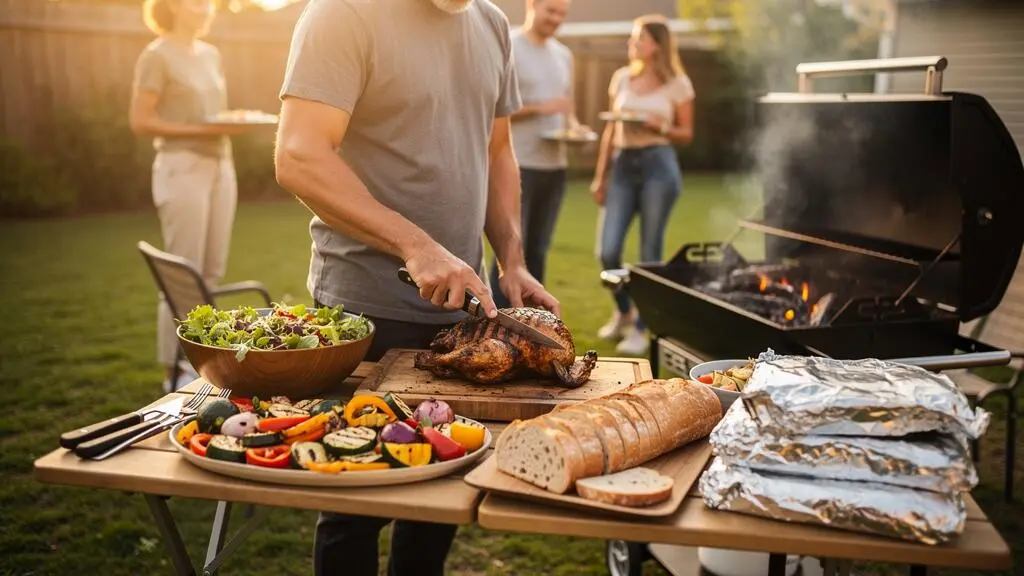
Large showpiece cuts present another challenge: carving. A whole chicken or rack of ribs may look impressive on the table but become awkward when ten people are waiting. Rest and portion it at a separate cutting station before the main serving rush.
Whichever option you choose, check internal temperatures rather than relying on colour or grill marks. The official US FoodSafety.gov’s minimum internal temperature chart specifies 71 °C for ground meat and sausages and 74 °C for poultry. These are US safety recommendations; hosts in other countries should also consult applicable local guidance.
Once grill throughput is manageable, the next consideration is how much attention the main will demand during the gathering.
The High-Maintenance Main Mistake That Makes You Miss Your Own BBQ
The most demanding grilled main is not necessarily the most impressive choice for hosting. The mistake is selecting food that requires constant turning, precise timing, delicate carving or frequent sauce applications while other dishes also need attention. A technically excellent menu can leave the host working throughout the evening instead of enjoying the meal with guests.
Consider a menu featuring delicate fish fillets, grilled asparagus and flatbreads. Each element can be delicious. Together, however, they demand different cooking zones, frequent checks and quick serving.
The host becomes responsible for three simultaneous finishing tasks, all of which lose quality when neglected.
A simpler menu might feature indirect-grilled chicken thighs, a prepared potato salad and crisp vegetables with a lemon dressing. It can be equally satisfying, but most of the final cooking attention is concentrated on one component.
Judge the main by active attention, not just total cooking duration. A slow-cooked cut that needs periodic temperature checks may be easier to host around than fish requiring a brief but uninterrupted finishing window.
The following scale is a practical planning guide rather than a universal ranking. Equipment, recipes and experience can change how demanding each dish becomes.
| Attention level | Typical example | Hosting implication |
|---|---|---|
| Low | Slow-cooked, already tender meat finishing gently | Most work can happen before guests eat |
| Low to moderate | Sausages over controlled heat | Occasional turning and temperature checks |
| Moderate | Chicken thighs with indirect heat and a probe | Requires temperature management, but less constant handling |
| High | Several rounds of made-to-order burgers or chops | Repeated active cooking and serving |
| Very high | Delicate fish requiring precise handling alongside grilled sides | Little freedom to leave the cooking station |
Ambitious mains can become less demanding through preparation. A probe thermometer can help monitor a larger piece of meat while it cooks indirectly. A dry rub can avoid the repeated brushing required by certain sticky sauces. Suitable dishes can also be partly cooked in the kitchen and immediately finished on the grill, provided the cooking process is managed safely without an unsafe holding interval between partial cooking and finishing.
For lean, delicate cuts, simplicity can be more useful than elaborate techniques. Prepare every accompaniment before the final grilling begins, then devote a short, uninterrupted period to the main.
One practical menu rule prevents most scheduling disasters: the more demanding the main, the more independent the sides must be. Conversely, if grilled vegetables, breads and hot accompaniments need active finishing, choose a main that can rest or be held safely during that work.
It also helps to decide who will manage carving, plating and bringing dishes to the table. A host does not need to perform every task personally.
Reducing active cooking is only one part of the solution; knowing when to rest, carve and hold the finished meat creates the next opportunity to reclaim time.
When Should You Slice and Hold Grilled Mains So They Stay Hot for Second Helpings?
Rest suitable grilled meats before carving, keep larger pieces intact for as long as practical, and slice portions close to serving time. Whole pieces generally cool less quickly than thin slices, while premature carving exposes more surface to drying. For second helpings, use safe temperature-controlled holding rather than leaving meat covered on an outdoor table indefinitely.
Resting serves two purposes. It gives certain cooked meats time to settle before cutting, and it creates a useful interval for finishing plates, arranging sides or bringing guests to the table.
The ideal resting period varies by cut and cooking method. A large roast, an individual steak and a chicken thigh should not automatically receive identical treatment.
For service, the practical principle is to carve only what the next group needs. A platter of sliced meat left exposed for an extended period loses heat and can dry around the edges.
Different mains also tolerate holding differently.
- Braised ribs and tender slow-cooked cuts: often remain appealing when covered and held at a controlled safe temperature, although their crust may soften.
- Chicken thighs and drumsticks: can be portioned before service and usually tolerate a short controlled holding period better than lean chicken breast.
- Sausages: remain convenient as individual portions, but excessively prolonged holding can make their skins and interiors less pleasant.
- Steaks and lean fillets: are best scheduled near serving because continued heat exposure can change their desired texture and doneness.
A covered tray in a genuinely temperature-controlled warm area can simplify second helpings. Merely positioning the tray beside a hot grill is not sufficient evidence that the food remains safely hot.
Use a food thermometer to check the holding temperature. The US FDA recommends keeping hot food at or above 60 °C. Its FDA barbecue food-safety guidance also gives time limits for perishable food left outside refrigeration or controlled hot holding, with stricter limits in high outdoor temperatures.
These guidelines are particularly relevant when guests take second helpings much later than the first serving.
Be cautious about returning sliced meat to a very hot grill. Direct heat can dry or burn the outside before the interior warms sufficiently. For suitable cooked food, gentle reheating in a covered pan, oven or indirect grill zone offers better control. Properly chilled leftovers must be reheated thoroughly in accordance with applicable food-safety guidance.
Do not confuse insulation with active heating. A foil-covered tray may slow cooling, but it does not guarantee a safe holding temperature.
When the main can rest or remain safely hot without constant intervention, it becomes possible to organise the entire menu around a genuine break for the host.
How to Build a BBQ Menu That Lets You Sit Down for at Least 30 Minutes
To sit down for at least 30 uninterrupted minutes during a BBQ, build the menu around a protected period with no active grilling, carving or kitchen work. Choose a main that can finish before the meal or cook predictably with minimal intervention, pair it with fully prepared sides, and delegate serving tasks. The goal is uninterrupted hosting time, not simply shorter cooking.
Start by identifying which jobs require the host’s physical presence. Turning burgers, carving a roast, warming bread, dressing salad and finding serving utensils may each seem minor. Together, they can prevent any meaningful break.
Move as many of those jobs as possible away from the intended sitting period.
Slow-cooked ribs, pulled pork prepared ahead and chicken cooked using indirect heat can be useful choices, provided the preparation and safe holding arrangements suit the recipe.
Cold salads, prepared dips, breads and pickled vegetables require far less intervention once serving begins. They also reduce competition for grill space.
The resting period of a substantial grilled main offers a natural scheduling opportunity. Rather than rushing to carve immediately, use that interval to organise the table and finish any remaining service tasks. Resting itself does not always last 30 minutes, so a longer break must rely on other prepared or safely held components as well.
Consider this hypothetical schedule for ten guests eating at 6:30 pm. Actual cooking start times depend on the cut, recipe, grill and weather.
| When | Task | Host’s attention |
|---|---|---|
| Previous day | Prepare suitable salads, dressings and marinades; refrigerate perishables | Preparation completed ahead |
| Well before guests arrive | Start the selected slow or indirect cooking process | Monitoring as required |
| Before 6:00 pm | Arrange serving utensils, plates, sauces and cold-side storage | Final setup |
| 6:00–6:25 pm | Complete active cooking, verify temperatures, rest and portion food as appropriate | Concentrated finishing session |
| 6:30–7:00 pm | Serve from prepared dishes with safe temperature control | Protected sitting period |
| After 7:00 pm | Handle additional portions and leftovers according to food-safety requirements | Short follow-up tasks |
The schedule works only if hot food can genuinely remain at a safe temperature and someone can manage any essential serving needs. A cook should never leave an unsafe or uncontrolled fire or grill unattended merely to meet the break target.
A particularly useful alternative is to finish the main before the protected sitting period, then rely on insulated or actively heated serving equipment that has been checked for appropriate food temperatures.
Five actions to create a 30-minute host break
- Write the complete menu: produce a one-page list showing the main, starch, vegetables and sauces.
- Mark active tasks: identify every dish needing hands-on work during the final cooking and serving period.
- Check grill capacity: record how many portions fit safely in one batch and how many batches are needed.
- Create a backwards timetable: assign finishing, resting, carving and serving tasks relative to the meal time.
- Protect the break: choose a specific 30-minute window and record who will handle serving, temperature checks and other essential responsibilities.
That last action matters. If a guest needs more bread or someone arrives late, there should be a simple arrangement that does not automatically send the host back to the grill.
With a workable timetable in place, safe hot holding becomes the practical bridge between finishing the cooking and enjoying the meal.
How to Keep Food Hot Outdoors Using Foil, Coolers, and Smart Serving Order?
Keep grilled food hot by combining appropriate insulation, controlled holding temperatures and a deliberate serving order. Foil and covered dishes can reduce heat loss, while a suitable insulated cooler may temporarily retain heat. None of these methods automatically guarantees food safety, however. Check temperatures with a thermometer and serve delicate, fast-cooling foods before dishes that tolerate holding better.
Foil is convenient for resting and short-term heat retention. Wrapping a suitable whole cut or covering a tray helps reduce exposure to cooler outdoor air. It can also trap moisture, which may soften crisp skin or a carefully developed crust.
For crisp foods, avoid unnecessarily tight wrapping and prioritise serving them promptly. For slower-cooked, moisture-rich dishes, covered holding may be more practical.
An insulated cooler can also function as a passive hot box. The method involves warming the cooler with hot water, emptying it, drying it thoroughly and placing appropriately wrapped hot food inside, insulated with clean towels.
Its main limitation is that insulation does not generate heat. Food temperature will still decline, and the rate depends on the cooler, food quantity, starting temperature, opening frequency and outdoor conditions.
The commonly suggested holding period of one to two hours should therefore not be treated as a verified safe duration. The provided food-safety evidence does not establish that a preheated cooler maintains a safe food temperature for that length of time.
Use an insulated cooler for hot holding only when its suitability and actual food temperatures can be verified. Where reliable temperature monitoring or control is not possible, properly refrigerating food for later reheating is a safer plan than assuming it will stay hot enough.
For outdoor service, distinguish three approaches:
- Short resting: cover appropriately and serve promptly, without assuming covered food can remain out indefinitely.
- Controlled hot holding: use suitable equipment and verify that food remains at the required safe temperature.
- Later service: chill food promptly under appropriate conditions, then reheat it thoroughly when needed.
Serving order can protect quality as effectively as additional insulation. Serve thin steaks, delicate grilled fish and crisp vegetables close to finishing. Reserve more forgiving, properly held items such as tender braised meat or chicken thighs for later portions.
Cold dishes need their own temperature management. Keep mayonnaise-based salads, cooked rice dishes and other perishable accompaniments appropriately chilled until needed, rather than placing the entire supply on a warm garden table.
60°C
The minimum hot-holding temperature recommended by the US FDA for cooked food. This is a food-safety threshold, not a guarantee that grilled meat will retain its preferred texture.
U.S. Food and Drug Administration, barbecue food-safety guidance.
For outdoor handling, the same US guidance recommends limiting the time perishable food spends outside temperature-controlled conditions to two hours, reduced to one hour when the outdoor temperature exceeds approximately 32°C. These limits are not permission to leave food at unsafe temperatures repeatedly, and local requirements may differ.
A useful approach is to divide the cooked food before guests begin serving: put out a modest first batch, maintain the remaining food under appropriate temperature control and replenish only when needed.
Once the food has a safe holding plan, the final challenge is organising the table so guests arriving at different times can still build a complete hot meal.
Key takeaways before serving
- Divide the cooked main into planned batches instead of exposing every portion as soon as the first guest is ready.
- Keep hot food under verified temperature control and cold accompaniments appropriately chilled.
- Give carving, replenishment and serving responsibilities clear owners so the grill does not become a permanent queue.
How to Serve an Outdoor Meal So Food Stays Hot Even if Guests Eat in Waves?
Serve an outdoor meal in planned waves by dividing the grilled main into smaller batches, preparing sides before guests begin eating and keeping remaining portions under appropriate temperature control. Arrange the serving station so every guest can build a complete plate without waiting for the entire menu. Clear serving times and delegated carving prevent queues from forming around the grill.
When guests arrive or eat at different times, serving everything at once is rarely the most effective approach. Early diners may take the best hot portions while later guests encounter cooling meat, depleted sides and an untidy table.
Instead, plan two or three distinct service waves according to your gathering.
In a hypothetical ten-person BBQ, one batch of chicken might be ready for the first group, another kept safely hot for the next group, and a separate batch finished later for guests who have explicitly said they will arrive late.
That arrangement is especially useful when the group includes children eating early, guests arriving after work or people who prefer to graze rather than sit down together.
Choose serving formats that match the arrival pattern. Chicken drumsticks, skewers and sausages are naturally portioned. Burgers can work for staggered arrivals when the toppings are ready and the host is willing to cook fresh patties in short sessions.
Whole roasts and large grilled cuts are more suitable for a carving station than for a platter that has been fully sliced long before serving.
A practical outdoor station has three zones:
- Main-dish zone: place the cutting board, serving utensils and cooked portions near the cooking or controlled hot-holding area, while keeping food away from raw-meat preparation surfaces.
- Warm-side zone: arrange substantial accompaniments in covered, appropriately heated dishes in the middle of the serving table.
- Cold-side zone: keep salads, pickles and chilled dressings separate, replenishing small quantities from suitable cold storage as needed.
This arrangement encourages guests to take a complete plate rather than collect a hot protein and then spend several minutes searching for bread, salad or sauce.
Announce when the first batch is ready rather than relying entirely on guests noticing that food has appeared. A simple invitation to collect hot plates gives the meal a recognisable rhythm.
If carving is necessary, assign it to someone comfortable using the equipment. This prevents the host from being pulled away every time another guest wants a slice.
Keep a sensible reserve for late arrivals, but do not use an open-ended warm tray as a substitute for controlled food storage. Food that cannot be held safely should be chilled promptly and reheated appropriately for later service.
Equally, avoid cooking all the food for everyone if only a small group is ready to eat. Deliberate batches reduce waste and help protect texture.
The most effective wave service feels effortless to guests because the decisions happened earlier: what will be cooked, where it will wait, who will serve it and how the plate will come together.
For your next BBQ, choose one main, sketch the full plate, count the grill batches and designate the first serving time. Set up the sides and temperature-control plan before lighting the grill. A complete outdoor meal comes from making the main, accompaniments and serving rhythm work together—not from choosing the most elaborate piece of meat.
How much grilled meat should be prepared when several guests prefer vegetarian food?
Count the guests who will actually eat each main before calculating portions, and plan vegetarian dishes as complete meals rather than relying on leftover side dishes. Grilled halloumi, tofu, substantial vegetable skewers or bean-based burgers can be paired with the same breads, grains and salads. Check dietary requirements, suitable cooking equipment and the risk of cross-contact beforehand.
Can a charcoal grill be used for cooking and holding food at the same time?
Yes, if the grill can be arranged into suitable heat zones and food temperatures are monitored. An indirect zone may allow some items to finish more gently while other food cooks over stronger heat. However, a cooler part of the grill is not automatically a safe hot-holding area, and keeping meat over heat too long may dry it out. Verify food temperatures rather than relying on where the tray sits.
Should BBQ buns and flatbreads be warmed before guests arrive?
Prepare and arrange them beforehand, but warm them close to serving when possible. Bread warmed too early may become dry or develop condensation when tightly wrapped. For staggered meals, keep the supply covered and finish smaller batches as guests are ready. This works particularly well with burgers, sausages and kebabs.
How can you avoid food waste when guests want second helpings at different times?
Serve smaller initial batches and retain the remaining food under appropriate temperature control. Use an accurate guest count, ask about dietary preferences and prepare substantial sides that can be replenished independently. Promptly chill food that will not be served within safe holding conditions, and avoid repeatedly warming portions simply because they remain on the table.