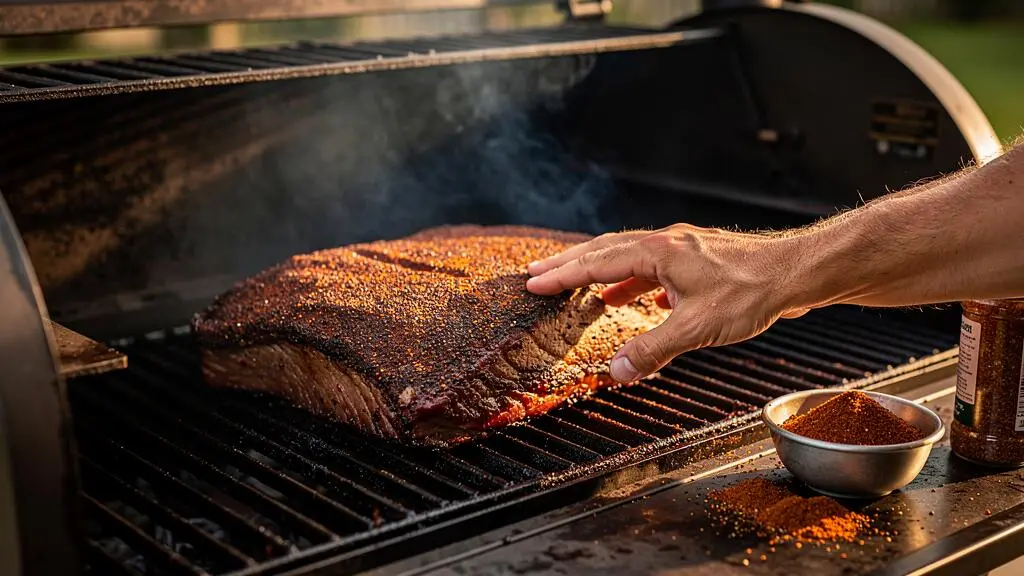
A spice crust that survives eight hours in a smoker starts forming before the meat reaches the cooking grate. The difference between a cohesive, flavorful bark and a patchy, sandy coating usually comes down to surface preparation, moisture control, seasoning proportions, and the timing of liquid applications.
For home smokers, the frustrating part is that a rub can look perfect at the beginning and still slide off, become bitter, or leave a gritty mouthfeel after several hours. Adding more seasoning rarely solves those problems. A heavier coating can actually make them worse by leaving dry particles that never integrate into the developing bark.
The reliable approach is to create a lightly tacky surface, apply a balanced rub in an even layer, and allow the exterior to dry progressively during smoking. Salt, dissolved seasoning, rendered fat, smoke deposits, and surface reactions gradually transform that initial coating into bark. There is no universal 45-minute setting time or guaranteed eight-hour adhesion threshold, but the process can be managed through observable changes rather than guesswork.
How to build a lasting spice crust
- Prepare a tacky, non-dripping meat surface and press on a moderate, even layer of rub instead of piling on dry seasoning.
- Separate overnight salting from final spice application when greater control is needed, especially for thick cuts and long smoking sessions.
- Keep cooker heat indirect, limit unnecessary spritzing, and judge bark readiness by texture rather than a fixed cooking timer.
- Why Does Your Rub Slide Off Meat in the First 60 Minutes of Smoking?
- How to Prep Meat so a Spice Crust Sets in 45 Minutes Without Burning?
- Salt First or Full Rub First: Which Works Better for an Overnight Cook?
- The Seasoning Ratio Mistake That Makes a Crust Taste Bitter After 6 Hours
- How to Keep a Spice Crust Crisp When You Spritz Every 45 Minutes?
- How to Build a Dry Rub Using a 4-Part Ratio So You Can Scale It Easily?
- How to Build a Savoury Bark Using Only 4 Core Spices Without Tasting Harsh?
- How to Build a Dry Rub That Tastes Balanced After 6 Hours of Smoking
Why Does Your Rub Slide Off Meat in the First 60 Minutes of Smoking?
Rub slides off during the first hour when the seasoning cannot establish a stable bond with the meat’s surface. Excess liquid washes particles away, while an overly dry surface offers too little moisture to dissolve and anchor seasonings. Melting surface fat and strong smoker airflow can make the problem worse before bark has time to develop.
Dry rub adhesion depends on a combination of surface moisture, dissolved seasoning, and physical contact. Salt begins dissolving in available moisture, while the surrounding spice particles gradually become incorporated into the developing surface layer. Meat proteins also influence surface texture, but exposed myosin has not been established as the single dominant adhesive mechanism in barbecue.
The distinction between tacky and wet matters more than whether the meat has been patted dry. A visibly wet brisket can shed seasoning as liquid moves down its sides. A completely powder-dry coating, meanwhile, may remain loose enough for airflow and handling to dislodge it.
During the first hour, the smoker’s moving air removes surface moisture while heat changes the fat beneath the rub. An offset smoker with stronger airflow may dry exposed particles relatively quickly. A more humid, enclosed cooker can leave the coating soft for longer. Neither condition guarantees better adhesion without proper preparation.
The AmazingRibs article on the science of dry rubs explains that seasonings can be applied directly or with a thin layer of water, oil, mustard, or another binder. It also reports relatively small differences in finished results among the binders tested.
Choose a binder for its practical behavior rather than assuming it will transform the finished flavor:
- Mustard: useful as a visible, spreadable coating on irregular surfaces; it does not necessarily leave a pronounced mustard flavor.
- Oil: helps distribute some fat-soluble aromatic compounds but does not guarantee better adhesion.
- Water: provides straightforward surface moisture without adding another substantial flavor ingredient.
To verify adhesion, inspect the drip pan and any covering used during preparation. A noticeable deposit of loose rub after the first hour suggests the coating did not stay attached. Compare photographs taken before and after smoking starts, paying particular attention to edges and fatty areas.
Once the surface holds a consistent coating, the next challenge is preparing it to set without drying the spices into a harsh, dusty shell.
How to Prep Meat so a Spice Crust Sets in 45 Minutes Without Burning?
To encourage a spice crust to begin setting within the first 45 minutes, remove loose surface fat, pat the meat until it looks matte, apply a very thin binder layer if needed, and press on an even rub coating. Cook with indirect heat and steady airflow. Forty-five minutes is an inspection point, not a guaranteed setting time.
Proper preparation creates the conditions for the next stage. Silverskin can prevent seasoning from bonding directly to the meat, while hanging fat and uneven edges can move or curl as they heat. Trim these areas before seasoning, keeping enough fat to protect the cut during a long cook.
Pat away excess liquid until the surface appears dull rather than glossy. The goal is not to remove every trace of moisture. It is to eliminate droplets that could carry the seasoning away. If the meat is unusually cold and condensation develops, allow that surface moisture to clear under controlled food-safe handling conditions rather than leaving raw meat unrefrigerated for an extended period.
Apply the binder sparingly, then distribute the rub across the exposed surfaces. Press gently to improve contact without grinding the seasoning into a paste. Avoid rubbing repeatedly, which can create bare patches and clumps.
As cooking begins, salt and any sugar in the rub dissolve in available moisture. The seasoned exterior then progressively dries and undergoes additional reactions. This is the beginning of bark development, not proof that a finished crust has already formed.
A relatively dry offset smoker may produce a firmer-feeling surface sooner than a humid electric smoker. Rather than demanding a specific time, inspect whether the coating is becoming stable, evenly colored, and resistant to light contact.
Sugar deserves particular attention. At typical low-and-slow temperatures, it participates in surface changes, but direct radiant heat or hot spots can blacken a sugary coating before the underlying bark develops. Darkening should progress across the exposed surface rather than appearing first as burned edges facing the fire.
Fatty brisket point and pork belly require an additional judgment. Thick, soft fat deposits can render beneath the rub and loosen the coating. Trim excessive or poorly attached fat, use shallow scoring only where appropriate for the cut, and prioritize an even coating on the leaner faces. Avoid deep cuts into the meat simply to anchor spices.
Five preparation checks before closing the smoker
- Remove silverskin and loose fat; confirm that no dangling tissue remains where seasoning needs to hold.
- Blot surface moisture; verify that the meat looks matte without visible droplets or condensation.
- Spread a thin, even binder layer if necessary; confirm that no liquid collects in folds or low spots.
- Apply and gently press the rub; inspect every exposed face for a consistent coating without loose piles.
- Position the meat away from direct flame; record the initial appearance so the first bark check has a useful visual reference.
With the surface prepared, the next decision is when salt should meet the meat and whether the full spice mixture belongs in an overnight rest.
Salt First or Full Rub First: Which Works Better for an Overnight Cook?
Salt-first preparation generally offers more control for an overnight cook on thick cuts. Salt can dissolve, diffuse inward, and influence moisture retention during refrigeration, while the remaining spices can be applied closer to smoking time. A full rub overnight is convenient and can work, but it makes salt concentration and surface moisture harder to manage independently.
Dry-brining starts when salt draws some moisture toward the meat’s exterior. That moisture dissolves the salt into a concentrated surface brine, and salt can subsequently move into the meat. The process affects muscle proteins and can improve seasoning distribution and moisture retention.
The Serious Eats explanation of dry-brining describes these mechanisms and recommends refrigerated resting on a rack. Larger cuts generally need more time than smaller ones for salt diffusion.
For a brisket or pork shoulder, salting ahead offers a useful separation of tasks: first establish the meat’s salt level, then build the aromatic exterior shortly before smoking. This reduces the chance of unintentionally adding salt twice when seasoning with a commercial blend.
A complete rub applied overnight is not automatically a mistake. However, the mixture can absorb surface moisture, accumulate in wet patches, or stick to plastic wrap when it is removed. Claims that spices necessarily become bitter simply because they sit overnight on wet meat are not supported by the supplied evidence.
Salt and sugar together can also change the surface texture during a prolonged rest. The extent depends on concentration, cut thickness, and time; a ham-like exterior should not be treated as an inevitable result. Thin ribs and chicken offer less margin for aggressive seasoning than a large brisket.
| Decision | Salt first | Full rub first |
|---|---|---|
| Salt control | Easier to measure separately | Depends on knowing the rub’s salt content |
| Surface handling | Spices stay dry until final application | Spices may become damp or stick to wrapping |
| Best practical fit | Thick cuts and carefully managed long cooks | Convenient preparation with a familiar, measured rub |
| Main precaution | Do not add another full salt dose later | Avoid excessive salt and pooled surface moisture |
Measure salt by weight whenever possible. Kosher salt brands and fine table salt can have substantially different bulk densities, so equal spoonfuls do not necessarily contain equal amounts of salt. Equal weights contain essentially the same mass of salt, though particle size affects distribution.
Once salt is controlled, the next source of inconsistency is the proportion of pungent spices that remain exposed to heat throughout the cook.
The Seasoning Ratio Mistake That Makes a Crust Taste Bitter After 6 Hours
A spice crust often turns bitter after prolonged smoking because its blend contains too much of one pungent ingredient relative to the rest, or because surface seasonings scorch in excessive heat. Large amounts of finely ground pepper, garlic powder, onion powder, or hot paprika can produce a harsh finish. The solution is balanced proportions and controlled heat, not simply less seasoning overall.
A rub should be designed for its cooked flavor. Garlic and onion powders contribute savory depth, but concentrated amounts can overwhelm meat when the exterior becomes dry and intensely seasoned. Cayenne increases perceived heat, while paprika varieties differ in sweetness, pungency, and smokiness.
The mistake is assuming every ingredient needs an equally large share. A generous amount of mild paprika may produce a more rounded crust than the same amount of garlic powder or cayenne. Conversely, a relatively small quantity of a very pungent spice can dominate the aftertaste.
Some flavor changes come from heat exposure rather than the original blend. Sugar can help develop color, but a sugary coating exposed to direct flame or high surface temperatures may char. Dried herbs can produce a brittle, dusty texture, while excess finely ground pepper can make the finished crust feel powdery or gritty.
Grind size changes the physical experience. Coarse pepper adds recognizable fragments and a stronger bite; fine pepper distributes more uniformly but can create dense, dusty patches when overapplied. Neither grind is inherently immune to bitterness, and controlled evidence establishing a universal grind-size advantage during long smoking is lacking.
To diagnose the problem, compare three stages:
- Examine the uncooked rub for an obviously dominant spice, while recognizing that raw flavor does not reliably predict cooked flavor.
- Check the bark during cooking for uneven blackening, dry powder, or concentrated seasoning deposits.
- Taste the finished crust separately from the meat and identify whether the harshness is concentrated at charred edges or present across the entire surface.
If only the burned edges taste acrid, investigate direct heat and hot spots. If an evenly cooked surface tastes excessively garlicky, peppery, or sandy, the mixture and grind deserve closer attention.
For long smoking sessions, build most of the rub around ingredients that perform reliably in the chosen conditions. Keep particularly pungent or delicate seasonings restrained, and consider a small late application when a fresher aromatic note is desired.
Even a well-balanced mixture can lose its intended texture if repeated liquid applications keep dissolving the surface, making spritzing the next important variable.
How to Keep a Spice Crust Crisp When You Spritz Every 45 Minutes?
To preserve a firm spice crust while spritzing, apply only a light mist when the meat’s surface actually needs moisture. Avoid spraying until liquid runs down the sides, and let the coating stabilize before the first application. A fixed 45-minute interval is not automatically beneficial; excess spraying can repeatedly soften bark and delay surface drying.
Spritzing creates a tension between moisture and texture. Evaporation helps cool the meat’s exterior, while gradual drying is necessary for bark formation. Repeatedly wetting the surface can interfere with the firm crust the cook is trying to develop.
The AmazingRibs experiments on barbecue spritzing and mopping include a comparison of three small brisket samples treated with a dry rub, sticky glaze, or spritzing. All three reportedly finished at approximately the same time at a cooking temperature of 260 °F. This practical comparison does not establish universal performance across different cuts or smokers.
What a small brisket comparison reveals about spritzing
AmazingRibs describes a practical experiment using three small brisket samples prepared with different surface treatments: dry rub, sticky glaze, and spritzing.
At the reported 260°F cooking temperature, the samples finished at approximately the same time. The result illustrates why spraying should not be assumed to accelerate cooking or automatically improve bark. The sample size and conditions do not justify a universal conclusion.
The most useful observation is the surface itself. A glossy exterior with visible droplets does not need another spray. A dull, cracking surface may justify a light application if it appears to be drying excessively before the bark has developed. Darkening and firmness alone are not reasons to keep adding liquid.
Spritz composition matters, although the flavor impact of a thin mist is often modest compared with the meat, rub, and smoke. Vinegar contributes acidity, but it should not be assumed to evaporate faster than water under the same conditions. Apple juice introduces dissolved sugars that can affect surface stickiness if applied repeatedly.
| Liquid | Practical use | Main limitation |
|---|---|---|
| Water | Minimal added flavor for brisket or pork | Still wets the bark and can extend surface drying |
| Apple juice | Light sweetness for pork ribs or shoulder | Sugars may contribute to sticky deposits or scorching |
| Diluted cider vinegar | Acidic accent for fatty pork | Does not guarantee faster evaporation or crisper bark |
Smoker design changes the decision. A strongly ventilated offset can expose the meat to more drying airflow than a tightly closed ceramic cooker. Opening either cooker unnecessarily also disturbs its cooking environment. Rather than spraying automatically at every 45-minute mark, assess whether moisture is genuinely needed.
Once bark is firmly established, spritzing is no longer required for initial rub adhesion. Any continued spraying is a separate choice about surface moisture, color, and flavor. Stop when the bark needs time to firm up, especially during the final part of an unwrapped cook.
With moisture management under control, rub composition can be made repeatable through a simple scaling system rather than a collection of inconsistent spoonfuls.
How to Build a Dry Rub Using a 4-Part Ratio So You Can Scale It Easily?
Build a scalable dry rub by dividing the mixture into four functional parts: salt, sweetness, savory body, and aromatic accents. Assign each part a deliberate proportion, then scale the recipe by weight while preserving those proportions. The four-part framework is flexible rather than a universal equal-parts formula; meat type and smoking duration should determine the final balance.
The four roles make it easier to understand what each ingredient contributes. Salt seasons the meat, sugar modifies sweetness and surface color, savory ingredients provide the rub’s main flavor identity, and aromatic accents add intensity without needing to dominate the mixture.
For a practical starting point, consider a hypothetical 100 g batch with the following composition. This is a recipe-development example, not a scientifically validated ratio or a universally appropriate salt dose.
| Functional part | Example allocation | Ingredient options |
|---|---|---|
| Salt base | 20 g | Kosher or fine salt, weighed rather than measured by volume |
| Sweet element | 15 g | Brown sugar or another suitable sugar |
| Savory backbone | 50 g | Mild paprika, garlic powder, onion powder, or mild chili |
| Aromatic accent | 15 g | Black pepper, cumin, or dried herbs |
Here, the four allocations total 100 g. To prepare a 200 g batch of this same example, double each ingredient weight. For a 50 g batch, halve each weight. The underlying percentages remain unchanged, although the amount of rub required per cut must still be judged separately.
Because 20% salt is substantial, this hypothetical mixture should not be applied indiscriminately. Its suitability depends on how much rub is used per unit weight of meat, whether the meat has already been salted, and personal preference. A salt-free version of the other three parts can be more convenient for meat that has been dry-brined separately.
Volume measurements are less dependable because different ingredients pack differently. A spoonful of fine salt can weigh considerably more than the same volume of a coarse ingredient. Small measuring errors also multiply when scaling batches. A kitchen scale makes ratios easier to reproduce.
Adjust the structure for the cooking conditions:
- For shorter pork cooks, a modest increase in sweetness may suit the desired flavor, provided the cooker does not expose the rub to direct heat.
- For long brisket cooks, reducing sugar and emphasizing a mild savory base may make surface development easier to control.
- For especially long cooks, keep intense aromatics restrained and reserve optional delicate flavors for a later application.
Commercial blends introduce another variable: their salt content may not be immediately obvious. Adding salt or another salted product to an existing rub can produce an excessive final concentration.
Test new blends on a small portion of meat or a cooked sample patty before seasoning an entire brisket. The test is most useful for identifying obvious salt or spice imbalances; it cannot perfectly reproduce the flavor of bark developed over hours of smoking.
Store bulk blends in clean, dry, airtight containers away from heat and light. Smaller batches help preserve aromatic intensity, especially when the ingredients are freshly ground.
Once the proportions are understood, the same principle can be reduced to a savory four-spice bark that depends less on sweetness and more on careful heat management.
How to Build a Savoury Bark Using Only 4 Core Spices Without Tasting Harsh?
A savory bark can be built with salt, coarse black pepper, paprika, and garlic powder by giving each ingredient a defined role and keeping the strongest flavors under control. Use enough salt for seasoning, pepper for bite, paprika for color and body, and a restrained amount of garlic for depth. Stable indirect heat and progressive surface drying matter as much as the spice mixture.
Bark is not simply caramelized fat and spices. It develops through several interacting processes, including dissolving seasonings, surface drying, rendered-fat interactions, smoke deposits, Maillard reactions, and polymerization. The relative contribution of each process depends on the meat and cooking conditions.
The AmazingRibs explanation of barbecue bark formation describes these chemical and physical interactions and why the exterior gradually transforms during low-temperature smoking.
For a simplified savory rub, the four ingredients should work together rather than compete. Salt is the seasoning foundation. Black pepper provides aromatic heat and a noticeable texture. Paprika builds color and contributes a comparatively mild flavor base. Garlic powder adds savory intensity but can become overwhelming if it occupies too much of the blend.
A hypothetical starting ratio by weight for the four ingredients is 2 parts salt, 2 parts coarse black pepper, 2 parts mild paprika, and 1 part garlic powder. This is a tunable cooking example, not an established optimal formula. Reduce or omit its salt component if the meat has already been salted separately.
The blend also needs the right physical structure. Very coarse pepper can create a pronounced bite that some diners enjoy but others interpret as gritty. Finer pepper produces a more uniform coating, yet an excessively thick layer can feel dusty. A moderate grind and even application are useful starting choices.
Successful bark usually develops in stages. Early in the cook, the surface may look slightly shiny as rub ingredients interact with moisture and fat. Later, the coating darkens and becomes progressively less soft. These changes are gradual and should not be used as a rigid readiness clock.
Consistent indirect heat allows the surface to evolve without exposing one side to excessive radiant heat. Adequate airflow supports drying, but a very aggressive draft can contribute to uneven results. Fat rendering also matters: a particularly thick or unstable fat layer may loosen the coating, whereas a well-prepared surface gives it a better foundation.
If bark tastes harsh halfway through the cook, first inspect the surface. A dark but unburned crust may benefit from avoiding additional heat exposure and excessive drying. A very light acidic spritz may change the immediate taste impression, but it cannot reverse scorched spice compounds.
Do not cover burned spice with more sugar. Added sweetness may disguise some bitterness, but it can also create a sticky coating and introduce further scorching risk. Severely blackened or acrid areas are better addressed by preventing hot spots or, if necessary, removing a damaged portion before serving.
Finally, distinguish bark from the meat’s cooking endpoint. A well-developed crust does not establish that the interior has reached an appropriate temperature or tenderness. Follow suitable cooking and food-safety guidance for the specific cut independently of bark appearance.
These decisions lead to the final question: how to judge the entire rub by its flavor after hours of smoking rather than by how appealing it tastes before cooking.
Key takeaways before the final balance check
- Judge a rub as part of a cooking process: the same blend can behave differently on fatty pork, lean beef, or a surface exposed to direct radiant heat.
- Control salt separately whenever practical, and change spice proportions by weight so each adjustment can be evaluated meaningfully.
- Treat bitterness, excessive grit, and loose bark as different problems requiring different corrections rather than adding more seasoning.
How to Build a Dry Rub That Tastes Balanced After 6 Hours of Smoking
A balanced dry rub for six hours of smoking should finish with appropriate saltiness, rounded savory flavor, restrained sweetness, and no lingering acrid or sandy aftertaste. Build the main coating from ingredients suited to the cooking conditions, apply it evenly, and avoid overloading the surface with pungent powders. Evaluate the cooked bark before changing the recipe.
Flavor balance changes during smoking. Moisture evaporates, fats render, and exposed seasonings undergo physical and chemical transformations. Pepper may seem more integrated into the finished crust than in the raw mixture, while a sugary coating can darken and, under excessive heat, become scorched.
A rub that tastes balanced straight from the container is therefore only a starting point. Raw spice tasting helps reveal obvious errors, such as excessive cayenne or salt, but it cannot fully predict the finished bark.
For long cooks, consider a two-stage seasoning strategy when the recipe contains delicate or especially intense ingredients. Put the main, relatively heat-tolerant components on the meat at the beginning, allowing them to integrate into the bark. Reserve a small amount of optional aromatic seasoning for a later application rather than exposing all of it to the entire cook.
The second application should be light. Adding a substantial quantity of dry powder after bark formation may leave unhydrated particles that taste gritty. For a cut with a well-established crust, a restrained finishing seasoning after cooking can be preferable to trying to force additional dry ingredients into the bark.
Evaluate the result in a consistent sequence. Take a bite that includes both bark and meat, then consider the crust alone to identify whether the exterior is overpowering the underlying protein.
- First bite — salt: Does the crust season the meat without making the outer layer noticeably saltier than the center?
- Second bite — sweetness and savoriness: Are the sugar, paprika, pepper, and garlic distinguishable without one overwhelming the others?
- After swallowing — finish: Does the flavor remain pleasantly smoky and savory, or does a bitter, ashy, powdery sensation persist?
A sandy mouthfeel often indicates an issue with particle size, uneven application, or seasoning that never fully became incorporated into the surface. Bitterness concentrated in blackened patches points more strongly toward heat damage. Excessive saltiness across an evenly cooked crust calls for a change in salt dose rather than a different smoker setting.
Record the actual rub weights, preparation method, cooking conditions, spritzing decisions, and finished results. Change one variable in the next cook: reduce garlic powder, choose a different pepper grind, adjust sugar, or improve surface preparation. Changing everything simultaneously makes it difficult to identify what worked.
Before starting another long smoke, confirm that the meat is properly trimmed, the salting plan is clear, the rub is balanced and evenly applied, and the cooker can maintain indirect heat. Decide whether spritzing is necessary by watching the surface rather than following an automatic timer.
The same evaluation works beyond a six-hour cook. A longer smoking session introduces more opportunities for surface drying, heat exposure, and handling, but the principles of adhesion and flavor balance remain relevant. No recipe can guarantee eight hours of intact bark under every cooking condition.
For the next cook, prepare one measured batch, photograph the surface before smoking, limit liquid applications to when they are needed, and taste the finished bark systematically. Those repeatable observations provide a more reliable path to a cohesive, flavorful crust than adding extra rub whenever the surface looks uneven.
Can a spice crust stay attached for more than eight hours without a binder?
Yes, a spice crust can remain attached throughout a long smoke without an added binder when the meat’s surface provides adequate moisture and the seasoning is applied evenly. However, adhesion depends on the cut, surface preparation, airflow, handling, and moisture conditions. A binder is optional rather than a guarantee of eight-hour performance.
Why does smoked meat bark sometimes feel like sand?
A sandy texture can result from excessive dry seasoning, very coarse spice particles, or powder that never becomes incorporated into the developing surface. Uneven rub deposits and late applications of dry spice can also contribute. Try a more moderate coating, a carefully chosen grind, and enough initial surface moisture for the seasoning to adhere.
Does wrapping brisket in butcher paper ruin the bark?
Wrapping can soften bark because it changes the moisture environment around the meat. Butcher paper can allow some moisture movement, although it does not preserve an entirely dry surface. Waiting until the bark is well developed before wrapping reduces the risk of disturbing an immature coating. The final texture still depends on how much moisture accumulates.
Should you add more rub when the bark looks patchy halfway through smoking?
Usually not. A heavy mid-cook application may leave dry, gritty patches rather than repair poor adhesion. First determine whether the uneven appearance comes from rendering fat, moisture runoff, or inconsistent heat. A small amount of finishing seasoning may improve flavor, but the underlying adhesion issue is best corrected during preparation on the next cook.
Is a thicker spice crust always better for long smoking sessions?
No. A thicker coating can produce an excessively salty, pungent, or powdery exterior, particularly when the spice particles do not fully integrate into the bark. A moderate, uniform layer usually offers a more manageable starting point. The ideal amount depends on the rub’s concentration, particle size, meat surface area, and cooking conditions.