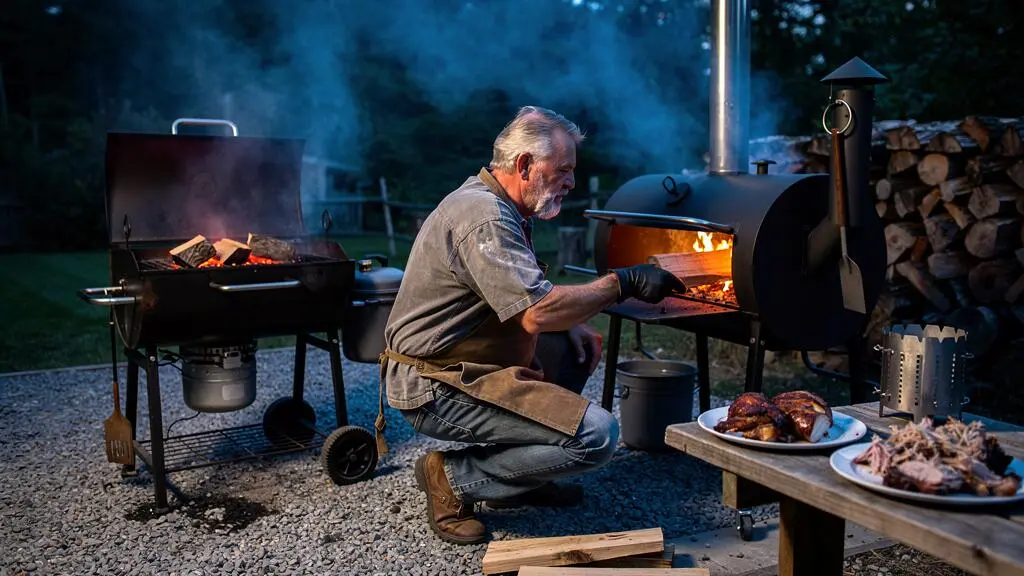
Choosing smoking wood is easier when you stop treating every species as a fixed flavour and start considering how its smoke behaves during your actual cooking session.
For a typical one-to-three-hour backyard barbecue, apple and cherry offer relatively mild, fruity smoke suited to chicken, vegetables and delicate cuts. Hickory creates a more assertive, traditional barbecue character, while oak provides a versatile middle ground. Mesquite demands greater restraint when a bold profile is not the goal.
Yet the wood itself is only part of the equation. A small charcoal kettle, a large offset smoker, the amount of wood added and the quality of combustion can all change the resulting flavour. A modest amount of hickory burning cleanly may taste more balanced than excessive applewood producing dirty smoke.
The practical objective is to match **wood intensity, food characteristics and smoke exposure**, then refine the combination through repeatable tasting rather than guesswork.
Quick guide to choosing a smoke profile
- For delicate or short cooks: start with apple or cherry and a modest amount of wood, especially for vegetables, fish and lightly seasoned chicken.
- For a stronger barbecue character: use hickory or oak, controlling the quantity and maintaining clean combustion rather than simply adding more wood.
- For predictable results: record the wood, cooker setup, smoke behaviour and tasting outcome. Change one variable at a time.
- Why Does the Same Wood Taste Different on a Kettle vs an Offset Smoker?
- How to Build a Smoke Profile Chart in 3 Cooks So You Stop Guessing
- Mild or Bold Smoke: Which Profile Works Better for Vegetables on the Grill?
- The Wood-Combo Mistake That Makes Smoke Taste Harsh Instead of Deep
- When Should You Choose a Milder Wood Because the Cook Is Too Short for Heavy Smoke?
- How to Blend Hickory With Fruit Wood Using a Simple 70/30 Mix Without Guessing
- Apple or Cherry: Which Fruit Wood Works Better for Pork Shoulder Over 8 Hours?
- Hickory or Apple Wood: Which One Tastes Better on Chicken Over a 2-Hour Cook?
Why Does the Same Wood Taste Different on a Kettle vs an Offset Smoker?
The same smoking wood can produce different flavours on a kettle barbecue and an offset smoker because combustion, airflow, smoke concentration and exposure time differ. A kettle often receives smoke from a limited quantity of wood placed near the charcoal, whereas an offset can supply smoke continuously from a separate firebox. Neither design automatically produces a milder result.
On a charcoal kettle, wood chunks placed among or near the coals release smoke as they heat and burn. The timing and duration depend on their size, position, available oxygen and the surrounding charcoal fire.
Because the cooking chamber is relatively compact, adding too much wood at once can create an unnecessarily concentrated smoke environment. However, kettle size alone cannot predict the strength of the finished flavour.
An offset smoker works differently. Its firebox is separated from the food chamber, with heat and smoke travelling through the cooker before leaving through the exhaust.
The operator controls the fire through fuel additions and airflow. A properly managed offset can maintain an extended period of clean smoke, while a poorly managed one can deliver harsh combustion products.
The underlying mechanisms are explained in AmazingRibs’ explanation of wood, smoke and combustion, which discusses how airflow, surface moisture, fuel and equipment affect smoke production and deposition.
For a practical comparison, consider the following operating differences.
| Factor | Charcoal kettle | Offset smoker |
|---|---|---|
| Smoke source | Wood added to or near charcoal | Wood fire in a separate firebox |
| Typical approach | Small initial wood addition | Managed fuel additions during cooking |
| Smoke timing | Can be concentrated around the initial burn | Can be maintained over a longer period |
| Main control challenge | Wood quantity and airflow around the coals | Fire stability and ventilation |
| Flavour prediction | Depends on the smoke generated and deposited | Depends on fire management and accumulated exposure |
Importantly, smoke flavour develops primarily through compounds accumulating on and near the food surface. It is misleading to picture smoke moving uniformly through the entire thickness of a joint.
The colour and behaviour of the smoke also matter. Thin, faintly bluish smoke is commonly associated with well-managed combustion during prolonged barbecue cooking. Dense white or grey smoke can indicate conditions that deserve attention, particularly when accompanied by a smouldering, oxygen-starved fire.
A bitter result therefore does not necessarily mean that hickory, oak or another particular wood was unsuitable.
Once the cooker is producing consistent smoke, wood species becomes a more meaningful variable to test. Without that baseline, comparing flavour profiles is little more than comparing different fires.
How to Build a Smoke Profile Chart in 3 Cooks So You Stop Guessing
Build a useful smoke profile chart by cooking the same food three times: once with a mild wood, once with a stronger wood and once with a measured blend. Keep the recipe, cooker arrangement, cooking temperature and approximate smoke exposure consistent. Record flavour intensity, sweetness and bitterness so each result becomes a meaningful comparison.
Chicken thighs are a practical testing food because their preparation can be repeated without the time commitment of a large barbecue joint.
For the first cook, choose applewood. For the second, use hickory. For the third, test a clearly recorded combination of the two.
Keep the same seasoning, cooking method, food size as closely as practical, and target doneness. Use comparable quantities of smoking wood rather than assuming that equal-looking chunks have the same mass.
A simple tasting sheet makes the comparison more reliable. The following ratings are a proposed personal scoring system, not measurements established by laboratory testing.
| Observation | Cook 1: Apple | Cook 2: Hickory | Cook 3: Blend |
|---|---|---|---|
| Wood amount and format | Record | Record | Record |
| Surface smoke intensity (1–5) | Rate | Rate | Rate |
| Overall smoky aftertaste (1–5) | Rate | Rate | Rate |
| Perceived sweetness (1–5) | Rate | Rate | Rate |
| Bitterness (1–5) | Rate | Rate | Rate |
| Smoke appearance | Describe | Describe | Describe |
| Would you repeat it? | Yes / Adjust / No | Yes / Adjust / No | Yes / Adjust / No |
The distinction between surface intensity and aftertaste is useful. Smoke compounds largely accumulate near the surface, but their flavours may remain noticeable after swallowing. A lingering taste is not evidence that smoke has physically penetrated deeply into the meat.
The equipment manufacturer also encourages recording ingredients, smoking woods, quantities and outcomes in Weber’s beginner’s guide to smoking.
Five actions for a repeatable smoke tasting test
- Define the reference cook: write down the chosen food, seasoning, cooker setup and cooking target. Deliverable: one baseline recipe.
- Complete the mild-wood cook: use applewood and record its quantity, format and smoke behaviour. Deliverable: tasting sheet A.
- Complete the bold-wood cook: substitute hickory while keeping the other conditions as consistent as possible. Deliverable: tasting sheet B.
- Test a recorded blend: document how much of each wood was used and when it was added. Deliverable: tasting sheet C.
- Choose the next adjustment: compare the three sheets and identify one variable to change next time. Deliverable: a preferred profile and a testable next-cook instruction.
Because weather, wood moisture and ventilation affect combustion, the chart describes results achieved under your particular cooking conditions. It is a working reference, not a permanent ranking of wood species.
A documented personal preference becomes especially useful when choosing smoke for delicate ingredients, where small changes in intensity can be immediately noticeable.
Mild or Bold Smoke: Which Profile Works Better for Vegetables on the Grill?
Mild smoke is usually the safer starting point for grilled vegetables, particularly tender courgettes, tomatoes and mushrooms. Apple, cherry or maple can add character without overwhelming their natural flavours. Firmer vegetables such as aubergines, peppers and sweet potatoes can also work with carefully controlled oak or hickory smoke, depending on preparation and personal preference.
Vegetables differ from meat in their surface structure, moisture content and cooking behaviour. They also vary considerably among themselves, so there is no universal rule that every vegetable absorbs less smoke than meat.
Cut surfaces expose moisture and plant tissue to smoke, while oil coatings, skins and cooking temperatures alter how smoke compounds accumulate.
A tomato cooked briefly over hot coals therefore presents a different smoke exposure from a thick aubergine half cooked indirectly.
For practical selection, use the following pairings as starting hypotheses rather than fixed rules.
| Vegetable | Starting wood | Flavour objective |
|---|---|---|
| Courgette | Apple or cherry | Light smoke that preserves its delicate flavour |
| Tomatoes | Apple | Gentle smoke without dominating acidity |
| Mushrooms | Cherry or oak | Complement earthy flavours with controlled smoke |
| Peppers | Cherry or oak | Balance sweetness, charring and smoke |
| Aubergine | Oak or restrained hickory | Give a substantial vegetable a bolder barbecue character |
| Sweet potatoes | Apple, cherry or oak | Complement natural sweetness without masking it |
Short vegetable cooks favour **deliberate smoke timing**. There is little value in adding smoking wood after the vegetables have almost finished cooking.
Instead, stabilise the fire first, introduce a modest quantity of suitable wood and place the vegetables in the cooking zone once smoke production is controlled.
Avoid deliberately creating a thick burst of dirty smoke to compensate for a short cooking time. A brief period of clean smoke is a more reliable experiment.
An informative comparison is to divide a batch of similarly sized vegetables into two portions. Grill one without added smoking wood and expose the other to a measured amount of smoke, keeping the cooking conditions as similar as possible.
Taste them together. If the smoked portion loses its identifiable vegetable flavour, reduce either the wood quantity or the exposure during the next test.
The aim is not to make every vegetable taste heavily smoked. It is to add a controlled flavour layer, which becomes more difficult when several assertive woods are combined indiscriminately.
The Wood-Combo Mistake That Makes Smoke Taste Harsh Instead of Deep
The common blending mistake is combining several powerful smoking woods and assuming that more varieties automatically create greater flavour complexity. Hickory, mesquite and oak can each contribute substantial smoke character, but excessive wood or poorly managed combustion may produce an overpowering, bitter result. A clearer approach is to choose one base wood and one complementary accent.
Consider a hypothetical backyard cook using equal amounts of hickory, mesquite and oak on a small charcoal kettle.
The result might be bold, but simply introducing three woods does not establish three recognisable flavour layers. Their smoke compounds interact with the food, fire conditions and one another in ways that cannot be predicted reliably from the species names alone.
There is also an important distinction between **smoke strength and flavour complexity**.
Strength describes how prominently smoke appears in the finished food. Complexity describes how different aromatic characteristics are perceived together.
Increasing wood quantity can raise smoke exposure without improving balance.
A more disciplined blend starts with two roles:
- Base wood: oak or hickory provides a recognisable smoky foundation.
- Accent wood: apple or cherry introduces a comparatively gentle, fruity character.
These roles are practical culinary descriptions. They do not imply that the fruitwood chemically neutralises the stronger wood or guarantees reduced bitterness.
Before blaming the combination, inspect the fire. Damp green wood, restricted airflow and incomplete combustion can all interfere with clean smoke production. Mouldy or treated wood should not be used for smoking food.
It is also incorrect to assume that a piece of meat becomes completely unable to take on additional smoke after a fixed period. Smoke deposition is influenced by changing surface conditions, but no universal saturation point applies.
Heavy late additions may make the exterior unpleasantly smoky even though the food remains capable of accumulating smoke compounds.
For a one-to-three-hour cook, adding smaller amounts of carefully chosen wood is usually more informative than repeatedly loading the fire in search of greater depth.
Once the blend has a clear purpose, the next decision is how much smoke the food can usefully receive during the available cooking time.
When Should You Choose a Milder Wood Because the Cook Is Too Short for Heavy Smoke?
Choose a milder smoking wood when cooking delicate, thin or lightly seasoned food and you want its original flavour to remain prominent. Apple and cherry are sensible starting points for many short cooks, while hickory or mesquite can work when deliberately restrained. Cooking time alone does not determine the result: wood quantity and combustion quality remain essential.
A one-hour cook offers fewer opportunities to adjust an unpleasantly strong smoke profile once it has developed.
For example, a thin chicken portion with a simple seasoning may show a pronounced hickory character more readily than a heavily seasoned, fatty barbecue joint.
That difference reflects the overall balance of food, smoke exposure and preparation, not a scientifically established rule that strong smoke requires a minimum number of hours to become acceptable.
There is also no fixed point at which a piece of meat stops accumulating smoke. As the surface becomes warmer or drier, deposition conditions change, but additional exposure can still affect flavour.
A practical decision framework is therefore based on the desired result.
| Cooking situation | Suggested starting profile | Adjustment to consider |
|---|---|---|
| Short cook, delicate fish or vegetables | Mild apple or cherry | Use less wood if smoke masks the food |
| One-to-two-hour chicken cook | Apple, cherry or restrained hickory | Increase smoke only after tasting |
| Two-to-three-hour pork or robust cuts | Oak, hickory or a mild blend | Match intensity to seasoning and fat content |
| Longer cook with substantial meat | Fruitwood, oak, hickory or a blend | Manage sustained exposure rather than assuming stronger wood is required |
Long cooking does not automatically erase the flavour of mild wood. Conversely, continuously adding a strong wood can make a long cook excessive.
A fruitwood may remain perceptible after many hours, especially when the fire, food surface and exposure have been managed consistently.
For predictable results, test a smaller portion under conditions resembling the planned cook. A wood that works well on an eight-hour pork shoulder may produce a very different balance on a quick chicken barbecue.
Once the preferred intensity has been identified, a measured two-wood blend can provide more flexibility than switching species at random.
How to Blend Hickory With Fruit Wood Using a Simple 70/30 Mix Without Guessing
A 70/30 hickory-and-fruitwood blend is a practical starting experiment, not a proven ideal ratio. It means using 70 parts hickory and 30 parts apple or cherry according to one consistent measurement method. Start with a modest total amount, record the result and adjust the balance according to flavour rather than treating the proportion as universal.
The first decision is what those parts represent.
For small chunks or chips, weighing the dry smoking wood provides a more repeatable comparison than counting pieces of unequal size.
For example, a hypothetical 100 g smoking-wood blend could contain 70 g hickory and 30 g applewood. This illustrates the arithmetic of the ratio; it is not a recommended total fuel quantity for every barbecue.
If a kitchen scale is unavailable, comparable-sized pieces or carefully measured volumes can provide a rougher reference.
However, equal volume does not necessarily mean equal mass, especially when comparing different woods or irregularly shaped chunks.
On a log-fired offset, some cooks may prefer to record the number and approximate size of splits or the timing of additions. Such methods are useful for consistent personal practice but do not guarantee a precise 70/30 mass ratio.
The purpose of the mixture is to combine two recognisable characteristics:
- Hickory supplies an assertive, traditional smoky character.
- Apple or cherry supplies a comparatively gentle, fruity component.
These qualitative distinctions are consistent with Weber’s comparison of six smoking-wood flavours, which describes hickory as more robust than fruitwoods.
A controlled calibration sequence is straightforward. Test 70/30, then shift to 60/40 if hickory dominates more than desired. Try 80/20 if the goal is a more pronounced hickory character.
The ratios are proposed tasting experiments rather than validated sensory thresholds. Keep total wood quantity, cooking conditions and food preparation consistent during the comparison.
Wood density, moisture and burn behaviour also affect how each component contributes smoke. Even a carefully weighed mixture will not guarantee identical results between suppliers.
The same discipline is valuable when comparing two mild woods over a much longer cook, where fire management and exposure may matter more than subtle differences between species.
Apple or Cherry: Which Fruit Wood Works Better for Pork Shoulder Over 8 Hours?
Applewood is a useful choice for pork shoulder when the goal is a restrained, slightly sweet smoke profile that leaves seasoning prominent. Cherrywood is equally suitable when you want gentle fruity smoke and potentially richer exterior colour. Neither is universally better over eight hours: bark formation, smoke exposure, cooker setup and seasoning all influence the final result.
Although an eight-hour pork shoulder sits outside the main one-to-three-hour cooking window, it is a useful comparison because sustained smoke exposure makes fire management especially important.
Apple and cherry are both traditionally associated with relatively mild smoke profiles.
Apple is generally characterised as mellow and lightly sweet. Cherry is also gentle and fruity, with a reputation for contributing attractive mahogany tones to the surface of smoked food.
Those descriptions are culinary guidelines rather than guarantees that cherry will create a darker bark in every controlled comparison.
Bark appearance also depends on rub ingredients, cooking temperature, moisture, smoke exposure and the underlying meat surface.
| Decision factor | Applewood | Cherrywood |
|---|---|---|
| Typical flavour description | Mellow, subtly sweet | Gentle, fruity and sweet |
| Best starting objective | Keep the rub and pork prominent | Add fruity smoke with an attractive exterior finish |
| Bark appearance | Depends on cooking conditions | May contribute mahogany colouring |
| Extended smoke exposure | Requires controlled fire management | Requires controlled fire management |
| Blend option | Can be paired with oak or hickory | Can be paired with oak or hickory |
The duration of an eight-hour cook does not mean that fruitwood flavour necessarily disappears after the first few hours. Smoke compounds can continue to accumulate, although the food surface and combustion conditions change as cooking progresses.
Nor is there a universal requirement to keep adding smoking wood throughout the whole session.
In a charcoal smoker, an initial controlled addition may be sufficient for the desired result. In a wood-fired offset, continued fuel additions are part of maintaining the fire, so smoke management remains relevant throughout cooking.
To compare apple and cherry fairly, prepare similarly sized pork portions using the same seasoning and cooker arrangement. Keep the temperature, smoke exposure and finishing conditions as consistent as practical.
A blended apple-and-cherry approach is also worth testing, but its superiority should not be assumed.
For shorter chicken cooks, these differences in smoke character can be evaluated without committing to an all-day barbecue session.
Key takeaways before choosing wood for chicken
- For a two-hour cook, define whether the objective is subtle smoke or a prominent smokehouse-style flavour before selecting the wood.
- Keep the overall wood quantity modest and the combustion conditions consistent; a strong wood does not have to mean an excessive smoke load.
- Use a controlled tasting comparison to decide what tastes better rather than relying on species rankings alone.
Hickory or Apple Wood: Which One Tastes Better on Chicken Over a 2-Hour Cook?
Applewood is generally the better starting choice for a two-hour chicken cook when you want mild smoke that complements the meat and simple seasoning. Hickory is preferable when you deliberately want a stronger, traditional smokehouse character. Neither is inherently superior: the winning choice depends on the amount burned, the quality of the fire and your preferred flavour intensity.
Chicken provides a useful comparison because its relatively mild flavour allows smoke character to become noticeable.
Applewood is typically described as mellow and slightly sweet, making it suitable for chicken seasoned with salt, pepper, herbs or a restrained spice rub.
Hickory has a stronger, more recognisable barbecue profile. Used carefully, it can create the flavour associated with traditional smoked poultry. Used excessively, it can overpower the chicken and leave an unpleasant aftertaste.
The cooking duration alone does not determine whether the flavour will be balanced.
For example, a chicken cooked for two hours with a small amount of clean-burning hickory may taste less smoky than one exposed to an excessive amount of poorly managed applewood.
A practical decision table helps make the choice before lighting the barbecue.
| Desired result | Starting choice | Reason |
|---|---|---|
| Chicken flavour remains prominent | Apple | Relatively restrained smoke profile |
| Distinct traditional BBQ smoke | Hickory | More assertive smoky character |
| Noticeable smoke without overwhelming the meat | Hickory and apple blend | Allows experimentation with the proportion of bold and mild woods |
| Uncertain personal preference | Controlled comparison | Establishes a result on your own equipment |
A comparison using two half chickens can be informative, but there is an important practical limitation: **two pieces sharing one open cooking chamber generally share the same smoke**.
Placing applewood beside one half and hickory beside the other does not reliably isolate their flavours. The smoke can mix and circulate around both pieces.
For a meaningful same-session test, use two independently ventilated cooking setups, one with apple and the other with hickory. Alternatively, perform two sequential cooks on the same barbecue, allowing the equipment to return to comparable conditions between tests.
Keep the chicken preparation, seasoning, cooking method and target doneness consistent. Use a food thermometer to verify that the chicken is safely cooked rather than judging doneness from skin colour.
Taste corresponding portions from each chicken without adding sauce first. Assess surface smoke, overall balance, bitterness and how well the seasoning remains identifiable.
If apple tastes too restrained, the next experiment could involve a modest increase in clean smoke exposure or a carefully measured blend. If hickory dominates, reduce the quantity or shift towards fruitwood.
For your next two-hour chicken barbecue, choose one clearly defined flavour objective, measure the wood you add and record the outcome. That single habit will do more for predictable barbecue flavour than buying another untested variety of smoking wood.
Should smoking wood chips be soaked before use?
Soaking is not a universal requirement. Advice differs between barbecue equipment guidance and technical discussions of combustion. Wet wood must lose moisture before it can burn effectively, so soaking changes the heating process rather than guaranteeing cleaner smoke. Follow the operating guidance for your smoker and prioritise controlled combustion.
Are wood chips or chunks better for a short barbecue?
Chips are useful when a relatively short smoke-producing interval is wanted, while larger chunks generally burn over longer periods. The appropriate format depends on the cooker and how the wood receives heat. Neither format guarantees better flavour on its own.
Can smoking wood make food bitter even when the wood species is mild?
Yes. Excessive smoke exposure and poorly controlled combustion can produce unpleasant flavours even when using apple or cherry. Check wood quantity, airflow, fire stability and fuel condition before assuming the species is responsible.
Does a stronger smoke ring mean the meat has a stronger smoky flavour?
Not necessarily. The visible smoke ring is associated with chemical reactions involving gases from combustion and pigments in the meat. Its appearance is not a reliable measurement of overall smoke flavour, which depends on smoke compounds deposited near the surface and how they are perceived during tasting.
Can you use locally available British hardwoods instead of imported hickory?
Yes, provided the wood is from a suitable, correctly identified, untreated species intended for food smoking. Oak is a practical option for cooks seeking a versatile smoke profile. Avoid painted, chemically treated, contaminated, mouldy or unidentified wood. When changing species or suppliers, begin with a modest quantity and record the flavour before increasing exposure.