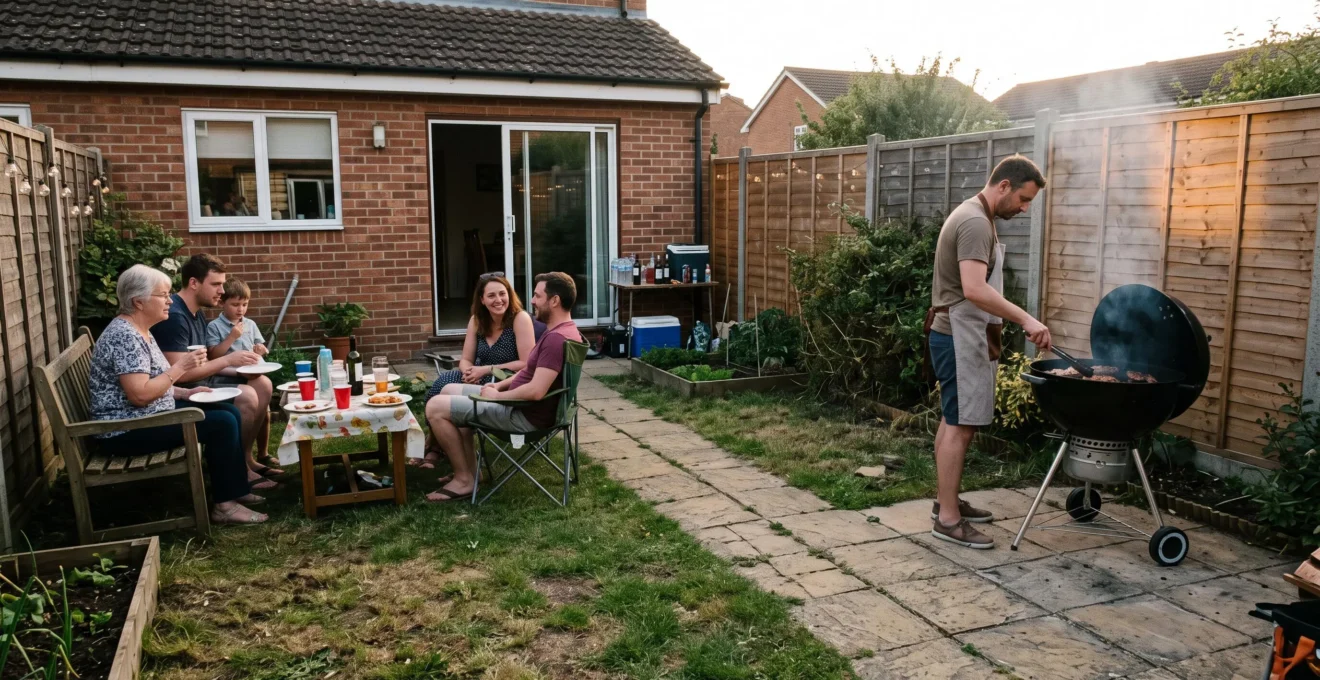
A comfortable barbecue starts with where people sit, not with how many chairs fit on the patio. When guests are positioned too close to the grill, they encounter heat, smoke and interruptions from the cook moving between food preparation and serving. In a narrow UK garden, even one badly placed chair can turn a relaxed gathering into a series of awkward manoeuvres.
The practical solution is to organise the garden into three functions: a protected cooking area, a comfortable social area and clear routes connecting the house, food and drinks. Guests should be able to refill a glass or leave their seats without crossing the cook’s workspace.
For a barbecue with 10 people, this often means combining benches and movable chairs, checking wind direction before arranging the furniture and preparing for cooler evening temperatures. The layout should suit the actual patio dimensions rather than an idealised garden. Most importantly, the grill must remain safely separated from combustible furniture, fences and planting, even when space is limited.
BBQ seating layout: the essentials
- Protect the cook’s workspace first, then arrange seating outside the heat, smoke and movement zones.
- Keep a clear walking route, separate guest traffic from food handling where possible, and use flexible seating for 10 people.
- Check the wind before lighting the grill and provide accessible blankets or suitable outdoor heating as temperatures fall.
- Why Does Seating Too Close to the Grill Make Everyone Less Comfortable?
- How to Lay Out Seating With a Clear Walking Lane in a Typical UK Garden?
- Bench Seating or Separate Chairs: Which Works Better for 10 Guests?
- The Wind-Direction Mistake That Sends Smoke Straight Into Guests’ Faces
- When Should You Add Blankets or a Heat Source So Guests Stay Out Longer?
- How to Lay Out Seating With a Clear Walking Lane in a Typical UK Garden?
- When Should You Add Blankets or a Heat Source So Guests Stay Out Longer?
- How to Run a Backyard Barbecue for 10 People Without Feeling Stuck at the Grill All Day
Why Does Seating Too Close to the Grill Make Everyone Less Comfortable?
Seating too close to a barbecue creates three overlapping problems: guests feel radiant heat, smoke can drift into their faces, and the cook needs them to move while preparing food. Creating space around the grill addresses all three. The right separation depends on the grill, its safety instructions and the cook’s actual movements, not simply a universal seating distance.
Radiant heat is often the most obvious discomfort. Someone facing the barbecue may feel unpleasantly hot across their legs and upper body while their back remains exposed to the cooler garden air. Moving a chair slightly sideways may improve comfort, but it does not automatically make a position safe.
Smoke creates a different problem. Even guests who are comfortable with the temperature may find themselves repeatedly turning their heads or changing seats when smoke crosses the dining area.
The third problem is less visible: people feel unsettled when they are occupying somebody else’s workspace. If a guest constantly moves their feet for the cook or worries about an open grill lid behind them, the seat stops feeling relaxing.
Before placing chairs, imagine the cook’s complete working footprint:
- The space needed to open the grill lid fully and safely.
- The area beside the grill for tongs, trays and preparation equipment.
- The route used to transfer cooked food to the serving table.
- The movements required to handle hot tools and replenish fuel where applicable.
A useful practical test is whether the cook has to ask a seated guest to move more than once during a cooking session. Repeated interruptions suggest that the seating arrangement is obstructing the workflow, even if it initially appeared spacious.
Guests can also become curious about what’s cooking and gather beside the barbecue. Positioning seats towards the table or garden conversation area helps redirect attention. A bench back or planter may establish a visual boundary, provided it remains outside the grill’s required safety clearances and does not restrict movement.
The UK government outdoor fire safety guidance advises placing barbecues well away from sheds, fences, trees, shrubs and garden waste, and keeping children and pets away from the cooking area.
Once these boundaries are established, the remaining patio space can be organised around comfortable seating and predictable walking routes rather than forcing the cook to work around furniture.
How to Lay Out Seating With a Clear Walking Lane in a Typical UK Garden?
In a narrow UK garden, start by choosing a safe position for the barbecue at one end of the usable outdoor area, then establish a clear route from the house to the cooking and serving stations. Keep seating outside this route. Where space permits, separate the cook’s movements from guests travelling indoors, collecting drinks or visiting the bathroom.
The common mistake is to position the table centrally, distribute chairs around it and only then work out how everyone will move. A better approach reverses that order: map circulation before placing furniture.
A grill positioned towards one end of a patio can help organise movement, but placing it against a fence or wall is not automatically safe. The grill must stand on stable, level ground and have the clearance required by its manufacturer, with combustible structures and plants kept away.
Cambridgeshire Fire and Rescue Service specifically advises against setting up a barbecue where people have to squeeze past it. Its barbecue safety guidance also emphasises stable positioning and separation from garden furniture.
For planning purposes, think of two different circulation needs. The cook needs a dependable route for food and tools, while guests need access to the house, toilets and refreshments. These routes do not necessarily require two completely separate paths in a small garden, but they should avoid crossing directly beside the hot grill.
Where the patio is too narrow for parallel routes, prioritise an unobstructed safe passage and schedule food transfers to minimise conflicting movements. Do not reduce the grill’s safety clearances to create more seating.
Make a simple paper plan by measuring the usable patio length and width. Draw the house door, safe grill location, table and any fixed obstacles. Mark the full space required when chairs are occupied rather than their dimensions when pushed neatly underneath a table.
Particularly in British gardens, check for irregular paving edges, raised decking transitions, pots, storage boxes and door clearance. Sliding patio doors do not generally swing into the garden, but their thresholds and access areas still require space; hinged doors need their opening arcs marked.
The final verification is physical. Walk the route carrying a full, unheated plate, then repeat the movement with unheated barbecue tongs. If you need to turn sideways, step over furniture or squeeze past a seating position, revise the arrangement before cooking begins.
Once safe movement is established, choosing the right combination of benches and chairs becomes much easier because every seating position has a defined space.
Bench Seating or Separate Chairs: Which Works Better for 10 Guests?
For a barbecue with 10 guests, a combination of benches and separate chairs is often more practical than relying exclusively on either. Benches keep furniture positions predictable and can preserve narrow walkways, while individual chairs offer flexibility for conversations, access and personal comfort. The best mix depends on garden dimensions, accessibility needs and how frequently guests will move.
Benches work particularly well along the outer edge of a seating area, provided the positioning leaves a comfortable way to sit down and stand up. Their fixed footprint helps prevent furniture from gradually spreading across the patio as guests reposition themselves.
However, a long bench creates its own inconvenience. Someone seated in the middle may have to ask others to move whenever they want another drink or need to go indoors. Benches without back support may also be less comfortable over a long evening.
Separate chairs solve many of these problems but require more attention to placement. People naturally turn them towards conversations, pull them away from tables or move them into sunny areas. On a small patio, those adjustments can gradually obstruct the walking lane.
The following comparison provides a practical starting point rather than a fixed capacity rule.
| Consideration | Bench seating | Separate chairs |
|---|---|---|
| Narrow garden | Predictable footprint along an appropriate boundary | More flexible but easier to spread into pathways |
| Guests leaving frequently | Less convenient for people seated in the middle | Usually easier to enter and leave individually |
| Changing group conversations | Encourages a settled group | Can be rearranged around smaller conversations |
| Mobility and individual comfort | May be difficult without adequate support and access | Can provide individual backs, arms and suitable seat heights |
| Damp UK weather | Weather-resistant materials can remain outdoors if suitable | Folding models are often easier to store; fabrics need protection |
A useful hybrid arrangement places a weather-resistant bench on the quiet side of the social area and a small collection of lightweight chairs nearer the house. Guests who remain at the table can use the bench, while people who regularly collect drinks or move between conversations have more accessible seats.
Match the seating to guest behaviour rather than trying to make every seat identical. Ten guests may naturally split between a dining group and a more informal lounging group, although this depends on the gathering rather than a fixed numerical threshold.
Check the space needed behind occupied chairs and leave clear access for anyone who needs additional support. Cushions can improve comfort but should be stored somewhere dry when not in use.
Furniture also needs to remain comfortable when conditions change, particularly if wind carries smoke into a seating area that seemed ideal earlier in the day.
The Wind-Direction Mistake That Sends Smoke Straight Into Guests’ Faces
The main wind-direction mistake is arranging all the seating around an assumed breeze without checking where barbecue smoke will travel during cooking. Wind can change as the afternoon becomes evening, and buildings or fences may affect airflow. Start with guests upwind of the grill where safe and practical, then reassess conditions before lighting and throughout the barbecue.
Smoke exposure is not merely a minor annoyance. Guests sitting in a smoky area may need to change seats, move indoors or abandon the outdoor dining space altogether. That disruption undermines the careful layout of walking lanes and furniture.
Loughborough University‘s reusable barbecue safety guidance, written for organised university events, recommends checking wind direction before lighting a barbecue and considering relocation where wind raises fire or smoke concerns.
For a domestic garden, a practical observation exercise is to examine how the breeze moves through the intended cooking area before the grill is lit. A small incense stick held safely at approximately grill height can help visualise airflow, provided it is extinguished and disposed of safely afterwards. This is an informal planning technique, not a validated smoke-exposure measurement.
If the observed breeze is carrying smoke towards the planned seats, consider the simplest corrections first. Moving the seating area is often easier than changing a fully prepared barbecue station. Before lighting, the grill itself may be repositioned to a different suitable location with appropriate clearances.
Existing walls, hedges and screens can affect the breeze, but a windbreak is not a guaranteed solution. Air passing around or over an obstruction may create turbulence and carry smoke downwards towards guests. Portable screens also introduce potential fire and stability concerns if placed near a grill.
Adjusting the grill’s height or position should never compromise stable support or the manufacturer’s operating instructions. Once a barbecue is hot or lit, do not attempt an improvised relocation.
Instead of assuming the morning breeze will continue all evening, make wind assessment part of the pre-cooking routine and observe actual smoke behaviour while cooking. If the smoke becomes problematic, move guests away from its path or pause cooking if conditions make continued operation unsafe.
Wind also affects how warm guests feel, so the same observations should inform where blankets and any suitable outdoor heat source are positioned.
When Should You Add Blankets or a Heat Source So Guests Stay Out Longer?
Add blankets when guests begin keeping their jackets on, huddling together or looking for warmer seats. Consider an outdoor heater only when simple measures are insufficient and the garden can accommodate one safely. In a UK garden, preparing for the cooler period after sunset is usually more effective than waiting until several guests have already retreated indoors.
Comfort is best managed through observable behaviour rather than a rigid temperature or time threshold. One guest may be comfortable in a light jumper while another wants additional warmth before dinner has finished.
Keep a basket of clean, dry blankets where guests can find it without interrupting the cook. A self-service arrangement allows people to adjust their comfort without creating a queue beside the grill.
Consider these signals and responses:
- Guests keep their coats on: make blankets available and check whether seats are directly exposed to the breeze.
- People gather on one sheltered side: consider moving suitable seating towards that area without blocking access.
- Guests repeatedly return indoors: assess whether a safer, more sheltered seating position or an appropriate heater would help.
- The evening loses its remaining sunlight: prepare blankets before the garden cools noticeably.
If outdoor heating is appropriate, position it at the edge of the seating area so people can choose how close they sit while staying within the manufacturer’s required clearances. Avoid placing a heater where guests must squeeze past it or where blankets could contact hot surfaces.
Fuel-burning heaters must only be used in environments specifically permitted by their manufacturers, with adequate ventilation and clearances from furniture, parasols, awnings, branches and other combustibles. Never rely on a patio heater to make an enclosed or poorly ventilated space suitable for combustion equipment.
Electric heaters also require careful planning. Outdoor electrical equipment must be suitable for the environment, and cables should not cross pedestrian routes.
Before buying or positioning a heater, assess whether the available garden space genuinely allows safe installation. If not, blankets, appropriate clothing and a sheltered seating arrangement are the more practical options.
Even a comfortable seating area can become congested if the drinks station, serving table and waste bin are poorly positioned, making the next stage of furniture planning essential.
How to Lay Out Seating With a Clear Walking Lane in a Typical UK Garden?
For a workable small-garden layout, give the grill its own safe cooking space, place the serving table near a convenient transfer point and move drinks away from the busiest cooking route. Position the bin where guests can reach it without approaching hot equipment. If the patio cannot accommodate these functions alongside safe access, reduce the furniture rather than narrowing the cook’s workspace.
This second stage turns the earlier walking-lane principle into a specific furniture-placement blueprint. Instead of treating the garden as one dining space, identify where people will make their most frequent journeys.
A drinks station positioned near the house can spread activity away from the barbecue. Guests collecting another glass then have little reason to enter the cooking area. The waste bin should sit somewhere similarly accessible, but clear of doorways and the main walking route.
The serving table requires a different balance. It should be convenient for the cook to reach with finished food without requiring a journey past seated guests, while remaining far enough from the grill to avoid heat-related hazards and congestion.
To sketch the complete arrangement, begin with a measured outline of the usable patio. Use one consistent scale on paper and mark permanent obstacles, door access and changes in surface level.
Next, draw the grill footprint together with its operating clearances and lid-opening area. Trace the cook’s movement between the house or food storage, preparation surface and cooking station. This forms a practical cook’s triangle for assessing unnecessary journeys.
Place the serving table, drinks station and bin around that movement pattern, then draw chairs and benches in their occupied positions. This approach reveals congestion before furniture has to be moved repeatedly.
If there is not enough room, a one-way movement pattern may be workable where the garden has suitable connected routes. However, it should not force guests to approach the grill or cross unstable ground. A one-way loop is not a substitute for adequate safety clearance.
The checklist below creates a simple, verifiable plan before anyone arrives.
Five checks before arranging your BBQ furniture
- Measure the usable garden area and record the dimensions on a paper sketch, including any uneven paving or decking edges.
- Mark the grill position, lid movement and manufacturer-required clearances; produce a clearly defined cooking zone on the sketch.
- Draw the cook’s food-transfer route and the main guest route, identifying every point where the two might conflict.
- Place the serving table, drinks station, bin and occupied chairs on the plan; create a final layout showing clear access to each.
- Walk the arrangement with a full plate and unheated tongs, then correct every obstruction and record the final furniture positions.
Where the plan reveals a genuine space shortage, consider fewer outdoor seats, staggered dining or a different safe cooking arrangement. Do not assume ten people can be accommodated simply because ten chairs physically fit.
With the traffic pattern settled, the remaining comfort question is how to keep the seating area inviting as the evening cools without introducing another obstacle or smoke problem.
When Should You Add Blankets or a Heat Source So Guests Stay Out Longer?
Use a three-level approach to evening comfort: begin with blankets and shelter from the breeze, consider suitable radiant heating if the garden allows it, and reposition movable seating towards a more comfortable area when practical. Check every option against the wind direction and walking routes. The aim is to make warmth accessible without increasing smoke exposure or obstructing movement.
This approach is more adaptable than deciding in advance that a heater must remain in the middle of the seating group. A small UK patio may offer several comfortable positions at different times of day, but not all of them will be safe or practical for heating equipment.
At the first level, make passive warmth easy to use. Place blankets in a visible basket and choose seats with reasonable protection from the wind. A position receiving the last afternoon sunshine may be attractive, provided it remains outside the cooking zone and does not obstruct access.
At the second level, assess whether radiant heating adds meaningful comfort. The decision should consider the available space, the installation requirements and whether the heater can remain separate from combustible items.
Electrical Safety First’s patio heater safety advice recommends using suitable electrical protection, including RCD protection for outdoor sockets, and following manufacturers’ positioning and clearance instructions. Cables should also be arranged to avoid trips and accidental displacement.
The third level is to reassess the overall seating position. If the garden has a more sheltered, appropriately accessible area, moving a few lightweight chairs may improve comfort without introducing another heat source. This should be planned rather than attempted through a crowded cooking route.
Warmth and smoke management must work together. A heater positioned downwind of the barbecue may make a seat warmer without solving the smoke exposure that makes it unpleasant. Check both issues before finalising the evening arrangement.
Prepare warmth before guests begin asking for it. Visible blankets and an appropriately positioned heater, operated only when safe and needed, reduce the host’s need to interrupt cooking to solve individual comfort problems.
Once guests have convenient seating, clear routes and accessible warmth, the final element is the cooking schedule that allows the host to enjoy the gathering too.
Key takeaways before the barbecue begins
- Choose a safe cooking position and protect the cook’s movements before deciding how many outdoor seats to provide.
- Set up food, drinks and seating so guests can help themselves without continually approaching the grill.
- Coordinate the cooking sequence with the seating and comfort arrangements, allowing the host to spend meaningful time with guests.
How to Run a Backyard Barbecue for 10 People Without Feeling Stuck at the Grill All Day
To host a barbecue for 10 without spending the entire gathering at the grill, finish preparation before guests arrive, establish self-service drinks and sides, and organise cooking into manageable waves. Ask one person to help transfer supplies and clear dishes. When guests are comfortably seated away from the cooking route, the host faces fewer interruptions and can join conversations between cooking tasks.
The seating layout and cooking schedule should function as one system. Even a carefully planned patio becomes congested if all 10 guests approach the grill at once to collect food or ask what is ready.
Start with tasks that can be completed before arrival. Prepare ingredients, organise utensils, set out clean serving equipment and position food-safe preparation surfaces. Keep chilled foods refrigerated until needed and protect raw ingredients from cross-contamination with cooked food.
Arrange the seating, check the weather and wind, and place drinks and other suitable refreshments in a self-service location outside the cooking area. The cook should not have to abandon hot equipment whenever someone needs another drink.
When guests arrive, allow them to settle while the cooking workflow begins. Explain where drinks, blankets and waste facilities are located, and keep children and pets away from the barbecue.
The main cooking period can then be divided into two waves:
- First wave: prepare suitable items that can be safely kept at the correct temperature while other food is cooked. Complete tasks that do not require constant last-minute attention.
- Second wave: cook items intended for prompt serving, coordinating their completion with the serving table and guests’ readiness to eat.
Holding cooked food safely requires appropriate temperature control; it should not simply be left warm on an ordinary garden table. Food that needs immediate cooking attention should never be abandoned so the host can socialise.
A helper acting as a runner can take finished dishes to the serving station, refill supplies and collect waste without guests gathering around the grill. This is particularly useful in a narrow garden where every unnecessary trip adds to congestion.
A realistic hosting sequence depends on the menu, equipment and weather rather than a universal minute-by-minute timetable.
| Stage | Host’s priorities | How the seating layout helps |
|---|---|---|
| Before arrival | Prepare food, check equipment, assess wind and arrange supplies | Furniture and routes are tested before the patio becomes busy |
| As guests arrive | Welcome guests, provide refreshments and begin planned cooking tasks | Self-service stations keep visitors away from the cooking zone |
| First cooking wave | Cook suitable items and safely manage anything awaiting service | Settled guests can socialise without gathering around the grill |
| Second cooking wave | Finish foods for immediate serving and coordinate assistance | A clear transfer route connects the grill and serving station |
| After serving | Safely manage the grill, clear food and join guests when cooking duties allow | Comfortable seating and accessible warmth support the rest of the evening |
A well-positioned bench, accessible individual chairs and a separate drinks area cannot replace thoughtful food preparation. However, they make the cooking schedule easier to follow by reducing movement conflicts around the barbecue.
The host should also plan how the grill will be supervised and made safe after cooking, including suitable extinguishing procedures for the equipment being used. A hot or fuel-burning barbecue must never be taken indoors or placed under an awning to escape changing weather.
For a group of 10, success is not measured by fitting every possible chair onto the patio. It is measured by whether guests can sit, move, eat and stay comfortable while the cook operates safely and with minimal interruption.
As the next practical step, measure the garden, mark a safe cooking zone and test the occupied seating positions. Then organise the cooking schedule around the space that genuinely remains, rather than asking guests to adapt to an overcrowded patio.
How far should BBQ seating be from the grill?
There is no single seating distance that suits every barbecue or UK garden. Start with the manufacturer’s clearance instructions and keep furniture and guests outside the cooking and lid-opening areas. Allow additional space for movement, radiant heat and smoke. If anyone needs to squeeze past the hot grill or repeatedly move for the cook, the seating is too close.
Can a barbecue be placed directly against a garden fence?
A barbecue should not be placed directly against a combustible fence. UK government and fire service guidance recommends keeping barbecues well away from fences, sheds, trees, shrubs and other combustible materials. Follow the grill manufacturer’s required clearances and choose stable, level ground. If the garden cannot accommodate the equipment safely, use a different suitable cooking arrangement rather than reducing the clearance.
What if a small patio cannot fit seating for all 10 guests?
Reduce the number of permanent seats rather than blocking access or compromising the grill’s safety area. Consider staggered dining, a separate suitable seating space or movable chairs that can be used without obstructing routes. A safe, comfortable arrangement for fewer seated guests is preferable to ten chairs packed around hot cooking equipment.
Is it safe to use a patio heater beneath a parasol or awning?
Only use a patio heater beneath or near an overhead structure if the manufacturer’s instructions expressly permit that arrangement and all clearance, ventilation and installation requirements can be met. Parasols, awnings and nearby branches may present fire hazards. If the required clearance is unavailable, use blankets or an alternative safe seating position instead.
How can guests collect food without crowding the barbecue?
Position a separate serving table outside the grill’s working area, with an unobstructed route for the cook or designated helper. Keep drinks elsewhere so refills do not concentrate traffic around the barbecue. Transfer cooked food safely to the serving station and invite guests to collect it there instead of approaching the grill.