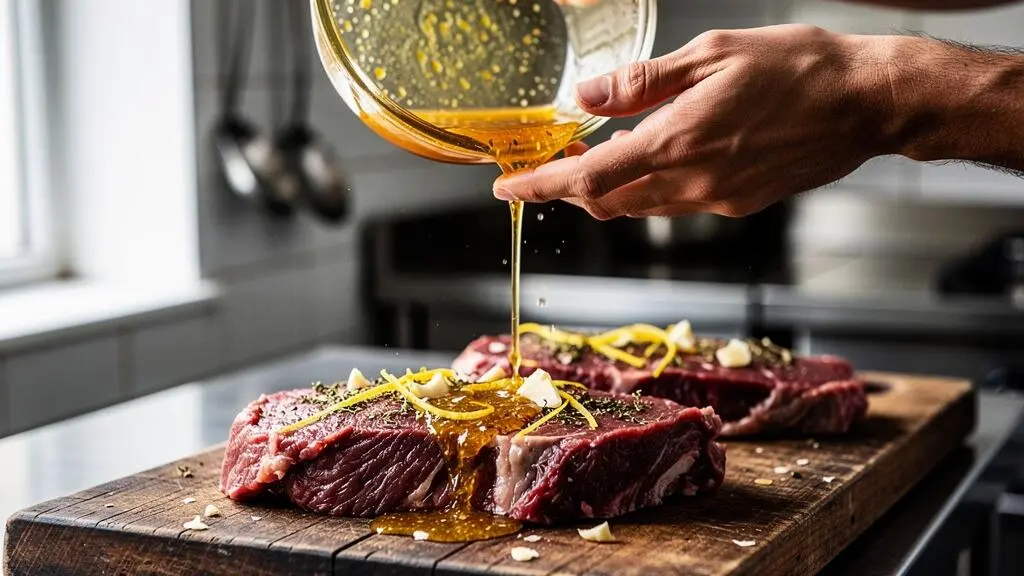
Thirty minutes in a lemon marinade can give lamb chops a fresh, aromatic surface. Leave thin chicken strips in the same mixture for hours, however, and their texture may become unpleasantly soft, pale or chalky. The difference is not simply how much lemon juice goes into the bowl. It is how acid concentration, meat thickness and exposure time interact.
For many everyday grilling cuts, 30–120 minutes is a useful starting window for acidic marinades, not a scientifically established limit that works for every recipe. Thin pieces generally warrant shorter exposure, while thicker cuts may tolerate longer contact, particularly when the acid is diluted. Salt, meanwhile, often contributes more to deep seasoning and moisture retention than additional acidity.
The practical approach is to measure the cut, control the acid, refrigerate throughout marination and stop before the surface loses its natural structure. A properly managed marinade should complement the meat’s texture rather than replace it with a softened outer layer.
Acidic marinades: the essential rules
- Match time to thickness: start around 30 minutes for thin pieces and consider longer periods only for thicker cuts and appropriately diluted marinades.
- Use acid for surface flavour: rely on salt for more substantial seasoning and moisture-retention benefits rather than increasing lemon juice or vinegar.
- Protect texture and food safety: refrigerate meat during marination, inspect the surface before grilling and never use contaminated raw marinade as an uncooked finishing sauce.
- Why Do Acidic Marinades Make Meat Mushy Faster Than You Expect?
- How to Choose Marinade Time Based on Thickness So You Don’t Guess
- Vinegar or Citrus: Which Acid Works Better for Lamb Chops on the Grill?
- The Marinade-Reuse Mistake That Can Make Guests Ill at a BBQ
- When Should You Stop Adding More Acid and Use Salt for Better Results?
- How to Choose Marinade Time Based on Thickness So You Don’t Guess
- How to Balance Citrus, Oil, and Salt in a Marinade Without Guessing Ratios?
- How to Use a Citrus-Herb Marinade for 2–6 Hours Without Turning Chicken Mushy
Why Do Acidic Marinades Make Meat Mushy Faster Than You Expect?
Acidic marinades can make meat mushy because lemon juice, vinegar and similar ingredients change the structure of proteins at the meat’s surface. With sufficient exposure, the outer layer can become excessively soft or chalky rather than pleasantly tender. Thin cuts are especially vulnerable because more of their flesh lies close to the acidic liquid.
Meat proteins normally maintain structures that contribute to firmness and elasticity. When the surrounding environment becomes acidic, these proteins can unfold or change their interactions. This process is called protein denaturation.
Controlled denaturation can alter surface texture in a desirable way. Excessive exposure, particularly to concentrated acid, can produce an uneven result: a softened exterior surrounding a centre that has barely changed.
This is related to the principle behind ceviche, where acidic ingredients change the appearance and structure of raw fish. However, acid treatment is not equivalent to heat cooking and should never be considered a reliable method of eliminating pathogens in raw meat.
Geometry helps explain why this happens sooner with certain cuts. A thick joint has comparatively little exposed surface relative to its total volume. Thin flank strips, small skewer cubes and flattened chicken fillets expose a much larger proportion of their flesh directly to the marinade.
That does not mean acid necessarily travels rapidly into the centre. Instead, a larger proportion of a thin piece is close enough to the surface to experience structural changes.
According to University of Illinois Extension‘s guidance on marinating, some marinades are used for only 15–30 minutes, while other recipes involve much longer periods. The appropriate duration depends on the meat and preparation.
Before grilling, watch for a dull, opaque or unusually soft outer layer. A wet surface can also hinder immediate browning because moisture must evaporate before a crust develops. These signs are useful warnings, although they do not establish an exact chemical threshold.
Another source of unexpected mushiness is fresh fruit containing proteolytic enzymes. Pineapple contains bromelain, while papaya contains papain. Unlike acids, these enzymes break down proteins through enzymatic reactions. Their effects can be substantial and should not be treated as interchangeable with those of lemon juice.
Once the surface begins losing its intended texture, adding more time is unlikely to fix the underlying problem. The next decision is therefore how to match the marinade window to the actual dimensions of the meat.
How to Choose Marinade Time Based on Thickness So You Don’t Guess
Choose acidic marinade time by measuring the thickest part of the meat and considering how much surface is exposed. Thin strips and small cubes generally belong at the shorter end of a 30–120-minute window, while thicker chops or whole pieces may tolerate longer exposure. These times are practical starting estimates, not validated universal rules.
For a typical home BBQ, the most useful measurement is the thickness of the meat rather than its total weight. Two pieces weighing the same can behave differently when one is thin and broad and the other is compact and thick.
The following grid assumes a moderately acidic marinade diluted with oil or other ingredients and kept refrigerated throughout. Strongly acidic mixtures may require shorter exposure.
| Cut or geometry | Suggested starting window | Texture consideration |
|---|---|---|
| Thin steak strips, small skewer cubes or thin chicken fillets | About 30 minutes; check earlier if highly acidic | Large exposed surface relative to meat volume |
| Thin chops under approximately 2.5 cm | 30–60 minutes | Edges may soften before the centre changes appreciably |
| Medium-thickness boneless portions | 45–90 minutes | Acid strength and thickness variation become important |
| Thicker chops or substantial whole pieces | 60–120 minutes with moderate acidity | Longer contact affects mainly the outer region |
| Large joints or roasts | Prefer longer salt-and-aromatic seasoning; add acid briefly near cooking | Prolonged acid contact is not an effective way to season the centre |
These are kitchen planning ranges rather than results established by the cited scientific studies. Start conservatively and adapt according to the acidity, cut and observed surface condition.
Measuring is straightforward: place the raw meat on a clean board and use a ruler to check its thickest section. A stack of identical coins can provide a rough visual comparison, but a ruler is more reliable.
When one end of a chicken breast is much thinner than the other, flattening the thicker section to achieve a more even profile is often more useful than trying to calculate a perfect marination time.
The reason thickness matters is also a reason not to overestimate marinades. University of Florida‘s publication on marinades and dry rubs describes marinade penetration of up to approximately a quarter of an inch, around 6 mm, depending on conditions including acid concentration.
That observation does not mean every marinade penetrates precisely that far. It demonstrates why surface treatment should not be mistaken for uniform seasoning throughout a thick cut.
A practical safeguard is to combine meat with salt, oil and aromatics first, then introduce the lemon juice or vinegar only during the final 30–45 minutes. This separates the time required for seasoning preparation from the time spent exposing the surface to acid.
After choosing a time range, the next ingredient decision matters just as much: vinegar and citrus deliver different flavours, even though neither guarantees a particular tenderising outcome.
Vinegar or Citrus: Which Acid Works Better for Lamb Chops on the Grill?
Citrus is often the better starting choice for lamb chops when you want a fresh flavour and brief marination. Vinegar suits sharper, savoury combinations, especially with rosemary, oregano and garlic. Neither acid is automatically gentler: its actual effect depends on concentration, pH, quantity and contact time rather than the ingredient name alone.
Vinegar’s principal acid is acetic acid, while lemon and lime juice contain citric acid. Both change the acidity around meat proteins, but their behaviour cannot be ranked reliably without knowing the concentration and formulation of the marinade.
For grilling, flavour is usually the more practical basis for choosing between them.
| Consideration | Vinegar | Citrus |
|---|---|---|
| Flavour profile | Sharp, tangy and savoury | Bright, fresh and aromatic |
| Suitable companions | Rosemary, oregano, garlic | Mint, cumin, coriander, harissa |
| Useful application | Robust herb marinades and cooked pan sauces | Short marinades and fresh finishing accents |
| Texture consideration | Depends on dilution and exposure | Depends on dilution and exposure |
| Particularly useful adjustment | Balance with oil and aromatics | Use zest for aroma without adding substantial juice acidity |
For a Mediterranean-style lamb chop, red wine vinegar, rosemary and garlic create a savoury combination that can complement rich lamb fat. A small amount of vinegar can also be incorporated into a properly cooked sauce or deglazing liquid.
For a North African-inspired preparation, lemon zest, cumin, coriander and a measured amount of harissa provide a different flavour direction. The zest contributes volatile citrus aromas without requiring a large quantity of acidic juice.
High heat does not instantly remove acidity. Lemon juice does not simply burn away when the chops reach the grill. If a finished dish tastes too acidic, the solution is to adjust the recipe or exposure time rather than assume grilling will eliminate the sourness.
As a hypothetical starting example, thin lamb chops could receive an oil-and-herb coating followed by lemon juice for the final 30 minutes. Thicker chops might tolerate a longer period with a less acidic mixture, provided their surfaces remain firm.
Yoghurt offers a third approach. Its acidity, dairy proteins and thicker consistency produce a different coating from straight vinegar or citrus juice. Yoghurt-based lamb marinades are commonly used for longer preparations, but they are not immune to texture changes or food-safety requirements.
Whichever ingredient you select, raw-meat handling becomes especially important when the marinade is also intended for basting or serving alongside the finished chops.
The Marinade-Reuse Mistake That Can Make Guests Ill at a BBQ
Reusing marinade that has touched raw meat as an uncooked sauce can transfer harmful microorganisms onto ready-to-eat food. Lemon juice and vinegar do not make contaminated marinade reliably safe. The safest method is to reserve a clean portion before adding raw meat, or thoroughly boil used marinade before using it as a sauce.
A common BBQ mistake begins with a perfectly reasonable idea: save the liquid that made the chicken or lamb taste good and brush it over the finished food.
The problem is that once raw meat enters the bowl, its juices can contaminate the marinade. Applying that liquid to cooked meat, salad or a serving platter creates a route for cross-contamination.
The same risk exists when a brush used on raw chicken later touches cooked chicken without proper cleaning.
University of Illinois Extension’s food safety guidance on preparation recommends marinating raw meat in the refrigerator and bringing marinade that has contacted raw meat to a boil before reuse as a sauce.
The source does not specify a universal boiling duration of several minutes, so there is no basis for presenting one duration as a guarantee for every marinade.
The most straightforward arrangement is to prepare two portions from the outset:
- Raw-meat portion: used exclusively for coating or soaking uncooked meat.
- Reserved clean portion: kept separate from raw meat, raw utensils and contaminated surfaces for later cooking or serving.
If you choose to reuse contaminated marinade, transfer it to a suitable saucepan and bring it to a thorough boil. For a cold finishing sauce, reserving an untouched portion from the beginning is the simpler option.
Keep raw and cooked meat on different plates, and use clean utensils for cooked food. A platter that held raw lamb chops should not receive grilled chops unless it has been properly washed.
Five checks before your BBQ marinade reaches the grill
- Prepare separate portions: label one container for raw meat and another for clean sauce; confirm that the serving portion has never touched raw meat.
- Refrigerate the meat: place the covered marinating container in the fridge and record the planned removal time.
- Separate equipment: assign a clean plate and utensil set for cooked food before starting the barbecue.
- Check any reused marinade: verify that contaminated marinade is thoroughly boiled before sauce use, or discard it.
- Inspect the serving area: confirm that finished meat, serving utensils and sauces have remained separate from raw-meat contact surfaces.
Do not leave meat marinating on a garden table while the barbecue heats up or guests arrive. Refrigeration is a separate requirement from the texture-related timing window.
With safe handling established, the next improvement is often to reduce the quantity of acid altogether and give salt a more deliberate role.
When Should You Stop Adding More Acid and Use Salt for Better Results?
Stop increasing acidity when the meat already has enough tang but still needs better seasoning or moisture retention. Salt is generally the more useful ingredient for those goals because it can move into muscle tissue and influence protein interactions. Acid primarily changes the outer region, while excessive exposure can damage the texture you are trying to improve.
Salt and acid should not be treated as two interchangeable tenderisers.
Salt dissolves in moisture and can diffuse through meat over time. Under suitable conditions, it changes how muscle proteins interact with water, which can improve moisture retention during cooking.
Acid changes the local pH and influences proteins differently. Its effects depend on both the acidic environment and the salt already present.
An experimental Meat Science study on acidic marination and turkey breast texture examined the interaction between sodium chloride, pH, water transfer and mechanical properties in turkey breast cubes. Significant mass gains were observed from 20 minutes under certain experimental conditions.
Those measurements should not be interpreted as proof that a 20-minute marinade is ideal for grilling, or that salt always improves every cut to the same extent. They demonstrate that ingredient composition and exposure time interact in measurable ways.
20 minutes
Significant mass gains were observed from this point in an experiment involving turkey breast cubes undergoing acidic marination with salt. The finding concerns measured mass changes under the study conditions, not a universal optimum for tenderness or juiciness.
Original research published in Meat Science, 2014.
For a recipe that calls for overnight lemon soaking, a more controlled approach is to season with salt and suitable aromatics in advance, then introduce the acidic component closer to cooking.
Dry brining is one option: apply salt directly to the meat and refrigerate under appropriate food-storage conditions. Alternatively, use a salted mixture without the acid initially.
Remember that soy sauce, Worcestershire sauce, miso and commercial marinades can already contribute substantial sodium. Adding a full separate salt allowance without accounting for these ingredients risks an over-seasoned result.
Salt also cannot compensate for incorrect cooking. Excessive internal temperature can dry meat out regardless of how carefully it was marinated.
Once the seasoning and acid are separated, managing the actual 30–120-minute window becomes much easier, even when barbecue preparation runs behind schedule.
How to Choose Marinade Time Based on Thickness So You Don’t Guess
For a practical 30–120-minute marinade schedule, give the shortest exposure to thin fillets, small cubes and flanken-style cuts, while reserving longer periods for thicker meat in moderately acidic mixtures. Check texture during marination rather than relying exclusively on a timer, and keep everything refrigerated until it is time to prepare the grill.
Thickness establishes the initial plan, but the shape of the meat determines how that plan works in practice.
For example, a chicken breast fillet flattened to an even thickness presents a relatively consistent surface to the marinade. An irregularly cut fillet may develop a noticeably altered thin edge while its thickest section remains comparatively unchanged.
Similarly, small beef cubes intended for skewers expose several faces directly to the acid. They generally do not need the same contact time as a thick pork chop.
When considering the full two-hour window, focus on three variables:
- Geometry: small or thin pieces have a greater proportion of meat near exposed surfaces.
- Marinade composition: concentrated lemon juice or vinegar generally warrants greater caution than a diluted mixture.
- Temperature: cold refrigeration provides appropriate food storage and influences the rate of chemical changes.
A cold marinade may behave differently from an otherwise identical mixture at a higher temperature. However, that does not justify leaving meat at room temperature to accelerate the process. Raw meat should remain refrigerated while marinating.
For a hypothetical Saturday barbecue scheduled to start at 6 pm, a 45-minute acidic exposure would begin at 5:15 pm, with the meat remaining in the fridge during that period. If the grill is delayed, remove the meat from the acidic mixture at the planned endpoint rather than allowing the exposure to extend indefinitely.
Inspect the surface at sensible intervals. A noticeably pale, slippery or excessively soft exterior may indicate that the texture is changing more than intended. Remove the meat, drain the marinade and pat the surface dry.
These signs are not a substitute for evaluating freshness or food safety. A suspicious smell, unexpected slime or evidence of spoilage should be treated as a reason not to cook or serve the meat.
After marination, keep the meat chilled until cooking preparation. There is no need to leave raw meat standing out for an extended period simply to reach room temperature.
The schedule provides the limit; the balance of oil, acid and salt determines how comfortably the recipe fits within it.
How to Balance Citrus, Oil, and Salt in a Marinade Without Guessing Ratios?
Start with approximately three parts oil to one part citrus juice, then adjust according to the cut, desired flavour and marination time. Measure salt in relation to the meat rather than simply adding it to the liquid by taste. The 3:1 ratio is a flexible home-cooking starting point, not a scientifically established optimum.
Each ingredient performs a different function. Oil distributes fat-soluble flavour compounds from herbs and spices and helps coat the meat. Acid provides tang and alters surface proteins. Salt contributes seasoning and affects how muscle proteins retain water.
More acid does not automatically make a marinade more effective. A mixture containing plenty of lemon juice but almost no oil can expose the meat surface to a relatively concentrated acidic environment.
Conversely, increasing oil changes the concentration of acid in the overall mixture but does not make acid harmless. Oil and acidic juice also tend to separate, so mixing thoroughly before coating the meat helps distribute the ingredients more evenly.
For an illustrative small batch, a cook might combine three tablespoons of olive oil with one tablespoon of lemon juice, followed by lemon zest, garlic and chopped herbs.
This example is intended to demonstrate proportions, not to prescribe the same quantity for every weight of meat or every container size.
| Ingredient | Main purpose | Adjustment when results disappoint |
|---|---|---|
| Citrus juice or vinegar | Acidity, brightness and surface protein changes | Reduce exposure time or concentration if the exterior softens too much |
| Oil | Coating and distribution of fat-soluble flavours | Use enough for an even coating; drain excess before grilling |
| Salt | Seasoning and influence on moisture retention | Account for salty sauces and season according to meat quantity |
| Herbs, zest and spices | Aromatic flavour | Increase aroma without necessarily increasing acidity |
Oil does not automatically prevent flare-ups. Excess oil dripping onto hot charcoal or burners can contribute to them, so the meat should not reach the grill dripping heavily with marinade.
Tasting the mixture before adding raw meat can help assess its flavour balance, but taste alone is an unreliable way to determine how much salt the meat will absorb. A marinade that tastes appropriately seasoned as a sauce may still produce a different result after contact with meat.
Never taste marinade after raw meat has been added unless it has been made safe through appropriate cooking.
When salt is the key concern, use a measured amount appropriate to the cut and recipe. If the mixture already contains soy sauce, miso or another salty ingredient, adjust additional salt accordingly.
For a citrus-forward flavour without substantial added acid, favour zest, fresh herbs and a small finishing squeeze of lemon over a longer soak in undiluted juice.
This approach is particularly useful for chicken, where a bright citrus-herb flavour can be developed without keeping delicate pieces in acidic juice for hours.
Key takeaways before marinating chicken
- Use the cut’s thickness, skin coverage and shape to decide how much direct acid exposure is appropriate.
- Build citrus aroma with zest and herbs when the overall preparation needs to last longer than the acid-contact window.
- Plan backwards from cooking time so that preparation delays do not unintentionally extend marination.
How to Use a Citrus-Herb Marinade for 2–6 Hours Without Turning Chicken Mushy
A 2–6-hour citrus-herb preparation is more manageable when most of that time is spent with salt, oil, herbs and citrus zest rather than a large quantity of acidic juice. Bone-in, skin-on chicken can offer some surface protection, but prolonged acid exposure still requires caution. Add lemon juice near the end and refrigerate throughout.
The distinction between total preparation time and actual acid-contact time is especially important for chicken.
Skin-on thighs, drumsticks and leg quarters differ substantially from thin, boneless, skinless breast fillets. The skin covers part of the underlying muscle, while the thicker shape means the centre is farther from exposed surfaces.
These characteristics can help limit direct contact with acid on protected areas. They do not establish that all bone-in pieces can safely withstand six hours in a strongly acidic marinade without texture changes.
For delicate boneless breast, a shorter acidic window is usually the more conservative approach.
A layered citrus-herb preparation offers a practical alternative.
- Prepare the aromatic base. Combine olive oil, lemon zest, garlic and herbs such as thyme, parsley or oregano.
- Season the chicken. Add an appropriate amount of salt, accounting for any already-salted ingredients in the recipe.
- Refrigerate during the longer preparation period. Keep the chicken covered and chilled while the aromatic ingredients coat it.
- Add the acidic juice near the end. Introduce a measured quantity of lemon juice for the final 30–45 minutes as a cautious starting approach, adjusting for cut thickness and acid concentration.
- Prepare the surface for grilling. Drain excess marinade, pat the chicken dry and use clean equipment before transferring it to the grill.
As a hypothetical example, chicken thighs prepared four hours before an evening barbecue could spend the first three hours and fifteen minutes with oil, salt, herbs and zest, followed by 45 minutes with added lemon juice. The full preparation lasts four hours, but direct exposure to the juice is much shorter.
This scheduling method is not a guarantee of a particular texture. It simply reduces unnecessary acidic exposure while allowing the cook to prepare the chicken in advance.
After removal from the marinade, moisture left on the surface must evaporate before effective browning can occur. Patting the chicken dry improves control over the initial sear and reduces excessive dripping into the barbecue.
Skin-on pieces may also benefit from careful grill heat management so the skin browns without the exterior burning before the centre is cooked.
Marination cannot establish that chicken is fully cooked. Use a suitable food thermometer and follow applicable local food-safety guidance for the safe internal cooking temperature. The appearance of the marinade-treated surface alone is not a reliable indicator of doneness.
Finally, avoid the common morning-preparation trap: adding lemon juice at breakfast for a barbecue that may not begin until evening. Timing backwards from the intended cooking session is more controllable than letting the meat sit in acid until the grill happens to be ready.
For the next barbecue, select the cut, measure its thickness, prepare the salt-and-herb base and set a separate timer for the acidic component. That small distinction between preparation time and acid-contact time is often the simplest way to keep grilled meat flavourful without sacrificing its texture.
Can lemon juice make raw meat safe to eat without cooking?
No. Lemon juice can change the colour and structure of surface proteins, but this is not the same as cooking meat to a safe internal temperature. Acidic marination is a flavouring and texture-modifying technique, not a validated substitute for appropriate cooking and hygienic handling.
Does adding more olive oil completely prevent over-marination?
No. Adding oil changes the overall proportions of a marinade, but it does not neutralise the acid or guarantee an even protective coating. Acidic liquid can still contact the meat, particularly as the mixture separates. Controlling the amount of acid and its exposure time remains important.
Can you rescue meat that has already become mushy in an acidic marinade?
Removing the meat from the marinade stops further direct exposure, but it does not reliably reverse protein changes that have already occurred. If the meat is otherwise safe and suitable to cook, draining, drying and cooking it appropriately may improve the exterior. Severely altered texture cannot necessarily be restored.
Is bottled lemon juice interchangeable with fresh lemon juice in a marinade?
Both can provide acidity, but their flavour and formulation may differ. Bottled products can have different processing characteristics and may contain additional ingredients. Neither should be assumed to have a particular tenderising strength without considering its actual acidity and the amount used.
Can you freeze meat in an acidic marinade to stop the timing problem?
Freezing greatly slows many chemical processes, but it should not be treated as a guarantee that acid-related texture changes stop completely. Further exposure may occur while the meat freezes or thaws. For more predictable results, freeze the meat with salt and aromatics, then add the acidic component during a controlled refrigerated marination period after thawing.