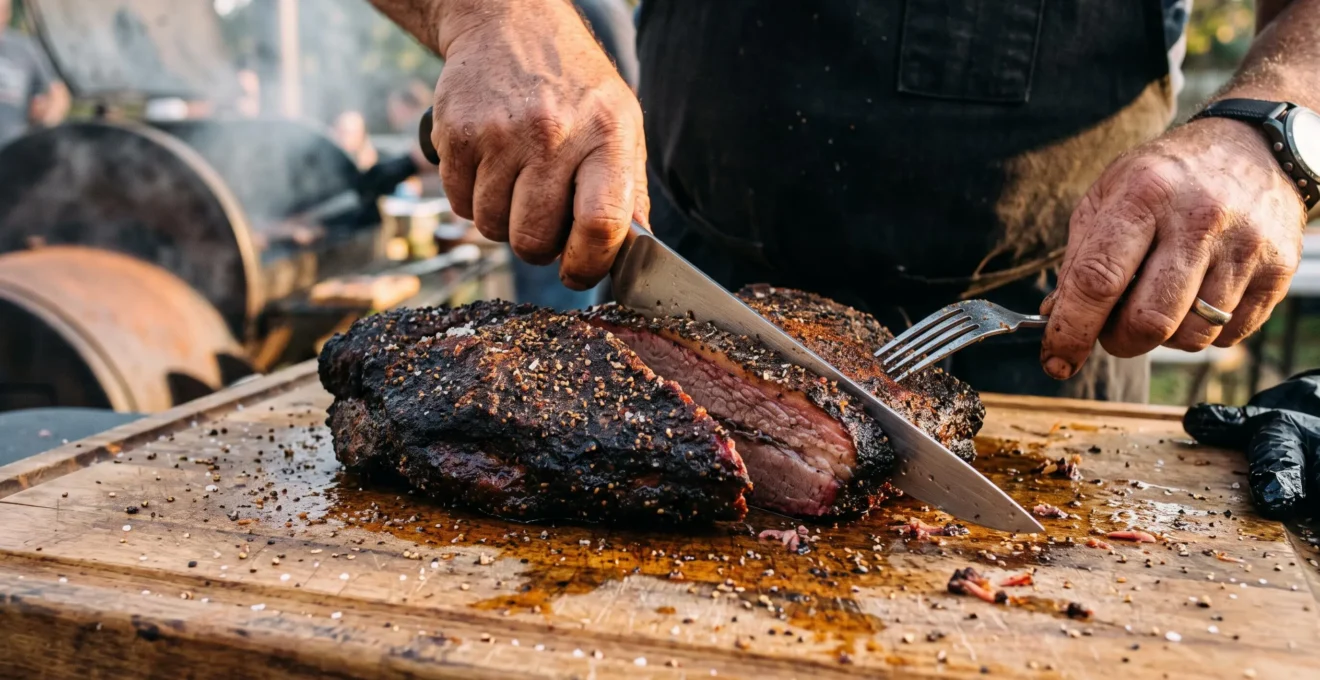
A properly smoked beef brisket should greet the knife with a dark, aromatic bark: cracked pepper, savoury garlic, gentle smoke and a satisfying crust that complements the meat rather than overpowering it. Yet a seasoning blend that smells excellent before cooking can taste aggressively salty after eight hours in the smoker.
The solution isn’t necessarily to use a weaker rub. It’s to manage salt separately from the ingredients that create aroma and crust. Salt interacts with the meat over time, while garlic, herbs and other aromatic ingredients mostly remain near the surface, where prolonged heat changes their flavour.
For UK home smokers, a reliable approach begins with weighing the meat, accounting for any previous brining, applying salt deliberately and building the aromatic layer around the cooking conditions. A pepper-led foundation, carefully timed garlic and restrained herbs can deliver substantial savoury character without an exhausting salt finish.
The following method treats seasoning as something that evolves throughout the cook, not a flavour that remains unchanged from preparation to slicing.
The essentials of a balanced savoury bark
- Measure salt against the meat’s weight and account for any brine or injection before applying the rub.
- Separate an early salt application from a salt-free aromatic layer to avoid adding sodium twice.
- Build the crust with heat-tolerant ingredients, preserve delicate aromas where possible and assess the finished bark alongside the meat.
- Why Does a Savoury Crust Taste Too Salty by the Time You Slice?
- How to Layer Savoury Seasoning in 2 Stages Without Overdoing Salt?
- Garlic-Forward or Pepper-Forward: Which Suits Beef Better for Long Smokes?
- The Dried-Herb Mistake That Turns a Savoury Crust Bitter After 5 Hours
- When Should You Add Aromatic Spices So They Still Smell Great at Serving?
- How to Layer Savoury Seasoning in 2 Stages Without Overdoing Salt?
- How to Build a Dry Rub Using a 4-Part Ratio So You Can Scale It Easily?
- How to Build a Dry Rub That Tastes Balanced After 6 Hours of Smoking
Why Does a Savoury Crust Taste Too Salty by the Time You Slice?
A savoury crust can taste too salty after a long smoke because its surface changes as the meat cooks. Moisture evaporates, fat renders, salt moves within the meat and aromatic ingredients undergo heat-driven changes. These processes can make the finished bark taste more intense than expected, although saltiness does not necessarily increase continuously throughout every cook.
During dry brining, salt dissolves in moisture at the meat’s surface and gradually moves inward. Most other rub ingredients do not penetrate nearly as far. Consequently, a pepper-and-garlic crust largely remains a surface seasoning, while the salt has an opportunity to season the interior.
The AmazingRibs‘ dry-brining instructions explain why the thickness of the cut matters when deciding how long to salt meat before cooking. A thick roast benefits from a different preparation schedule than a thin steak.
Once the meat enters the smoker, its exposed surface loses moisture while the bark develops. That can make the seasoning appear more concentrated. However, evaporation, inward salt diffusion, rendered fat and changing surface moisture interact, so a darker or drier bark is not proof that its sodium concentration has risen.
There’s another important distinction: excessive saltiness isn’t the same as excessive savoury intensity. A crust rich in roasted proteins, concentrated drippings, pepper and garlic can feel overwhelming even without an unusually large salt dose.
To identify the problem, taste a small piece of cooked bark beside a slice of the meat. A clearly saline aftertaste points towards salt management. An acrid, bitter or aggressively pungent finish suggests an aromatic balance or heat-exposure problem instead. Mid-cook tasting can provide clues, but it cannot reliably predict the final flavour on its own.
Several cooking variables influence that judgement:
- Cooking duration: Longer exposure allows more moisture loss and more changes in aromatic compounds.
- Cut thickness: Thin cuts offer less interior meat to balance a heavily seasoned exterior.
- Bark thickness: A thick crust delivers more seasoning per bite than a thin, even coating.
- Sugar content: Sweetness and browning can modify perceived balance, while excessive heat may produce burnt flavours.
- Smoker humidity: Surface drying and bark formation depend partly on the moisture conditions around the meat.
The most reliable prevention is to establish the salt allowance before building the crust, then treat every additional seasoning layer as a separate flavour decision.
How to Layer Savoury Seasoning in 2 Stages Without Overdoing Salt?
Two-stage seasoning separates salt penetration from aromatic crust development. Apply a measured salt layer before cooking, giving it time to interact with the meat, then use a second blend containing pepper, garlic, onion and herbs without additional salt. The second layer can go on before smoking or later when suitable, without increasing the original salt dose.
The first stage should be almost invisible. The goal isn’t to construct the complete bark during preparation, but to distribute the planned salt evenly across the meat.
A thick brisket can receive its salt well ahead of the cook, whereas a thinner piece needs less preparation time. The dry-brining guidance cited earlier suggests longer intervals for thick roasts than for steaks or chops. Those intervals are practical starting points, not fixed requirements for every barbecue cut.
The second stage carries the recognisable savoury profile. Cracked black pepper provides texture and pungency. Garlic granules and onion granules create a rounded savoury base, while carefully chosen herbs provide additional fragrance.
For a conventional long smoke, applying most of this salt-free layer shortly before cooking gives the particles time to adhere as the surface develops. More delicate aromatic additions may be reserved for a later stage, provided the bark can still absorb or hold them.
Applying both layers far ahead of cooking removes much of the flexibility. It doesn’t necessarily make the meat saltier if the total salt remains unchanged, but it exposes the aromatic ingredients to a longer period on the meat, followed by the full cooking process.
Previously brined or injected meat requires special attention. A supermarket joint labelled as cured, seasoned, enhanced or containing an added salt solution cannot automatically be treated like an unsalted butcher’s cut.
As explained in AmazingRibs’ salting and wet-brining article, combining brined meat with a salty rub can produce an excessively salty result. The guidance favours seasoning previously brined meat with a rub that contains no additional salt.
When the existing salt contribution is unknown, it isn’t possible to calculate a precise remaining allowance from appearance alone. Choosing a salt-free aromatic crust is therefore the more controllable option.
Once the salt allowance is established, the next choice is which aromatic ingredients can withstand the cooking conditions and which deserve more protection.
Garlic-Forward or Pepper-Forward: Which Suits Beef Better for Long Smokes?
For a long beef smoke, a pepper-forward rub is often the more forgiving starting point, particularly when building a substantial bark. Garlic-forward seasoning can also work, but its distinctive aroma changes with heating and may become less recognisable after prolonged exposure. The better option depends on the cut, surface conditions, smoker temperature and desired finishing flavour.
Cracked black pepper gives beef a textured, earthy, pungent exterior. Its coarse particles help create a recognisable bark and can provide a useful seasoning framework without relying on additional salt.
Garlic behaves differently. Its characteristic flavour depends on compounds that change during heating. A study published in Analytical and Bioanalytical Chemistry, accessible through the PubMed record of a study on garlic volatiles during heating, investigated three garlic varieties and found that heating time influenced their volatile profiles.
This provides a reason to consider how garlic is exposed to heat, although the study did not test smoked brisket, establish an ideal application time or prove that garlic inevitably becomes acrid during long smoking.
The following comparison is a practical seasoning guide rather than a scientifically validated ranking.
| Cooking situation | Pepper-forward approach | Garlic-forward approach |
|---|---|---|
| Large fatty brisket | Useful foundation for a textured, assertive bark | Can add richness, particularly with controlled application |
| Lean beef joint | Coarse pepper provides flavour without a thick powdered coating | Consider a lighter coating to avoid dominating each bite |
| Extended low-temperature smoke | A practical choice for seasoning from the start | Consider reserving part of the garlic for later |
| Hotter surface exposure | Monitor for excessive darkening or harshness | Monitor finer particles closely for scorching |
| Strong finishing aroma desired | Use freshly cracked pepper near serving if needed | Use a modest, integrated finishing addition |
Fat can affect how a seasoning is experienced by carrying flavour compounds and changing mouthfeel. However, fatty beef does not guarantee that an excessively strong garlic rub will become mellow.
A useful middle path is to construct the initial crust with cracked pepper and a modest quantity of garlic granules, then reserve a little additional garlic for a late application when the surface conditions allow it to adhere.
Coarser particles may offer more control than a thick dusting of fine powder, although particle size alone cannot guarantee that garlic will avoid scorching. Similarly, applying garlic to a fat cap is an experiment in placement, not a proven method of preventing flavour degradation.
At slicing, compare a bark-heavy bite with a more meat-dominant bite. If the garlic dominates both, reduce its overall quantity next time. If the flavour has disappeared, consider changing its application timing rather than automatically adding more.
Whichever direction works best, dried herbs need their own strategy because many of their desirable aromas are particularly sensitive to prolonged heat exposure.
The Dried-Herb Mistake That Turns a Savoury Crust Bitter After 5 Hours
The main dried-herb mistake is applying a thick coating of finely crushed, delicate herbs at the beginning of a lengthy smoke without considering surface temperature and drying. Excessive exposure can leave the herbs dull, harsh or scorched. Five hours is not a universal bitterness threshold; the result depends on the ingredient, smoker conditions and how the herbs are distributed.
Dried parsley, basil and oregano can contribute appealing green, earthy and slightly sweet notes to a savoury crust. However, putting them through the entire cook isn’t always the best way to preserve those qualities.
In Penn State Extension‘s publication on drying herbs, the authors explain that herb flavour depends substantially on aromatic oils and that excessive drying heat can damage flavour, colour and oil quality. The publication also notes that whole herbs generally retain their aromatic properties longer than crushed ones.
Although this research-based guidance concerns herb preservation rather than barbecue, it supports an important ingredient-handling principle: the timing and physical form of herbs matter as well as their quantity.
Consider the difference between two approaches. In the first, finely powdered parsley is mixed heavily into the initial rub and left exposed throughout a long smoke. In the second, a smaller amount of coarser herb material is introduced later, while the initial crust relies primarily on pepper and other savoury ingredients.
The second approach may preserve a more recognisable herbal aroma, but it also needs adequate moisture and contact with the bark to avoid leaving loose, raw-tasting particles.
Woody herbs such as rosemary and thyme are practical candidates for experimenting with earlier application. Still, there is no universal scientific ranking proving that they always withstand smoking better than oregano or basil. Rosemary can also become overpowering when finely ground and applied generously.
To assess a new herb blend, cook a small seasoned test portion under comparable conditions. Check for scorched aroma, excessive bitterness and surface appearance rather than relying solely on colour.
Alternatively, inspect a small exposed piece of the main cut when opening the smoker is already necessary. If the bark is becoming harsh, shielding the meat with a wrap or reducing additional heat exposure may help prevent further deterioration. Spritzing with an unsalted liquid can alter surface moisture, but it will not remove established bitterness.
Any mid-cook tasting should use meat that has reached a safe cooking condition, or a separately cooked test portion. Raw or undercooked meat should not be sampled simply to check the seasoning.
That same principle extends beyond herbs to the broader family of aromatic spices, whose most attractive notes may not survive an entire long cook.
When Should You Add Aromatic Spices So They Still Smell Great at Serving?
Add sturdy foundation seasonings early enough to integrate into the developing bark, but consider adding more delicate aromatic ingredients later when their fresh fragrance is important. Heat changes volatile compounds, so an ingredient that provides excellent aroma before smoking may contribute a different flavour at serving. Late additions must still adhere properly to avoid a dusty, uncooked finish.
Seasoning a brisket with cumin, coriander, paprika, garlic and black pepper creates a complex starting aroma. After hours of heat exposure, however, the proportions of the recognisable aromas may change.
That doesn’t mean the spices have stopped contributing flavour. Some compounds transform, while others become less noticeable. The challenge is to preserve enough of the desired character without building a crust that tastes like raw seasoning.
A useful practical framework is to divide ingredients into three application groups. These are culinary starting points, not experimentally established heat-tolerance categories.
| Application group | Candidate ingredients | Practical approach |
|---|---|---|
| Foundation | Coarsely cracked black pepper, onion granules | Apply before smoking to help establish the principal bark |
| Adapt to exposure | Garlic granules, paprika, ground cumin | Use moderately early or divide between initial and later layers |
| Aroma-focused finish | Freshly crushed coriander, delicate herbs, a small amount of fresh garlic preparation | Consider late addition or a controlled finishing accompaniment |
The principal risk with an aromatic finishing dust is that the ingredients arrive too late to integrate. Dry spices scattered over a fully developed bark may stay powdery, fall off during slicing or create isolated pockets of intense flavour.
When adding a late aromatic layer, look for a surface that is sufficiently tacky to capture fine particles without becoming a wet paste. The bark should retain its structure under a light touch rather than shedding a visibly dry coating.
Use a restrained application and allow it to settle before carving. If the meat is already cooked and resting, a freshly prepared salt-free finishing accompaniment may be preferable to forcing more dry powder onto the crust.
Salt control remains essential throughout this process. A commercial spice blend containing salt, garlic salt or onion salt cannot be treated as a sodium-free finishing layer, even when its label emphasises herbs or spices.
The timing becomes easier to execute when the whole cook is organised around clear preparation, seasoning and inspection checkpoints.
How to Layer Savoury Seasoning in 2 Stages Without Overdoing Salt?
In practice, successful two-stage seasoning depends on three checkpoints: calculate the salt allowance when preparing the meat, apply the salt-free aromatic mixture when the surface is ready, and assess the developing bark during an appropriate cooking check. Record the quantities used so adjustments are deliberate rather than reactive, especially when smoking several cuts.
Start at trimming. Weigh the meat after removing unwanted fat or other material, inspect the packaging for salt-containing treatments and decide whether any additional salt is appropriate.
Next, distribute the measured salt across the accessible meat surfaces. Avoid concentrating it in folds, crevices or one particularly exposed edge. Refrigerate the meat appropriately during the pre-cook salting period.
When it’s time for the aromatic stage, the meat may have a slightly moist or tacky exterior. Apply the salt-free blend evenly, using the surface condition to judge whether additional seasoning will adhere.
There is no requirement to divide the total seasoning weight equally between the stages. The early layer contains the deliberately measured salt; the second supplies the bulk of the aromatic ingredients without further sodium.
At the next convenient inspection, look for even colour development and a coherent crust. Avoid constantly opening the smoker, as repeated checks can disrupt the cooking environment.
Five checks for a controlled two-stage seasoning
- Weigh the prepared cut. Record its trimmed weight and any declared brining or added-salt treatment on a preparation note.
- Measure the salt separately. Weigh the selected quantity and record it as the complete planned addition, rather than estimating by spoonfuls.
- Mix the aromatic layer without salt. Check each ingredient label and keep a written record of the pepper, garlic, onion and herb quantities.
- Log the application stages. Note when the salt and aromatic blend were applied, together with the smoker’s operating conditions.
- Evaluate the finished crust. Taste a fully cooked bark sample with the meat, then record one specific adjustment for the next cook.
What happens if the bark already tastes too salty? First establish whether the problem is genuinely saline or instead bitter, pepper-heavy or overly concentrated.
If excessive salt is confined to a loose surface layer, gently removing some of that seasoning may reduce the intensity. However, wiping an established bark can damage its texture, and salt that has already entered the meat cannot simply be wiped away.
Adding unsalted seasoning may change the overall flavour balance without removing sodium. Similarly, mopping or spritzing with an unsalted liquid can affect surface moisture but should not be presented as a reliable desalting technique.
For a finished cut, serving thin bark-bearing slices alongside unsalted accompaniments may make the meal more balanced, although it does not lower the total salt already present in the meat.
Once those checkpoints are consistent, a modular rub formula makes scaling the aromatic ingredients much easier.
How to Build a Dry Rub Using a 4-Part Ratio So You Can Scale It Easily?
Build a scalable savoury rub around four functions: salt, savoury foundation, aromatic heat and a balancing or binding element. Measure salt separately against the prepared meat rather than using a fixed volume proportion in every batch. This preserves the distinction between seasoning intensity and sodium quantity, especially when scaling from a small joint to a large brisket.
The four-part structure is a formulation method, not a universal recipe claiming that every ingredient should occupy one equal quarter of the mixture.
For a home smoker, the roles can be organised as follows:
- Part one — salt: A separately weighed allowance, determined with reference to the cut and any previous salting or brining.
- Part two — savoury foundation: Unsalted garlic and onion granules, which help establish the underlying flavour.
- Part three — heat and aromatics: Black pepper, coriander, cumin or other suitable spices, chosen according to the cooking conditions.
- Part four — balance and texture: A small amount of sugar, paprika or another unsalted component selected for its flavour or contribution to the surface coating.
The fourth component doesn’t have to be sweet. For a savoury beef bark, sweetness may be unnecessary, particularly if the smoker conditions make scorching a concern.
A practical way to scale is to create an unsalted aromatic blend with documented proportions, then adjust the total amount applied according to the size and surface area of the meat. The planned salt remains a separate calculation.
Hypothetical example: scaling a salt-free seasoning blend
Suppose a cook develops a salt-free aromatic mixture containing 4 parts cracked pepper, 2 parts onion granules, 2 parts garlic granules and 1 part paprika, all measured by weight.
For a 90 g batch, those hypothetical proportions yield 40 g pepper, 20 g onion, 20 g garlic and 10 g paprika. For a 180 g batch, each quantity doubles. These are arithmetic examples of scaling, not tested optimal proportions or instructions to apply the entire batch to one cut.
The salt is measured separately for the meat receiving the rub. Doubling the aromatic batch does not automatically justify doubling the salt unless the relevant meat quantity and seasoning requirements also change.
Ingredients with especially powerful flavours deserve additional caution. Cayenne, finely ground rosemary and concentrated commercial seasonings can dominate when scaled mechanically.
Rather than assuming every component should always double, start with a restrained quantity of these potent ingredients and evaluate the result before increasing them. Keeping some strong spices below the proportional increase is a useful experimental approach, not a universal mathematical rule.
Commercial blends introduce another complication: salt may already be part of their formulation. Without knowing the quantity being added, an apparently simple four-part recipe can unintentionally increase the sodium load.
When consistency matters, label the spice container with its ingredients, batch weight and date. That makes future adjustments traceable instead of relying on memory.
The final test is whether the mixture maintains a balanced flavour after the specific cooking conditions have transformed it.
Key takeaways before the next smoke
- Judge a seasoning formula by the finished bark and the meat together, not solely by how the raw rub smells or tastes.
- Keep the salt allowance stable while changing one aromatic ingredient or application stage at a time.
- Record cooking conditions alongside seasoning changes so differences can be interpreted rather than guessed.
How to Build a Dry Rub That Tastes Balanced After 6 Hours of Smoking
A dry rub that tastes balanced after six hours of smoking starts with controlled salt, a robust savoury foundation and an aromatic blend adapted to the smoker’s heat and moisture conditions. Six hours is a useful calibration point, not a universal finishing time. The reliable test is the flavour of fully cooked bark alongside the meat, followed by consistent adjustments between cooks.
A seasoning blend changes throughout smoking. Salt interacts with the meat, surface moisture changes, some aromatic compounds diminish or transform, and excessive exposure may introduce harsh notes.
These changes explain why tasting a dry rub straight from the mixing bowl cannot reliably predict its finished flavour.
To develop a personal reference, select a repeatable cut and preparation method. Use the same salt-management approach, keep the main aromatic proportions consistent and record smoker conditions.
When testing a new blend, a small separate portion can reveal how its crust develops under similar cooking conditions. It should reach a safe cooked state before tasting, and its results should not be assumed to represent a much larger joint perfectly.
For the main cook, track the following variables:
| Observed result | Possible contributor | Adjustment to test next time |
|---|---|---|
| Clearly salty finished bark | Excessive added salt or previously brined meat | Reassess the total salt allowance and eliminate additional salted blends |
| Harsh, dark aromatic coating | Excessive surface heat or a heavy coating of fine spices | Reduce vulnerable spices or change their application stage |
| Weak garlic aroma | Changes to garlic volatiles during heating | Reserve a modest unsalted garlic component for later application |
| Soft, poorly defined bark | Surface moisture conditions or repeated wetting | Review spritzing practices and allow the crust to develop appropriately |
| Powdery finishing layer | Late addition without sufficient adherence | Apply a lighter layer while the surface can still capture the particles |
Higher surface temperatures may accelerate drying and increase the risk of scorching sensitive ingredients. Longer cooking can further change aromatic character, although it doesn’t guarantee a steadily saltier result.
Spritzing introduces another variable. It can alter surface moisture and the development of the coating, but frequent wetting may interfere with the dry, textured bark that many smokers want.
Rather than changing salt, garlic, pepper, smoker temperature and spritzing frequency simultaneously, adjust one principal variable between comparable cooks. This gives the resulting flavour change a more useful interpretation.
Keep a simple record of trimmed meat weight, salting method, rub components, smoker conditions, cooking duration and the character of the finished bark. Include specific tasting observations such as saline, bitter, pungent, aromatic or flat rather than recording only whether the result was good.
The most valuable reference is the flavour at serving. A perfectly dark bark that overpowers every bite isn’t necessarily a successful crust, while a slightly lighter bark with clear pepper, garlic and beef character may be considerably more enjoyable.
For the next smoke, select one manageable improvement: measure the salt more precisely, change the garlic timing or reduce the most dominant spice. Preserve everything else where practical, then compare the finished slices rather than relying on the raw mixture.
Can a BBQ rub be completely salt-free and still produce good bark?
Yes. A crust can develop colour, texture and aromatic character from pepper, garlic, onion, smoke and the meat’s surface reactions without salt in the rub itself. If the meat has already been adequately salted or brined, a salt-free aromatic coating also helps prevent accidental additional sodium.
Should mustard be used to help a savoury rub stick to brisket?
A thin mustard coating can be used as a binder, but it isn’t essential. Seasoning often adheres to the meat’s naturally moist surface. Using a binder should not become an excuse to apply an excessively thick rub, and any additional seasoning in the mustard must be considered.
Does wrapping brisket make an over-salted crust less salty?
Wrapping changes moisture and surface conditions, potentially softening the bark and affecting how its flavours are experienced. It does not remove salt already present in the meat. Wrapping can be useful for controlling further surface exposure, but it is not a dependable correction for over-salting.
Can smoked beef be seasoned again after resting?
Yes, but use restraint. A small amount of freshly cracked pepper or a suitable salt-free finishing mixture can add aroma. Because the spices will not undergo the same cooking process as the original rub, a separate finishing accompaniment is often easier to control than a thick coating added directly to the sliced meat.
Is it better to apply garlic powder or garlic granules before a long smoke?
Both can season beef, but their different particle sizes affect how they distribute and adhere. Garlic granules are worth testing when a cook wants a less powdery coating, while fine garlic powder can blend more evenly with other ground spices. Neither form is proven to preserve the original garlic aroma throughout every long smoke, so cooking conditions and application timing remain important.