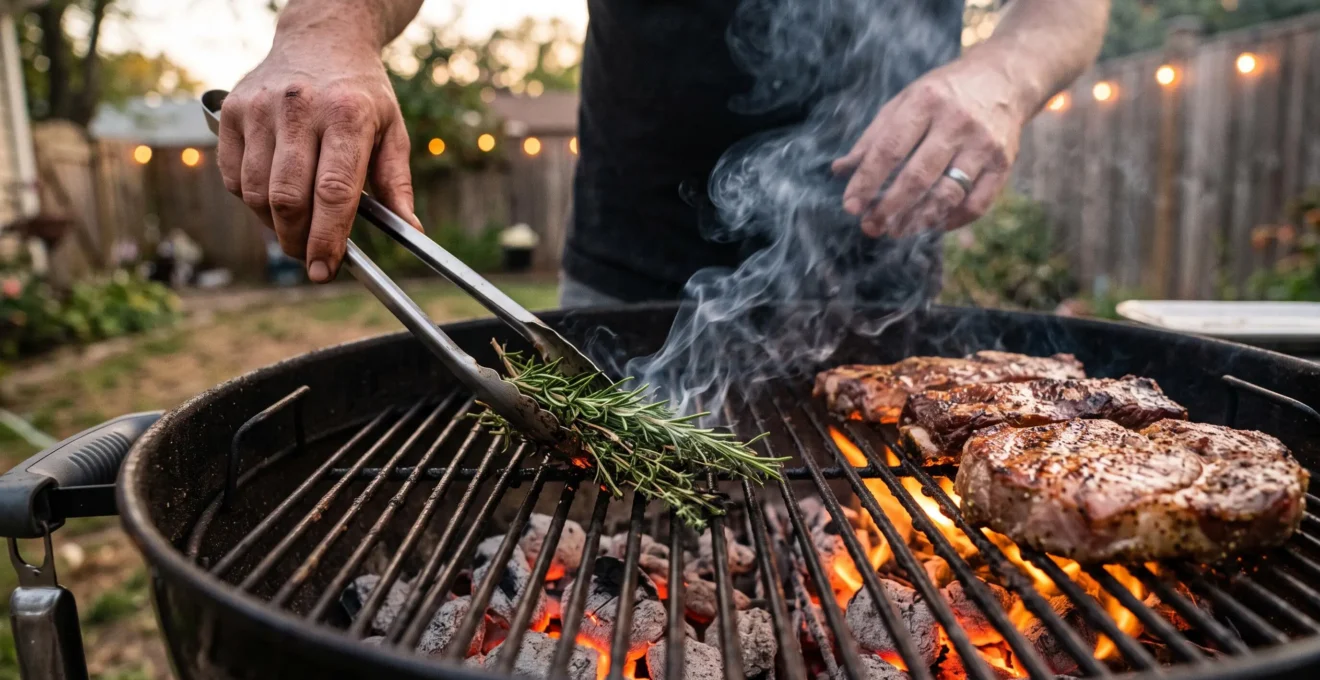
Fresh rosemary thrown straight onto a scorching barbecue can smell wonderful for a moment, then leave an unpleasant bitterness on your chicken or lamb. The problem is rarely the herb itself. It is the combination of direct heat, prolonged exposure and the moment those aromatic leaves meet the fire.
The quickest fix is to separate the herbs from intense direct heat. Move woody sprigs towards the edge of the charcoal, use an indirect cooking zone and reserve delicate leaves for the end. With a small adjustment to your barbecue setup, you can keep the unmistakable fragrance of thyme, rosemary or oregano without coating your food in burnt plant material.
There is also a difference between seasoning meat, generating herb-scented smoke and adding a fresh herbal finish. Each requires its own timing. A rosemary branch used over charcoal behaves differently from chopped parsley in a glaze, while a lemon-and-thyme marinade introduces another challenge: preserving both flavour and texture.
These practical techniques work across charcoal kettles, suitable gas barbecues and smokers, with adjustments for equipment, airflow and cooking duration.
Herbs on the barbecue: the essentials
- Keep delicate leaves away from direct flames and scorching grill bars; use indirect heat or add them after cooking.
- Use small quantities of woody herbs near the heat source when you want aromatic smoke, and avoid excessive smoke exposure.
- Add fresh herbs to glazes, finishing oils or rested meat late enough to preserve their distinctive fragrance.
- Why Do Grilled Herbs Taste Bitter Even When You Use Fresh Sprigs?
- How to Use Herb Bundles and Indirect Heat So the Aroma Infuses Without Burning?
- Fresh or Dried Herbs: Which Works Better After 6 Hours of Smoking?
- The Early-Herb Mistake That Makes Glaze Taste Dull Instead of Fresh
- When Should You Add Herbs if You Want the Aroma to Still Show Up at the Table?
- How to Use Herb Bundles and Indirect Heat So the Aroma Infuses Without Burning? (Smoke Positioning for Different Grill Types)
- How to Balance Citrus, Oil, and Salt in a Marinade Without Guessing Ratios?
- How to Use a Citrus-Herb Marinade for 2–6 Hours Without Turning Chicken Mushy?
Why Do Grilled Herbs Taste Bitter Even When You Use Fresh Sprigs?
Grilled herbs turn bitter when their leaves scorch rather than gently release fragrance. Freshness does not prevent this: moisture may briefly delay scorching, but once the leaves dry out, intense heat rapidly destroys their delicate aroma. The resulting harsh, burnt flavour is different from the pleasant smokiness produced by controlled exposure to aromatic herbs.
When rosemary hits a very hot grate, the first smell can be intensely pine-like and inviting. Leave it there too long and that fragrance gives way to something dry, sharp and ashy. The shift reflects a change from releasing aromatic compounds to overheating and burning the plant material.
Fresh herbs contain volatile aromatic compounds that contribute significantly to their flavour. As explained in Penn State Extension‘s article on cooking with herbs, cutting or heating plant tissues releases these compounds. Excessive handling or exposure can diminish the fragrance you intended to preserve.
The important distinction is not simply fresh versus dried. It is the structure of the herb and how it encounters heat.
- Tender herbs: basil, parsley and coriander have delicate leaves that are poorly suited to prolonged exposure on very hot grill bars.
- Woody herbs: rosemary and thyme have tougher stems that can be useful for controlled aromatic smoking, although their leaves can still burn.
- Intermediate herbs: sage and oregano can contribute to either cooking or finishing, depending on their form, moisture and placement.
Do not confuse fragrant smoke with the smell of burning leaves. Gentle herb smoke may add a subtle resinous or savoury note. Harsh smoke accompanied by blackening leaves is a reason to move the herbs away or remove them.
For a quick practical check, place a small spare sprig in the intended position while preparing the grill. Observe it briefly, rather than tasting hot or charred leaves straight from the grate. If it blackens rapidly or gives off an acrid smell, the position is unsuitable. A roughly 30-second observation can be useful, but it is not a scientifically established threshold: grill temperatures vary enormously.
Fresh leaves also contain moisture, so they may initially steam before scorching. That short delay is not protection against direct flame. Dried herbs, meanwhile, have less available moisture and can burn almost immediately when scattered over intense heat.
Once you recognise the moment fragrance becomes scorching, the next step is controlling where the herbs sit in relation to the fire.
How to Use Herb Bundles and Indirect Heat So the Aroma Infuses Without Burning?
Use a two-zone barbecue and keep aromatic herbs away from the hottest cooking surface. Place a small bundle of rosemary or thyme near the edge of the charcoal for controlled smoke, or use a suitable smoking attachment. Cook the food over indirect heat so circulating air carries the fragrance without exposing the herbs to continuous flames.
On a charcoal barbecue, bank the coals to one side and leave the opposite side without fuel beneath the cooking grate. This creates a hotter zone for browning and a cooler zone for gentler cooking.
For a smoky rosemary note, place a modest quantity of woody sprigs at the edge of the embers rather than spreading leaves directly beneath the meat. Close the lid where appropriate, maintain adequate ventilation and check the aroma before adding anything more.
Weber‘s beginner’s guide to smoking describes using moistened aromatic branches and stems to add smoke flavour. It also notes that herbs burn quickly, may need replenishing and can become overpowering when too much smoking material is used.
Moisture changes how quickly a bundle heats up. Soaking woody stems can delay ignition, but it does not guarantee better smoke or a particular smoke colour. Dry herbs usually heat and ignite more readily, making them harder to control near exposed coals.
There is another distinction worth making: herbal steam is not the same as herbal smoke. A loosely wrapped, heat-safe foil packet containing tender herbs may release scented moisture as it warms. Put it in a gentler indirect-heat position rather than directly in the fire. This approach is more suitable for protecting delicate leaves than trying to burn them for smoke.
Too much smoke can be just as troublesome as scorched herbs. Strong, lingering smoke may overwhelm chicken, fish or vegetables, leaving an unpleasantly medicinal flavour. A small initial quantity is easier to manage than a large bundle that produces more smoke than the dish needs.
Five checks before smoking with herbs
- Separate the heat zones. Identify the area without fuel directly beneath the grate; the result should be a clear indirect cooking position.
- Select suitable herbs. Prepare a small rosemary or thyme bundle and set tender leaves aside for finishing.
- Choose the smoke position. Place the woody bundle near the edge of the charcoal or in equipment designed for smoking; confirm that it is not engulfed in flame.
- Check airflow and aroma. Maintain the grill manufacturer’s required ventilation and assess whether the smoke smells pleasantly herbal rather than acrid.
- Adjust the amount. Remove or stop adding herbs if the smoke becomes overpowering; the outcome should be a gentle aromatic contribution rather than a dense smoke cloud.
Smoke colour may offer a visual clue, but it is not a reliable test of herb quality by itself. Thick white smoke can come from moisture as well as incomplete combustion. The actual smell, fuel conditions and visible flare-ups matter more than trying to achieve one exact colour.
This method works particularly well when the aim is subtle smoke rather than a powerful coating of rosemary flavour. Longer cooks, however, call for a different approach to maintaining that aroma.
Fresh or Dried Herbs: Which Works Better After 6 Hours of Smoking?
Neither fresh nor dried herbs is automatically better after six hours of smoking. Both can lose their distinctive aromas during prolonged heating, while leaves exposed too closely to the fire may become bitter. Hardy dried herbs and woody stems suit certain long-cooking applications, but fresh herbs are often more effective when added towards the end.
Imagine smoking a shoulder of meat over several hours. Fresh rosemary placed on the fire at the beginning may create an appealing fragrance early in the session, but that does not mean its individual aroma will remain recognisable at the table.
Some aromatic compounds escape with the smoke or change during heating. Others combine with the wider smoky character of the dish. The result depends on herb quantity, temperature, airflow, food composition and whether the herb touches the meat or is used as smoking material.
Fresh and dried herbs also differ in concentration. Dried herbs generally deliver a more concentrated flavour by volume, although drying and storage can reduce certain fresh aromatic notes. This does not establish that dried herbs survive six hours of smoke better in every application.
A useful choice is based on the herb’s physical structure and the role it needs to perform.
| Herb | Practical use | Consideration |
|---|---|---|
| Rosemary | Woody sprigs for controlled smoking; fresh leaves for finishing | Its assertive aroma can dominate delicate foods. |
| Thyme | Stems near the smoke source; leaves in seasoning | Small leaves can scorch when directly exposed. |
| Sage | Moderate use in seasonings and late additions | Strong flavour can become overpowering. |
| Oregano | Dried leaves in rubs and cooked seasoning | Loose leaves should not be scattered over flames. |
| Basil, parsley and tarragon | Fresh additions towards the end | Delicate character is easily lost with prolonged heat. |
Instead of asking which herb survives the entire cook, consider staged seasoning. Use a modest amount of suitable herbs in the earlier stages to develop background flavour, then add a fresh aromatic element just before serving.
For example, a long-smoked chicken dish might receive rosemary smoke during an early phase, with finely chopped fresh thyme stirred into warm oil near serving time. This is a practical culinary approach, not a verified six-hour comparative experiment.
The six-hour figure therefore describes a cooking scenario rather than a universal herb-performance threshold. A short grilling session can preserve flavours that prolonged smoking would diminish, especially when herbs are protected from intense heat.
Once the smoking strategy is settled, the finishing sauce becomes the next place where fresh herbal fragrance can either flourish or disappear.
The Early-Herb Mistake That Makes Glaze Taste Dull Instead of Fresh
Adding delicate herbs to a glaze at the beginning of a long barbecue cook can leave the finished sauce tasting flat. Prolonged heat reduces their bright aromatic character, while sugar-containing glazes may darken or burn. Prepare the glaze base first, then introduce chopped fresh herbs late in cooking or immediately before serving.
A sauce made with lemon, garlic, honey and parsley may smell vibrant while cold. Brush it onto chicken too early, however, and the final flavour can become dominated by caramelised sugar and smoke instead of fresh parsley.
The issue is twofold. Aromatic compounds gradually escape or change during heating, while sugar and other glaze ingredients may scorch on a sufficiently hot surface.
In Weber‘s grilling-grate care and sauce application tips, the manufacturer advises applying barbecue sauce during the final five to ten minutes of grilling. This is contextual guidance intended to reduce the risk of burning sugary sauces, not a fixed timing rule for every glaze.
A more controlled approach separates the cooked flavour base from the fresh herbal finish.
- Build the base: combine the glaze’s oil, garlic, seasoning and other ingredients suited to heating.
- Infuse carefully: use hardy herb stems when appropriate, then remove them if the desired aroma has developed.
- Apply the glaze late: brush on sugar-containing sauces when the food is approaching doneness and the heat is manageable.
- Finish with fresh leaves: stir chopped parsley, thyme leaves or another suitable herb into a reserved clean portion of glaze immediately before serving.
If a glaze contains both sugar and herbs, timing the two components independently gives more control. Sugar needs enough heat to develop an appealing coating, whereas delicate herbs often benefit from shorter exposure.
There is no universal order in which herbs burn and sugar caramelises. Both processes depend on moisture, concentration, surface temperature and the actual ingredients. What matters is avoiding unnecessary direct heat exposure for either component.
Use your sense of smell as a practical quality check. If the glaze smells almost entirely of dark caramel and smoke, a fresh herbal finish may be needed. A spoonful of unused, clean glaze combined with freshly chopped herbs can restore aromatic contrast without further cooking.
The same principle applies beyond glaze: the point at which herbs enter the cooking process determines whether they become a background seasoning or remain distinctly fragrant at the table.
When Should You Add Herbs if You Want the Aroma to Still Show Up at the Table?
Add delicate herbs towards the end of cooking or immediately before serving if their fragrance should remain recognisable. Early additions contribute background seasoning and smoke, but their fresh top notes may fade. Woody stems can be used earlier, while chopped parsley, basil or thyme leaves usually deliver a clearer herbal impression when added late.
Timing is about the role of each ingredient. A sprig of rosemary placed near the coals contributes to the cooking atmosphere. Chopped rosemary stirred into warm olive oil after cooking creates a much more direct aroma on the food.
These are complementary techniques rather than interchangeable ones.
| Stage | Herb application | Expected sensory role |
|---|---|---|
| Beginning | Small quantities of woody stems used for controlled smoke | Background smoky, herbal character |
| During cooking | Hardy herbs in appropriate seasonings or protected cooking positions | Integrated savoury flavour |
| Final cooking stage | Chopped herbs in a late-applied glaze or basting mixture | More noticeable herbal notes |
| After resting | Fresh leaves, herb oil or a finishing dressing | Distinct fragrance immediately before eating |
Fat can help distribute certain fat-soluble aromatic compounds from herbs across the food. A little olive oil or melted butter also helps finely chopped leaves adhere to grilled meat and vegetables.
That does not mean oil preserves every volatile compound through cooking or resting. Temperature and exposure still matter. Treat the fat as a useful carrier, not an absolute shield against aroma loss.
For grilled lamb, a practical finish is finely chopped rosemary and parsley mixed into warm, rather than aggressively heated, olive oil. Brush it over the meat shortly before serving. The result is a noticeable herbal note above the roasted flavour.
The resting period deserves particular attention. Heat continues to redistribute through meat after it leaves the barbecue, and delicate herbs added immediately may still warm considerably on the surface.
For a long rest, save the most fragrant garnish until afterwards. For a short rest, some herbs can be added before resting if gentle warming is desirable. The choice depends on whether the goal is a softened herbal note or a distinctly fresh finish.
Do not rely on dry herbs sprinkled onto a finished dish to behave exactly like chopped fresh leaves. Dried herbs often benefit from contact with moisture or fat to disperse their concentrated flavour.
Once the timing is clear, the remaining challenge is adapting the technique to the particular barbecue or smoker in use.
How to Use Herb Bundles and Indirect Heat So the Aroma Infuses Without Burning? (Smoke Positioning for Different Grill Types)
Position herb bundles according to the barbecue’s heat source and airflow. Charcoal kettles can accommodate small woody bundles near the edge of the coals, while suitable gas barbecues use smoking accessories or manufacturer-approved trays. Smokers require particular care because herb stems may ignite rapidly when exposed directly to concentrated heat.
There is no single herb position that works equally well on charcoal, gas, pellet and offset equipment. The fire layout determines whether the bundle smoulders, overheats or contributes almost no aroma.
Start with the manufacturer’s operating instructions, especially when using smoker boxes or accessories near burners.
| Equipment | Suitable approach | Main precaution |
|---|---|---|
| Charcoal kettle | Small woody bundle at the edge of the embers, with food in the indirect zone | Avoid open flames engulfing the herbs. |
| Gas barbecue | Compatible smoker attachment or approved foil tray near a lit burner | Keep smoking materials away from unprotected burner components. |
| Offset smoker | Carefully controlled herb additions in an appropriate firebox or smoking accessory | Maintain suitable combustion and airflow. |
| Pellet smoker | Use only a suitable, manufacturer-approved smoking accessory or cooking method | Do not place loose herbs where they could disrupt pellet feeding or combustion. |
A kettle barbecue offers a relatively straightforward visual arrangement: the heat sits on one side, the meat on the other, and the smoke travels through the covered cooking chamber.
Gas equipment is more variable. Some barbecues have dedicated smoker boxes or metal heat-distribution bars that can accommodate a suitable smoking tray. Others do not. A packet or tray must not obstruct burners, ventilation or other safety-critical components.
Foil packets also behave differently according to their contents. A packet with small openings may expose woody herbs to enough heat to release smoke, while a gently heated packet containing moist leafy herbs may mainly produce steam.
Do not seal smoking material in an airtight packet. At the same time, loosely exposed dried leaves can ignite quickly. Controlled heating, rather than a fixed number of holes, is the practical objective.
Airflow matters because smoke must circulate across the cooking chamber and escape appropriately. Blocking ventilation to trap more herb smoke can interfere with combustion and produce undesirable cooking conditions.
A faint, pleasant herbal smell is a better target than a dense cloud. Visible smoke appearance alone cannot reliably distinguish useful aromatic release from poor combustion. If the smoke becomes harsh or the herbs flare up, stop the addition and restore normal airflow according to the equipment’s instructions.
For a hypothetical weekend cook, a small rosemary bundle placed near the coals of a kettle barbecue could provide background fragrance while chicken cooks indirectly. If that aroma becomes too strong, removing the bundle is preferable to trying to disguise the flavour afterwards.
Once smoke generation is under control, complementary seasoning becomes easier to manage. Citrus, oil and salt can reinforce herbal flavours without requiring additional smoke.
How to Balance Citrus, Oil, and Salt in a Marinade Without Guessing Ratios?
Balance a citrus-herb marinade by considering what each ingredient contributes rather than following one universal ratio. Citrus adds acidity and brightness, oil helps distribute flavours and coat the food, and salt provides seasoning. Begin with moderate quantities, assess the mixture before it touches raw meat, and adjust for the cut and marinating time.
A lemon-and-rosemary marinade needs enough acid to taste lively, but not so much that the meat’s surface spends hours in an aggressively acidic environment.
Oil carries certain herb-derived flavour compounds and helps ingredients spread across the surface. It does not, however, make acidic marinades penetrate deeply or guarantee tender meat.
Salt serves a different function. Given suitable time and concentration, it can diffuse into meat and affect its seasoning and moisture behaviour. The effect depends on the food’s thickness, salt quantity and contact time.
For an adaptable kitchen starting point, equal volumes of citrus juice and oil can be tried, then adjusted to the dish. This is a culinary trial ratio, not a scientifically validated optimum. Some marinades work better with substantially less acid, particularly where longer contact is expected.
Season a small, clean sample of the mixture before adding raw poultry. Avoid attempting to judge salt concentration by calling a marinade “brine-strength”: the appropriate amount depends on the weight of food and the rest of the seasoning.
Consider the following sensory adjustments:
- Too sharp: reduce the proportion of citrus or shorten the intended contact time.
- Too oily: reduce oil slightly while keeping enough to coat the ingredients.
- Flat or indistinct: reassess the salt level and herb freshness before increasing acidity.
- Overpoweringly herbal: use fewer strong herbs such as rosemary or sage rather than masking them with more lemon.
Fresh zest provides a different aromatic impression from juice, but citrus peel and pulp can scorch on a very hot grill. Garlic and chopped herbs can also stick to the surface and burn.
Drain excessive marinade and remove loose solids before direct grilling. This helps prevent flare-ups and allows the food’s surface to brown more effectively.
Acidic marinades affect primarily the outer layers of meat over ordinary household marinating periods. Their effects cannot be predicted simply by tasting the liquid, and a visibly altered surface is not proof that marination has reached an ideal point.
The next decision is how long chicken should remain in that mixture without compromising its texture or safe handling.
Key takeaways before marinating chicken
- More lemon juice does not automatically mean better tenderness; prolonged acid contact can damage the surface texture.
- Thin pieces and substantial bone-in portions should not be treated as interchangeable when choosing a marinating period.
- Seasoning with salt separately can reduce the time chicken spends in an acidic mixture, but refrigeration and safe marinade handling remain essential.
How to Use a Citrus-Herb Marinade for 2–6 Hours Without Turning Chicken Mushy?
To use a citrus-herb marinade for chicken without damaging its texture, adjust the contact time to the cut, acidity and thickness rather than automatically marinating for six hours. Thin, skinless pieces often benefit from shorter exposure, while thicker portions may tolerate longer. Always refrigerate the chicken and remove excess marinade before grilling.
Lemon juice contains citric acid, which changes proteins at the meat’s surface. Moderate exposure can contribute to flavour and texture, but prolonged contact with a strongly acidic mixture may leave the outside unusually soft, mealy or otherwise unpleasant.
The familiar two-to-six-hour window should therefore be treated as an optional recipe range, not a universal recommendation. Certain preparations need substantially less time, particularly when the citrus concentration is high.
According to University of Illinois Extension‘s meat-marination safety guidance, acidic marinades can add flavour and help tenderise meat, but extended marination may adversely affect the texture of already-tender foods. The guidance also requires refrigeration during marination and safe treatment of used marinade.
Chicken breasts, boneless thighs and bone-in pieces differ in thickness, skin coverage and texture. Their response to marination cannot be reduced to one fixed schedule.
| Chicken cut | Practical approach | What to monitor |
|---|---|---|
| Thin, skinless breast pieces | Start with a relatively short acidic marination | Softening or an unpleasantly altered exterior |
| Boneless thighs | Use a moderate contact period suited to the recipe | Excess acidity and loose marinade on the surface |
| Bone-in, skin-on portions | Adjust marination to portion size and exposed surfaces | Uneven coating and prolonged acid contact on exposed meat |
Skin and thicker geometry change how much meat is directly exposed to the marinade, but they do not make long acidic soaking automatically safe for texture. There is insufficient evidence here to assign a precise optimal time to each cut.
One useful strategy is to separate salting from the acidic stage. Lightly salt the chicken in advance, keeping it refrigerated, then introduce the lemon-and-herb mixture closer to cooking time. This is a practical option for limiting acid contact rather than a guarantee of superior tenderness.
When the chicken leaves the marinade, allow excess liquid to drain. Pat the surface gently with clean kitchen paper if necessary, particularly before high-heat browning. A heavily coated, dripping surface can steam initially and may cause unwanted flare-ups when oil and solids reach the fire.
Discard used paper immediately and prevent raw poultry juices from contaminating utensils, salad ingredients or ready-to-eat garnishes.
Never use raw-poultry marinade as an uncooked finishing sauce. Reserve a separate, uncontaminated portion before adding the chicken if fresh citrus-herb dressing is wanted at the table. Marinade that has contacted raw chicken must be brought to a boil before it is reused as a sauce, following the food-safety guidance cited above.
Acid does not make raw chicken microbiologically safe. Keep poultry refrigerated while marinating and cook it thoroughly, checking the thickest part with a suitable food thermometer in accordance with local food-safety recommendations.
Finally, remember that the brightest herb aroma can be added after cooking. A clean dressing of fresh thyme, lemon zest and olive oil delivers a more distinct finishing note than leaving every aromatic ingredient in an acidic marinade for hours.
For your next barbecue, try one controlled change: shorten the acidic marination where appropriate, drain the chicken well and finish with a clean portion of freshly prepared herb dressing. Compare the texture and aroma with your usual method, then adjust according to the particular cut and grill.
Can you put rosemary directly on barbecue charcoal?
Yes, small quantities of rosemary stems can be used near or on charcoal to introduce aromatic smoke, provided the barbecue is suitable for this technique. Keep the quantity modest, avoid uncontrolled flames and maintain proper airflow. The objective is a gentle herbal contribution, not continuous combustion of large bundles.
Should herbs be soaked before placing them on the barbecue?
Moistening woody herb branches can delay ignition, and some barbecue manufacturers recommend soaking aromatic stems before introducing them to the fire. Soaking is not essential for every technique and does not guarantee cleaner smoke. For delicate leafy herbs, gentle indirect heating or adding them after cooking may be more appropriate.
Can dried oregano be sprinkled directly over hot coals?
Loose dried oregano is difficult to control over hot charcoal and may ignite or burn very quickly. It is generally more useful as part of a seasoning rub, marinade or finishing dressing. If herb smoke is the objective, suitable woody stems are easier to manage than loose dried leaves.
Why does grilled chicken still taste bitter after the burnt herbs are removed?
Burnt herbs and excessive smoke can leave flavour compounds on the food even after the original material is removed. Scorched sugary glaze or marinade solids may contribute additional bitterness. Removing the source stops further exposure but does not necessarily reverse flavour already deposited on the chicken.
Is it better to add fresh herbs before or after the meat rests?
For a distinctly fresh aroma, add tender herbs after resting or immediately before serving. Adding them before a short rest can gently warm and soften their flavour, but a long rest may diminish their brightness. Woody herbs can be introduced earlier when their role is integrated seasoning rather than fresh fragrance.