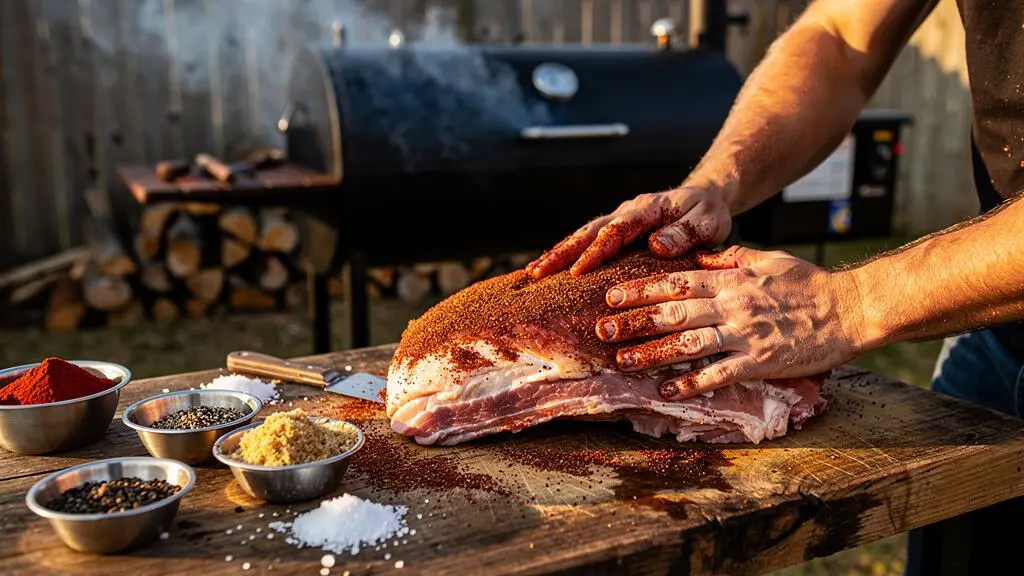
A dry rub that tastes perfectly balanced before smoking can produce an aggressively salty, peppery or strangely flat crust six hours later. The problem is rarely a single missing spice. Salt moves into moist meat, surface water evaporates, aromatic compounds change under heat, and smoke contributes another layer of flavour.
Building a reliable rub means designing the finished bite rather than the raw seasoning mixture. Start with four adjustable components: salt, savoury aromatics, sweetness and heat. Weigh them separately, account for the meat’s fat content and the smoker’s behaviour, then evaluate the result after cooking.
For a typical UK home setup running at approximately 121 °C (250°F), restraint matters more than an elaborate ingredient list. A moderately salted, aromatic-forward rub gives pork shoulder or brisket room to develop its own flavour without forcing smoke and spices to compete. The following framework provides repeatable starting ratios, practical adjustments and diagnostics for cooks lasting six to eight hours.
Dry rub balance: the essentials
- Control salt independently whenever possible, and judge seasoning across the bark and interior meat rather than tasting the uncooked blend.
- Build the spice mixture by weight using four adjustable flavour components. Change one component at a time when adapting it to another cut or smoker.
- Use deliberate grind sizes and manage surface moisture. A firm, savoury bark develops through cooking reactions, not simply through adding more sugar.
- Why Does a Rub Taste Too Salty After a Long Smoke?
- How to Build a Dry Rub Using a 4-Part Ratio So You Can Scale It Easily?
- Paprika-Heavy or Pepper-Heavy Rub: Which Works Better for Pork at 250°F?
- The Too-Fine-Grind Mistake That Makes Dry Rub Taste Dusty on the Bite
- When Should You Apply Dry Rub for Maximum Flavour Without a Hammy Texture?
- How to Build a Dry Rub Using a 4-Part Ratio So You Can Scale It Easily — Applying the Ratio Across Different Meats and Smokers
- How to Build a Savoury Bark Using Only 4 Core Spices Without Tasting Harsh?
- How to Build a Savoury Bark That Stays Firm After 8 Hours Without Going Too Sweet?
Why Does a Rub Taste Too Salty After a Long Smoke?
A dry rub can taste excessively salty after six hours because salt dissolves in meat moisture while the outer surface progressively dries. Salt can migrate into the meat, but the finished bark also contains concentrated seasoning and less water. The outcome depends on how much salt was applied, its distribution and how the crust developed.
Salt behaves differently from most dried spices. Once dissolved, sodium and chloride ions can move through moist muscle tissue. A scientific study of salt diffusion in meat investigated this movement using sodium magnetic resonance imaging.
The researchers examined a 1 kg meat sample exposed to a 10% sodium chloride brine over curing periods ranging from 3 to 100 hours. They reported a sodium diffusion coefficient of approximately 1 × 10⁻⁵ cm²/s after three hours, decreasing to around 8 × 10⁻⁶ cm²/s at longer curing times under those experimental conditions.
These findings demonstrate that salt distribution changes over time, but they do not establish how far salt travels during six hours of dry-rub smoking at 121°C. Meat thickness, water availability and cooking conditions all affect the outcome.
Meanwhile, the exterior loses moisture as bark forms. Salt may remain unevenly distributed across the crust, and strong surface seasoning can taste more prominent against a relatively mild interior. This does not mean the actual salt concentration must increase uniformly throughout the bark.
To diagnose the problem, compare two bites after cooking:
- Bark alone: Does the crust deliver an immediate salty impact before the aromatics become noticeable?
- Bark with interior meat: Does the complete bite taste balanced, underseasoned or still excessively salty?
- Interior alone: Has enough seasoning reached the meat, or is most of the flavour confined to the surface?
If the bark is harsh but the interior is pleasant, reduce the surface salt load or distribute the rub more lightly next time. If the entire bite is salty, reduce total salt relative to meat weight. Increasing paprika or sugar may distract from excessive saltiness but does not remove the excess salt.
A fingertip taste of the dry blend is particularly misleading. Undiluted salt, uncooked garlic and concentrated pepper do not reproduce the flavour of the cooked rub mixed with meat juices and smoke.
Once the salt load is understood, the next decision is how to organise the remaining flavours into a formula that scales without changing character.
How to Build a Dry Rub Using a 4-Part Ratio So You Can Scale It Easily?
Build a scalable dry rub by dividing its ingredients into four weight-based components: salt, savoury aromatics, sweetness and heat. Assign each component a proportion, weigh the ingredients in grams and multiply the entire formula when making larger batches. The proportions are adjustable starting points, not a universal recipe for every meat or cooking time.
The advantage of weighing becomes obvious when comparing paprika with fine salt. A tablespoon measures volume, not mass, and different ingredients pack differently. Using a digital kitchen scale makes the formula reproducible across small and large batches, especially when different cooks measure or prepare the ingredients.
For a practical starting point, the following is an illustrative formulation for testing, not a scientifically validated optimum for six-hour smoking.
| Component | Weight | Function |
|---|---|---|
| Salt | 10 g | Seasoning and moisture interactions |
| Savoury aromatics | 60 g | Colour, depth and aroma |
| Sweet element | 20 g | Sweetness and flavour contrast |
| Heat element | 10 g | Pungency and finishing bite |
The weight ratio is 1:6:2:1. For a hypothetical 50 g batch, use 5 g salt, 30 g aromatics, 10 g sweetness and 5 g heat. For 200 g, multiply every component by two. Batch size and application rate remain separate decisions: mixing 200 g does not mean applying all of it to one cut.
In this framework, savoury aromatics might include sweet paprika and dried garlic, while the heat component might contain black pepper and a smaller quantity of chilli. Ingredients can overlap in flavour, so classification is simply a consistent way to formulate.
AmazingRibs‘ article on the science of dry rubs explains a broader five-category seasoning framework and recommends considering salt separately from other rub ingredients. The four-part approach here is a practical simplification rather than a formula established by that source.
The next adjustment depends on cooking conditions. The table below describes formulation directions to test rather than fixed targets.
| Cooking situation | Adjustment to test | Reason |
|---|---|---|
| Six-hour pork shoulder | Modest salt, aromatic-forward, moderate sweetness | Preserves pork flavour and leaves room for smoke |
| Long brisket cook | Less sweetness, more black pepper | Creates a more savoury flavour profile |
| Lean poultry | Carefully control total salt and surface application | Smaller portions may be easily over-seasoned |
| Hotter-running smoker | Reduce exposed sugar if it darkens excessively | Limits unwanted sweetness and darkening |
Five steps to a repeatable rub formula
- Weigh the meat and record its cut, mass and intended cooking method. Deliverable: a written cook specification.
- Choose a four-component ratio and weigh a small test batch in grams. Deliverable: a formula totalling 100%.
- Record the amount of rub actually applied rather than assuming the full batch will be used. Deliverable: grams applied per kilogram of meat.
- Test a small quantity on unsalted cooked pork trim or another neutral base. Adjust one component and record the revised weight. Deliverable: a clearly labelled second version.
- After smoking, assess bark and interior flavour separately. Deliverable: tasting notes identifying the next single adjustment.
The neutral-base test reveals obvious seasoning imbalances, but it cannot reproduce prolonged smoking. Treat the cooked meat as the final validation and keep the original weights so that a successful blend can be reproduced.
Once the structure is fixed, paprika and pepper provide the next important choice: which ingredient should lead the bark when pork cooks slowly over smoke?
Paprika-Heavy or Pepper-Heavy Rub: Which Works Better for Pork at 250°F?
At 250°F (approximately 121°C), a paprika-heavy rub is a useful starting point for pork when a rounded flavour and reddish bark are desired. A pepper-heavy rub produces a sharper, more assertive crust, particularly suited to fattier cuts. Neither is universally better: the wood, fat content and amount of pepper determine which profile tastes balanced.
Sweet paprika contributes colour, gentle sweetness and mild pepper-fruit character without requiring substantial sugar. Black pepper contributes pungency and a distinctive aromatic bite. Its impact also depends on grind size, freshness and application thickness.
Extended smoking changes how those flavours are experienced. Aromatic compounds evolve with heat, while moisture loss and bark formation change the coating’s texture. However, there is no demonstrated universal rule that black pepper becomes bitter after exactly six hours at 121°C.
Wood selection matters because smoke and seasoning share the same finished bite. Fruit woods such as apple can provide a relatively gentle smoke profile, leaving more room for a pepper-forward rub. Hickory or mesquite can taste more assertive, making a restrained pepper dose a reasonable starting point when smoke intensity is already high.
| Criterion | Paprika-heavy | Pepper-heavy |
|---|---|---|
| Dominant impression | Mellow, aromatic, slightly sweet | Pungent, savoury, assertive |
| Bark appearance | Red-brown before further darkening | Darker, with visible pepper particles |
| Leaner pork | Useful when avoiding excessive pungency | Requires careful application |
| Fatty pork shoulder | Balanced, rounded flavour | Can suit a more pronounced crust |
| Strong smoke | Often an easier starting point | May compete with smoky notes |
For a controlled trial, keep the salt, sweetness and total rub application unchanged. Prepare two small spice mixtures, one with more paprika and one with more cracked black pepper. Apply them to comparable pork portions and smoke them under similar conditions. Taste each with both bark and interior meat.
The goal is to identify the dominant flavour, not to find the blend with the strongest immediate impact. A rub that works on a pork chop grilled for 15 minutes should not automatically be transferred unchanged to a six-hour shoulder cook, because the meat, cooking environment and finished crust differ.
After choosing the dominant spices, their particle size becomes the next variable: the same ingredients can produce noticeably different bark textures depending on how finely they are ground.
The Too-Fine-Grind Mistake That Makes Dry Rub Taste Dusty on the Bite
A very fine dry rub can produce a pasty or powdery-feeling bark when its small particles absorb surface moisture and form a dense coating. Coarser pepper and dried aromatic particles can give the crust more noticeable structure. The solution is not to grind everything coarsely, but to choose particle size according to each ingredient’s function.
Fine salt and sugar dissolve readily in available moisture, which helps distribute their flavour. Dried herbs, cracked pepper and chilli flakes behave differently: larger particles may remain recognisable in the surface crust after cooking.
Grinding everything into a uniform powder makes mixing easy, but it can also produce a compact coating when applied heavily to a damp surface. Such a layer may feel muddy, chalky or dusty depending on moisture, spice composition and how the bark sets.
Grind size is only one possible cause. Excess rub, low-quality dried spices, inadequate surface drying and heavy spritzing can contribute to a disappointing texture. The claim that ultra-fine spices necessarily scorch faster under identical smoking conditions should therefore be treated as a possible formulation concern, not a proven universal rule.
For a balanced texture, use these practical starting choices:
- Salt: Fine-to-medium grains that distribute consistently, preferably weighed separately.
- Sugar: Fine-to-medium grains to avoid large, uneven sweet patches.
- Black pepper: Coarsely cracked rather than reduced entirely to dust.
- Chilli and dried aromatics: A controlled mixture of moderately coarse particles, avoiding unusually large hard flakes.
Before smoking, press a clean fingertip lightly against the rubbed surface. A coating with visible particles and reasonable adhesion is a useful starting condition. If the rub instantly becomes a thick wet paste, check whether too much was applied or whether the surface was excessively wet.
This is a consistency check, not a validated predictor of bark quality. A moist coating can still develop excellent bark, and dry-looking seasoning can fail if cooking conditions are poorly controlled.
For the next experiment, change only the grind of one component while keeping spice weights and application quantity constant. This isolates texture from overall flavour concentration.
Texture also depends on how long the rub sits on the meat before smoking, especially when salt and surface moisture are involved.
When Should You Apply Dry Rub for Maximum Flavour Without a Hammy Texture?
Apply the aromatic spice blend shortly before smoking when a fresh, bark-forward coating is the priority. Salt can be applied earlier as a separate dry-brining step to improve seasoning distribution. Ordinary advance salting does not automatically create cured ham, and the familiar pink colour of cured pork should not be confused with a barbecue smoke ring.
The most useful distinction is between salt and the other rub ingredients. Salt dissolves and can move into the meat over time, whereas many dried spices primarily affect the exterior. Applying everything at once may be convenient, but it reduces control over those different processes.
There are three practical timing strategies:
- Rub immediately before smoking: A simple approach when surface flavour and convenience matter most.
- Salt in advance, spice shortly before cooking: Allows an independent dry-brining period while retaining control over the aromatic crust.
- Apply the complete rub in advance: Useful for workflow convenience, but requires attention to moisture, salt concentration and how the coating changes during refrigeration.
When salt is applied to meat, moisture may initially appear on the surface as salt dissolves. Some of this liquid can subsequently move back into the meat, while refrigeration and airflow also influence surface drying. That means advance salting can affect the condition of the surface before it enters the smoker.
The claim that salting pork overnight inevitably produces a dense, ham-like texture is too strong. Normal dry-brining and deliberate curing are not the same process.
The USDA FSIS explanation of meat curing distinguishes curing ingredients such as nitrate and nitrite, which contribute to the characteristic cured flavour and reddish-pink colour of cured pork. Regular salt alone, used for routine barbecue seasoning, should not be described as producing that same result automatically.
Similarly, a pink smoke ring near the exterior of smoked meat is not proof that the meat has been cured. The appearance of a smoke ring and the characteristic colour of nitrite-cured pork involve different contexts.
For a six-hour shoulder cook, a reasonable experiment is to salt one portion in advance and another shortly before cooking, using the same total salt mass. Add identical salt-free spice mixtures just before both portions enter the smoker. Compare the finished seasoning distribution, bark adhesion and texture.
Keep advance-salted meat refrigerated under safe food-storage conditions. Avoid treating room-temperature holding as part of a dry-brining technique.
Once timing is under control, the same four-component formula can be adapted across different proteins and smoker types without losing repeatability.
How to Build a Dry Rub Using a 4-Part Ratio So You Can Scale It Easily — Applying the Ratio Across Different Meats and Smokers
A four-component rub can be adapted across pork, beef and poultry by keeping its structure constant while changing the relative weights of salt, aromatics, sweetness and heat. Pork often suits a sweeter aromatic balance, beef commonly benefits from more pepper, and poultry requires careful seasoning distribution. Smoker temperature and cut thickness also determine which adjustments are useful.
The key is to distinguish formula scaling from formula reformulation. Scaling multiplies all components by the same factor. Reformulation alters their proportions to suit a different cooking task.
Consider the hypothetical 100 g pork formulation introduced earlier: 10 g salt, 60 g savoury aromatics, 20 g sweetness and 10 g heat. It provides a convenient baseline for a six-hour pork shoulder cook, but is not an established optimum.
For an eight-hour brisket experiment, the cook might redistribute that same 100 g total into 10 g salt, 60 g aromatics, 5 g sweetness and 25 g heat, with the heat component led by black pepper rather than chilli. This is a deliberately pepper-forward illustrative variation, not a tested recommendation for all briskets.
Both formulas contain 10 g of salt per 100 g of blend, but that figure does not determine the final salt dose until the amount applied to the meat is known. For a large brisket, assess total salt independently against meat weight rather than applying an arbitrary quantity of rub simply to obtain full coverage.
| Meat or smoker | Formulation direction | Practical check |
|---|---|---|
| Pork shoulder | Aromatic-forward with moderate sweetness | Does pork flavour remain prominent? |
| Beef brisket | More black pepper, less sugar | Does the bark complement the beef? |
| Poultry | Control salt application and pungency | Is each finished bite evenly seasoned? |
| Offset smoker | Match rub intensity to smoke exposure | Is smoke or pepper dominating? |
| Kettle or pellet smoker | Watch actual surface heat and exposed sugar | Is the coating becoming excessively dark? |
Smoker labels are not precise predictors of rub behaviour. An offset does not always produce more intense smoke, and a pellet smoker does not necessarily run hotter than a kettle. Fuel, airflow, cooking position and actual temperature are more useful observations.
Likewise, sugar does not automatically burn merely because a cook lasts eight hours. Its behaviour depends on the surface temperature, moisture and other ingredients. When sweetness or excessive darkening is observed, a lower sugar proportion is a reasonable variable to test.
For mixed-meat cooking, prepare a shared salt-free aromatic base and divide it into smaller batches. Adjust sweetness and pepper separately for each protein. Salt each cut independently so that a single all-purpose blend does not force identical seasoning onto meats with very different sizes and surface characteristics.
Record the base formula, the changes for each protein and the applied mass. This makes the results comparable without requiring an entirely new recipe for every cook.
The next refinement is ingredient restraint: a small group of complementary spices can create a more coherent savoury bark than a long list competing for attention.
How to Build a Savoury Bark Using Only 4 Core Spices Without Tasting Harsh?
Build a savoury bark around four core spices: paprika for colour and mild sweetness, black pepper for pungency, garlic for savoury depth and an earthy spice such as cumin for background warmth. Keep the strongest ingredients restrained, control salt independently and allow the meat surface to develop naturally rather than covering harshness with more sugar.
Four spices provide enough contrast to create a complex crust while making problems easier to diagnose. Every ingredient has a purpose, so there is less temptation to add another seasoning whenever the result feels incomplete.
For a deliberately hypothetical 60 g salt-free spice base, a starting experiment could use 30 g sweet paprika, 18 g cracked black pepper, 9 g dried garlic and 3 g ground cumin. This is a formulation exercise, not a source-validated ideal recipe. The quantities describe the mixture, not the amount that should be applied to a particular piece of meat.
The function of each component is distinct:
- Paprika: Creates the broad aromatic base and contributes visual colour.
- Black pepper: Supplies a sharper bite and visible bark texture when coarsely cracked.
- Garlic: Provides a familiar savoury background that complements pork and beef.
- Cumin: Adds an earthy note that should support rather than dominate the blend.
If the bark tastes harsh, identify the cause before changing the formula. Excessive black pepper or cumin can dominate a minimal blend. An overly thick coating may make dried spices taste concentrated. Excessively darkened sugars, when present in the broader rub, can contribute unwanted flavours.
Bark quality also depends on meat-surface reactions. AmazingRibs’ explanation of barbecue bark formation describes the contribution of Maillard reactions, polymerisation, moisture evaporation and smoke adhesion.
The underlying meat proteins play an important structural role. Rendered fat can help moisten the surface and hold spices, but fat alone does not create the persistent protein-based bark layer.
Consequently, changing the spice blend cannot necessarily repair a surface that remains continuously wet. Excessive spritzing may delay bark development, while insufficient moisture management may create other texture problems. Consider the exposed fat, airflow and spraying habits alongside the rub.
For a controlled tasting cycle, take a small sample from one suitable edge or use comparable test portions at approximately hours two, four and the finish. Assess whether the dominant impression is raw spice, pungency, smoke or cooked savouriness. Avoid repeatedly opening the smoker merely to follow a rigid tasting schedule.
Document what changed rather than assuming that a flavour detected at hour two must become stronger by hour six. Heat, evaporation and sensory interactions do not follow one universal pattern.
With harshness controlled, the remaining challenge is structural: keeping a savoury bark firm during an extended cook without relying on high sugar levels.
Key takeaways before an eight-hour smoke
- Treat bark firmness as a cooking and moisture-management problem first; more sugar is not a reliable structural solution.
- Choose the target texture before adjusting the rub: slicing brisket and pulling pork shoulder create different expectations for crust firmness.
- When bark is too sweet, change the sugar proportion, exposure or wrapping strategy one variable at a time, recording the result.
How to Build a Savoury Bark That Stays Firm After 8 Hours Without Going Too Sweet?
A firm, savoury bark after eight hours depends primarily on surface drying, protein reactions, smoke deposition and controlled moisture exposure rather than a large dose of sugar. Use a moderate, savoury-led rub, avoid unnecessarily wetting the crust and time any wrapping around the bark’s actual condition. Firmness must still suit the finished meat.
The central mistake is treating sugar as the main ingredient responsible for bark structure. Sugar can influence sweetness, colour and surface behaviour, but barbecue bark also forms through interactions involving meat proteins, spices, smoke and heat.
As the exterior loses moisture, a surface layer develops and darkens through complex chemical reactions. Ingredients that dissolve can move within the wet surface coating, while particles and smoke compounds become incorporated into the developing crust.
That means a savoury rub with restrained sugar can form substantial bark. A large sweet component is not necessary for an eight-hour cook, and adding more sugar does not guarantee a firmer crust.
Tomato powder or umami-rich dried ingredients can be useful experimental additions when a deeper savoury profile is desired. Their flavour contribution should not be confused with proven structural binding. Neither tomato powder nor a specific umami ingredient is established by the supplied evidence as an essential bark binder.
Salt can influence surface moisture and protein behaviour, but increasing it solely to make bark adhere risks spoiling the final seasoning balance. Keep the total salt dose appropriate to the meat, then adjust bark development through cooking technique.
Moisture management has a more direct practical role. Frequent heavy spritzing can repeatedly wet the crust, while wrapping exposes it to a more humid environment. A bark that looks dark but feels soft may need additional uncovered cooking rather than extra spices.
For a straightforward inspection, touch a small accessible section of bark with a clean utensil. If the seasoning readily smears into a wet paste, the outer layer has not achieved the desired firmness. If it holds together but feels excessively dry or leathery, further exposure may worsen the eating texture.
When a finished bark tastes too sweet, distinguish between the amount of sugar originally applied and the way the overall flavour balance changed as moisture was lost. The former is a recipe decision; the latter is influenced by cooking conditions. A sweeter perception after cooking does not, by itself, prove that sugar became more concentrated through one specific mechanism.
Wrapping is also a trade-off. Wrapping earlier can limit further surface exposure but may soften bark through trapped moisture. Delaying wrapping may promote a firmer exterior but can increase drying. The right decision depends on the meat and the desired final texture.
| Target | Bark priority | Adjustment to consider |
|---|---|---|
| Sliced brisket | Defined, cohesive crust that remains pleasant to chew | Avoid an excessively thick coating and assess wrapping carefully |
| Pulled pork shoulder | Flavourful bark that mixes comfortably into shredded meat | Prioritise seasoning balance over maximum hardness |
| Thin pork portions | Protect tenderness without creating a leathery exterior | Use lighter application and avoid unnecessary prolonged drying |
The eight-hour mark should be treated as a cooking reference, not a guarantee of perfect bark. A thick brisket and a smaller shoulder can have very different surface conditions at the same elapsed time, even at the same measured smoker temperature.
Choose one meat cut, weigh the seasoning, record the smoker conditions and evaluate the finished bark alongside the interior. Repeating that controlled test will reveal more than adding extra spices or sugar to compensate for an unexplained result.
Should a six-hour smoking rub contain less salt than a grilling rub?
Not automatically. The required salt depends on the meat’s mass, application quantity, thickness and desired seasoning level. Long cooking changes surface moisture and bark formation, but there is no established universal rule requiring a particular reduction in salt percentage for every six-hour smoke. Controlling total salt independently is more reliable than comparing the percentage of salt in two different blends.
Can a completely sugar-free rub still develop proper bark?
Yes. Bark formation involves meat proteins, heat, smoke, moisture changes and surface reactions, not simply sugar caramelisation. A sugar-free mixture built around pepper, paprika, garlic and other savoury ingredients can develop a substantial crust when the smoker and surface moisture are managed effectively.
Is it better to mix salt into the rub or apply it separately?
Both methods can work, but applying salt separately offers more control. It allows the cook to determine total salt according to the meat and to adjust aromatic spices without unintentionally changing sodium levels. A premixed rub is convenient provided its salt content and application quantity are known.
Does smoked paprika give the same result as smoking with wood?
No. Smoked paprika contributes flavour compounds from its own smoking process, whereas a working smoker exposes the meat surface to smoke throughout cooking. The two can complement one another, but adding smoked paprika is not equivalent to changing the fuel, smoke exposure or airflow. Use it sparingly when the cooking smoke is already assertive.
How can a home cook repeat a successful rub without making a fresh batch every time?
Keep the original ingredient weights, grind specifications and batch total. Record how many grams were applied per kilogram of meat, along with the cut and cooking method. Store the remaining dry mixture in an appropriately sealed container away from heat and moisture, and label it clearly. Retain a separate record of salt application if salt is not included in the spice mix.