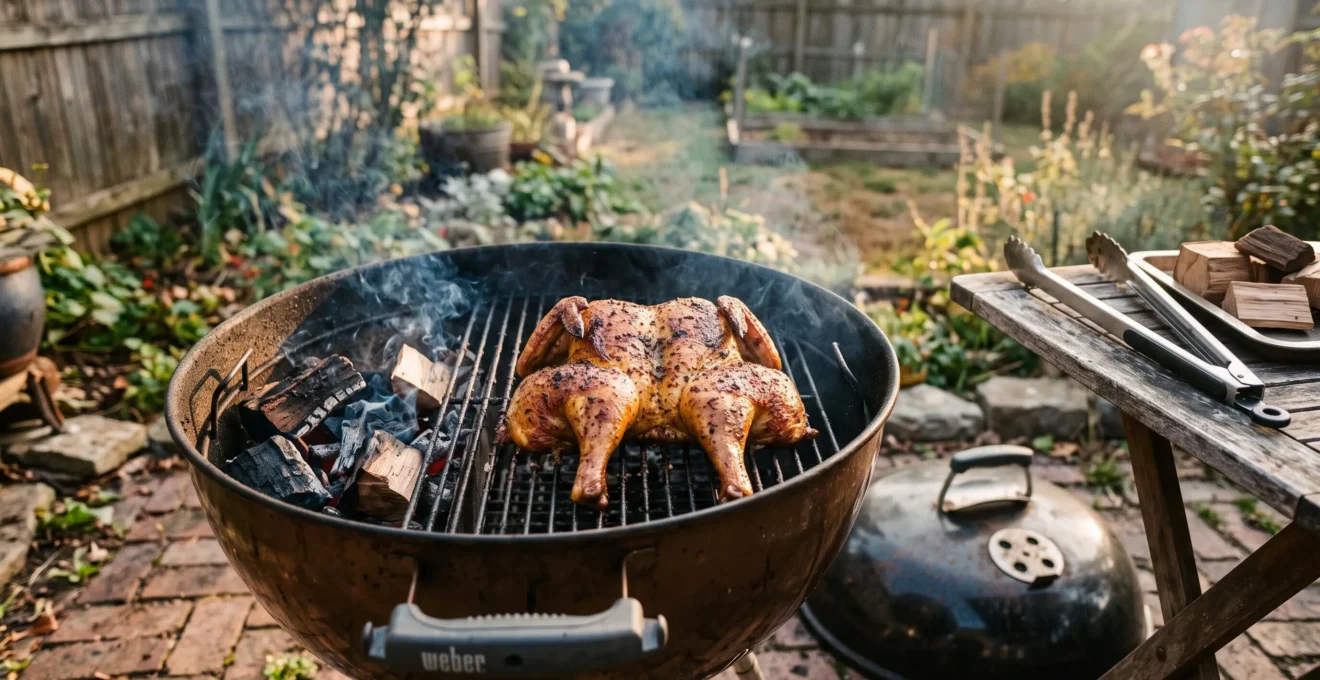
Apple wood is generally the safer starting choice for chicken cooked over two hours when the aim is a gentle, slightly sweet smoke flavour. Hickory delivers a more assertive, savoury, bacon-like character that can work beautifully with barbecue seasoning, but it leaves less room for error when the fire is producing heavy smoke.
The choice is not simply about which hardwood tastes stronger. Wood quantity, airflow, combustion quality, surface moisture and the timing of smoke exposure all influence the result. A small amount of clean-burning hickory can taste better than an excessive amount of apple wood, particularly when the chicken is served with a robust rub or sauce.
For UK kettle owners buying smoking chunks, the practical approach is to select the flavour intensity first, then control how much wood actually burns. A measured apple-and-hickory blend offers a useful middle ground, provided the proportions are treated as an experiment rather than a guaranteed recipe.
Hickory vs apple wood: the quick decision
- Choose apple for a mild, rounded smoke profile that leaves the chicken’s seasoning prominent.
- Choose hickory for a stronger barbecue character, using a modest amount and maintaining clean combustion.
- Blend the two when neither extreme suits your taste, and weigh your chunks so the result can be repeated.
- Why Can Hickory Taste Harsh on Chicken During Short Cooks?
- How to Blend Hickory With Fruit Wood Using a Simple 70/30 Mix Without Guessing?
- Apple or Cherry: Which Fruit Wood Works Better for Pork Shoulder Over 8 Hours?
- The Short-Cook Wood Mistake That Over-Smokes Fish in 20 Minutes
- When Should You Add Wood Chunks on a Kettle So Smoke Shows Up Without Turning Bitter?
- How to Blend Hickory With Fruit Wood Using a Simple 70/30 Mix Without Guessing?
- Apple or Cherry: Which Fruit Wood Works Better for Pork Shoulder Over 8 Hours?
- How to Get Clean Blue Smoke Instead of Bitter White Smoke in the First 30 Minutes
Why Can Hickory Taste Harsh on Chicken During Short Cooks?
Hickory can taste harsh on chicken because its pronounced smoky character becomes prominent when too much smoke collects on the meat’s surface. Chicken offers less strongly flavoured meat to balance that intensity than a heavily seasoned brisket. However, bitterness often points to poor combustion or excessive smoke exposure, not an inherent defect in hickory wood.
Smoke contains flavour-active compounds, including phenols, that settle principally on the exterior of food. Cooler, moister surfaces encourage deposition, making the early stages of cooking particularly influential. This does not mean chicken skin absorbs smoke at a proven fixed rate faster than beef, or that smoke travels deeply through the meat.
The distinction matters when troubleshooting. Hickory can produce a desirable savoury flavour when the fire burns efficiently. Restricted airflow, smoky ignition conditions and too much wood can create a heavy, sooty result regardless of the species selected.
AmazingRibs‘ explanation of wood combustion and smoke behavior discusses how food temperature, surface moisture and combustion conditions influence smoke deposition and flavour.
For a practical comparison, cook a chicken with a modest initial hickory addition, such as one small chunk. Assess the skin and meat separately after cooking. Skin can carry a concentrated smoke flavour, while the meat underneath may taste considerably milder.
Repeat the exercise with apple wood under otherwise similar conditions. Keep a record of chunk weight, cooking temperature, smoke appearance and tasting results. The comparison is more informative than assuming that one hardwood is universally superior.
Skinless chicken breasts deserve particular restraint, not because they have a demonstrated faster chemical absorption rate, but because they lack the flavour contribution of browned skin and can be easily overwhelmed by an assertive smoke profile.
For a two-hour cook, apple is a sensible default for mild flavour, while hickory remains appropriate when stronger barbecue seasoning calls for a more assertive smoke character.
How to Blend Hickory With Fruit Wood Using a Simple 70/30 Mix Without Guessing?
A 70/30 blend gives you a repeatable starting point, but the direction of the ratio matters. For mild chicken, try 70% apple or cherry and 30% hickory by weight. Reverse the proportions for a deliberately stronger experiment. Neither mixture is scientifically established as optimal, so wood quantity and clean combustion remain essential.
Weighing chunks is more consistent than counting them because pieces differ in size and density. For a hypothetical 100 g wood mixture, a fruit-forward blend contains 70 g of fruit wood and 30 g of hickory. That calculation illustrates the ratio; it is not a recommendation to burn 100 g during a chicken cook.
In fact, the total wood amount can matter more than the ratio. A small fruit-forward mixture may deliver a pleasing background flavour, while an unnecessarily large quantity can overwhelm the chicken even when most of the wood is apple.
Weber’s kettle guidance for smoked turkey offers an instructive comparison. In Weber‘s cherry-and-hickory turkey smoking instructions, the manufacturer describes three parts cherry to one part hickory when using chunks. That is 75% cherry and 25% hickory by counted parts, not proof that an equivalent blend is best for chicken.
The same guidance suggests reducing wood quantity for a lighter result, reinforcing the value of deliberate calibration.
Combustion sequence also deserves attention. Smoke tends to deposit more readily on cool, moist food, so the wood burning early in the cook can have a disproportionate effect on the finished exterior.
For a bold experiment, position a modest hickory portion where it will begin burning early and allow fruit wood to contribute later. For milder chicken, place fruit wood in the earliest active position. These are practical experiments, not proven flavour-improvement sequences.
| Desired result | Fruit wood | Hickory |
|---|---|---|
| Mild family-style chicken | 70% | 30% |
| Balanced experimental blend | 50% | 50% |
| Bold barbecue character | 30% | 70% |
These are suggested experimental proportions by weight, not validated sensory thresholds. Use less total wood when increasing the hickory share, and compare results under similar cooking conditions.
Once a blend has been measured and tested, its usefulness comes from repeatability rather than mathematical precision alone.
Apple or Cherry: Which Fruit Wood Works Better for Pork Shoulder Over 8 Hours?
Apple and cherry are both suitable for an 8 hours pork shoulder cook. Apple is a natural choice when you want gentle fruitwood smoke that leaves the seasoning prominent. Cherry provides another mildly sweet option and is often chosen when cooks want a darker-looking exterior. Neither wood is objectively better, and fire management matters more than a subtle flavour difference.
Pork shoulder provides a different flavour-setting from chicken. Its substantial fat and connective tissue, alongside a frequently assertive spice rub, create a dish that can accommodate a stronger smoking profile.
The wood choice should therefore respond to the finished dish rather than the cooking duration alone.
| Criterion | Apple wood | Cherry wood |
|---|---|---|
| Typical smoke character | Mild, sweet and fruity | Mild, sweet and fruity |
| Pairing objective | Keep the rub prominent | Complement a rounded, slightly sweet flavour profile |
| Appearance | Can contribute surface colour | Often selected for darker exterior colouration |
| Best practical use | Subtle pulled pork | Pork served with a comparatively restrained sauce |
Appearance is not a reliable way to identify which wood was used. Bark colour also depends on the rub, cooking time, surface moisture, temperature and smoke exposure.
For a third option, blend apple and cherry. Their similar general intensity makes this a reasonable experiment when trying to balance a rounded smoke flavour with the desired appearance.
Eight hours on the smoker does not mean the shoulder must receive eight hours of active wood smoke. Deposition conditions change as the exterior warms and dries, while smoke management and charcoal combustion continue to determine flavour quality.
Similarly, an eight-hour cook does not automatically require a fixed multiple of the wood used for a two-hour chicken. Smoker size, fuel arrangement, airflow and desired intensity all affect consumption.
Hickory can also be part of the pork shoulder mixture. A strongly seasoned pulled pork served with a robust sauce may benefit from its more pronounced character, whereas a plainly served shoulder can make milder fruitwood nuances easier to distinguish.
For an overnight or extended cook, prioritise a stable fuel arrangement and consistent airflow over repeated additions made solely to keep smoke visibly pouring from the smoker.
The Short-Cook Wood Mistake That Over-Smokes Fish in 20 Minutes
The common mistake when smoking fish for 20 minutes is using the same wood quantity and intensity intended for beef or pork. Fish can develop an overpowering surface smoke flavour during a short cook, especially when exposed to a heavy smoke cloud. Alder or apple provides a gentler starting point, but restraint matters more than the wood name.
Fish presents a different flavour balance from heavily seasoned red meat. A delicate fillet can become dominated by the smoky exterior before the cook has developed the texture you want.
Oily fish such as salmon may accommodate a more pronounced smoke character than a delicately flavoured white fish, but the result depends on the preparation, thickness and personal preference. There is no established rule that all fish absorb smoke at the same rapid rate because of their fat composition.
Start with a minimal amount of smoking wood and observe the smoke quality throughout the short cooking window. A light, intermittent smoke stream is easier to manage than a continuous thick plume.
Colour can help you follow surface changes, but it cannot establish a universal smoke-saturation point. A pale amber appearance may be desirable for one recipe, while another preparation can naturally become darker without tasting bitter.
For fish, determine doneness with an appropriate food thermometer and a method suited to the recipe rather than relying on colour as a substitute for temperature. A fillet can look beautifully smoked while still requiring additional cooking.
The flavour problem is difficult to reverse once smoke compounds have accumulated on the surface. Removing skin or an excessively smoky outer layer may reduce some perceived intensity in certain preparations, but it cannot reliably restore the original flavour.
With delicate fish, the most useful discipline is to begin conservatively and increase the smoke contribution on a future cook if the result is too subtle.
That lesson carries directly into chicken cooking: a relatively short session still requires careful smoke timing and quantity control.
When Should You Add Wood Chunks on a Kettle So Smoke Shows Up Without Turning Bitter?
Add smoking wood when the charcoal fire is established, stable and receiving enough air for efficient combustion. On a kettle, place a modest chunk near or on the active coals according to the fuel arrangement, then allow the smoke to settle before exposing the chicken to a sustained heavy plume. Avoid adding multiple chunks simply to maintain visible smoke.
A charcoal kettle works best for this style of cooking when the food is positioned away from the strongest direct heat. Arrange the charcoal for indirect cooking, manage the vents according to the kettle’s instructions and monitor the cooking temperature.
Wood added to a young, oxygen-starved fire may release substantial white smoke while heating, drying and breaking down. Established embers provide a more predictable environment for producing the lighter smoke generally preferred for prolonged barbecue cooking.
The ideal visual target is not complete invisibility. A thin, pale blue-grey stream often indicates a more controlled situation than a dense, lingering cloud. Smoke colour is only a practical indicator, however; it is not a complete measurement of combustion chemistry.
When adding another chunk, first consider whether the existing smoke contribution is already sufficient. Each intervention can disturb the cooking environment by releasing heat and smoke when the lid is opened. The size and duration of any temperature change will vary with the cooker and fuel arrangement.
For a two-hour chicken, one carefully managed early smoking phase may be enough. Adding more wood in the latter part of the cook is optional, not a requirement for maintaining flavour.
Longer smoking sessions benefit from a different approach. A Minion-style charcoal arrangement, or chunks distributed within an unlit fuel bed that ignites progressively, can reduce repeated lid opening. Such methods require an appropriate setup and temperature management rather than indiscriminately filling the charcoal bed with wood.
Once the fire is stable, the next improvement comes from documenting how the chosen wood mixture actually tasted.
How to Blend Hickory With Fruit Wood Using a Simple 70/30 Mix Without Guessing?
Use the 70/30 mixture as a controlled tasting experiment, not merely a preparation formula. Keep the wood format, total weight, cooking method and seasoning as consistent as possible between sessions. Then change one factor at a time. This helps distinguish whether an unwanted flavour came from excessive hickory, excessive total smoke or poor combustion.
Start by categorising the result rather than immediately altering the ratio. A bitter aftertaste combined with dark, persistent smoke suggests that combustion management should be investigated first. Reducing hickory alone will not necessarily solve that problem.
If the smoke is clean but the flavour is stronger than desired, reduce the total wood load or shift the blend towards apple or cherry. If the chicken tastes barely smoked, examine whether the chunks burned effectively before increasing the proportion of hickory.
The type of smoking wood also affects consistency. Large chunks generally burn over a different period from small chips, while pellets behave according to the equipment feeding and burning them. Wetting chips introduces another variable, and soaking is not a universally necessary preparation method.
Do not compare a 70/30 pellet blend directly with a 70/30 chunk blend and expect identical smoke exposure. The nominal proportions may match while combustion rate, temperature and delivery differ.
Five actions to calibrate your next chicken cook
- Weigh the wood. Write down the total weight and each species’ weight before lighting the kettle; the deliverable is a recorded blend.
- Record the cooking setup. Note the grill, charcoal arrangement, intended temperature and whether the chicken is skin-on; the deliverable is a repeatable setup description.
- Observe the smoke. Record whether the smoke was thin, intermittent or persistently thick during the early cook; the deliverable is a smoke-quality observation.
- Taste separately. Compare the skin and underlying meat after safe cooking and resting; the deliverable is two flavour notes.
- Choose one adjustment. Change total wood weight, blend ratio or fire management for the next session, keeping other variables steady; the deliverable is a specific next-test plan.
A simple record can be as useful as specialised equipment. The important fields are species, weight, wood format, cooking duration, smoke appearance and flavour verdict.
Over several cooks, those observations help build a personal reference that reflects the actual kettle, charcoal, weather and preferred seasoning rather than someone else’s universal recipe.
This method becomes especially valuable when moving between chicken and larger cuts, where the cooking conditions and intended intensity can be very different.
Apple or Cherry: Which Fruit Wood Works Better for Pork Shoulder Over 8 Hours?
For an eight-hour pork shoulder, choose apple or cherry according to the flavour and presentation of the finished dish, then plan how the smoker will maintain its fuel and smoke supply. Apple is a dependable mild starting point; cherry is another mild option worth testing for its contribution to exterior colour. Both can work without continuous wood additions.
Long cooking sessions introduce a practical purchasing question: how much smoking wood is actually needed? That depends on whether the equipment burns wood as its main fuel or uses charcoal with small hardwood additions for flavour.
A charcoal kettle or bullet smoker using chunks may consume considerably less flavouring wood than an appliance burning logs as its primary heat source. An eight-hour duration alone therefore cannot establish the wood quantity or cost.
When comparing products from UK smoking-wood suppliers, consider chunk consistency, wood condition, species identification and the package quantity rather than selecting purely by the lowest pack price. A repeatable supply makes flavour experiments easier.
A very mild fruitwood profile can become less noticeable when the shoulder is covered with strongly seasoned bark and served with a powerful sauce. That does not mean the smoke has vanished; the overall balance of flavours may simply make it less prominent.
For robust pulled pork, consider a modest hickory contribution during an established early smoking phase, followed by apple or cherry if more wood is genuinely needed. For pork served without a heavy sauce, an all-fruitwood preparation provides an opportunity to appreciate the subtler differences.
Hickory and fruit wood do not have to be assigned rigidly to the first and second halves of a cook. Actual smoke deposition depends on changing surface conditions and fire behaviour, and no validated sequence guarantees a superior flavour.
During extended or overnight cooking, prioritise stable temperature, reliable airflow and appropriate equipment supervision. Avoid creating unnecessary interruptions simply to maintain a dramatic smoke plume.
Ultimately, the best long-cook wood strategy is one that produces the intended flavour without making combustion control or fuel management unnecessarily complicated.
Key takeaways before lighting the kettle
- Smoke character depends on combustion quality as well as whether the wood is hickory, apple or cherry.
- The early cooking stage deserves attention because cool, moist food surfaces can collect more smoke.
- A stable fire and a deliberately modest wood load provide a better starting point than chasing continuous visible smoke.
How to Get Clean Blue Smoke Instead of Bitter White Smoke in the First 30 Minutes
To encourage clean blue smoke during the first 30 minutes, establish a properly ventilated charcoal fire before relying on smoking wood for flavour. Add a modest amount of dry, suitable hardwood once combustion is stable, and avoid exposing the chicken to prolonged heavy, sooty smoke. White smoke at ignition is normal; persistent dirty combustion is the concern.
Freshly heated wood releases moisture and volatile compounds as it dries and breaks down. During this process, visible white smoke can occur even with suitable hardwood. Its appearance alone does not prove the food will become bitter.
However, restricted airflow can favour inefficient combustion and heavier smoke, increasing the risk of unpleasant flavours. That is why smoke colour should be interpreted alongside ventilation, fuel condition and how the fire is behaving.
In Weber’s beginner’s guide to smoking, hickory is characterised as pungent and bacon-like, apple and cherry as slightly sweet and fruity, and alder as delicate and suitable for fish. The guide also warns that excessive wood smoke can make food bitter and recommends beginning with a small quantity.
For a kettle chicken session, use the following first-half-hour sequence as a practical framework rather than a rigid timer.
- Prepare the fuel arrangement. Set up an appropriate amount of charcoal for indirect cooking and leave suitable airflow paths.
- Establish the fire. Allow the charcoal to ignite properly, with vents adjusted according to the kettle’s operating instructions.
- Introduce the smoking wood. Place a modest dry chunk on or near established coals so it can begin burning under controlled conditions.
- Observe the smoke. Give heavy ignition smoke time to clear and check that the fire is not being starved of oxygen.
- Begin and monitor cooking. Position the chicken for indirect heat, manage the kettle temperature and verify final doneness with a food thermometer.
The first 30 minutes are a useful monitoring period, not a scientifically established deadline after which smoke can no longer deposit on food. As the chicken’s exterior becomes warmer and drier, conditions for smoke deposition generally change.
Wood condition can complicate even a well-managed fire. Avoid damp, rotten, mouldy, contaminated, painted or chemically treated wood. Choose hardwood supplied for food smoking and store it in a dry, ventilated location.
There is also no need to force the charcoal into an excessively hot burn merely to eliminate every visible trace of white smoke. Cooking temperature and efficient combustion need to be managed together.
For the next two-hour chicken cook, choose a modest apple-wood addition for a gentle flavour, or a measured fruitwood-and-hickory blend for more character. Record the outcome, then make one controlled change on the following cook.
Can apple and hickory wood chunks be used together on a charcoal kettle?
Yes. Both are suitable smoking hardwoods, and combining them is a practical way to adjust flavour intensity. For mild chicken, a fruitwood-forward ratio such as 70% apple and 30% hickory by weight is a reasonable experiment. Keep the overall wood quantity modest and maintain stable combustion.
Should smoking wood chunks be soaked before use?
Soaking is not a universal requirement. Dry chunks are commonly used directly on established charcoal, while some manufacturer guidance describes soaking as a preparation option. Water changes how wood heats and releases moisture, so use a consistent method when comparing flavour results and follow the relevant equipment instructions.
Does stronger smoke mean a stronger and better barbecue flavour?
Not necessarily. Dense smoke may indicate moisture release or inefficient combustion rather than desirable flavour development. Heavy exposure can produce a bitter or sooty result. A lighter smoke stream and a modest wood load generally provide more control, although some cooking styles intentionally use heavier smoke for short periods.
Can smoking wood be added after the chicken has been cooking for an hour?
Yes, smoke can still affect the food’s surface later in cooking. However, the warmer and drier exterior may collect smoke differently from the initial cool, moist surface. An additional chunk may be unnecessary if the early smoking phase has already produced sufficient flavour.
Is it better to buy smoking chunks or chips for a two-hour chicken cook?
Chunks are often convenient on a charcoal kettle because they generally provide a longer-lasting smoke contribution than small chips. Chips can also be used with suitable arrangements, but their faster heating behaviour requires different management. Choose the format compatible with your equipment and keep it consistent when testing wood blends.