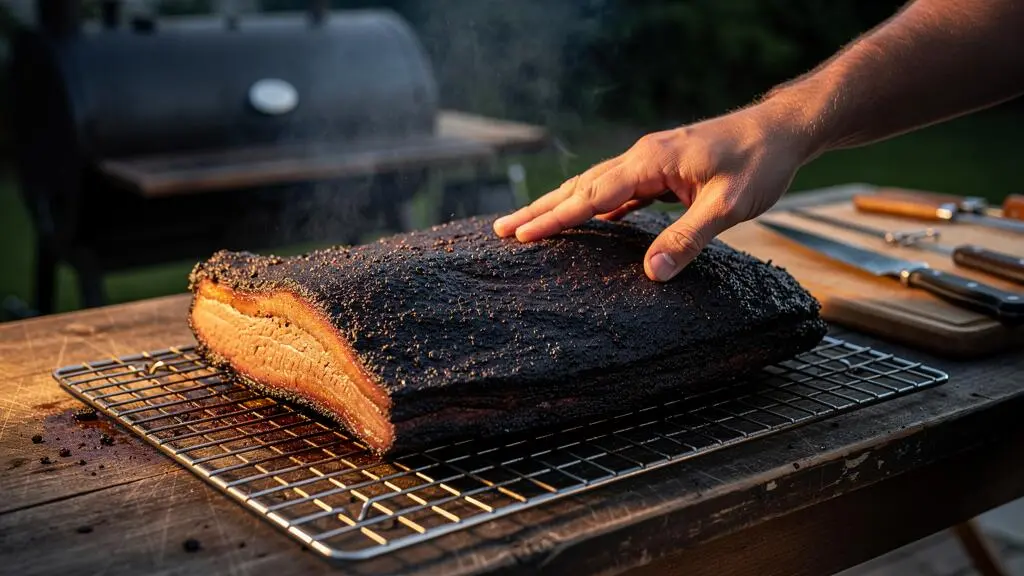
A smoked brisket can leave the barbecue with a magnificent dark bark, only to arrive at the table with the texture of damp leather. The seasoning still tastes right. The smoke is still there. But that satisfying resistance under the teeth has disappeared.
The problem often begins during resting, when heat, moisture and restricted airflow change the surface faster than expected. A crust that felt firm when the meat came off the grill may soften within 15 minutes, particularly if it has been tightly wrapped, placed directly on a board or coated with sauce.
The most reliable approach is to finish with a properly set crust, rest the meat where steam can escape, and protect serving temperature without sealing moisture against the surface. For a steak or ribs, that may mean a brief uncovered rest on a rack. For a whole brisket, the decision is more complicated because the centre needs time to settle while the exterior remains vulnerable to moisture.
The goal is not simply to keep the meat hot. It is to preserve the contrast between a tender interior and an exterior that still offers a deliberate, satisfying bite.
How to keep barbecue crust crisp after resting
- Rest meat on a wire rack over a tray so its underside does not sit in accumulated juices and moisture can escape.
- Avoid tight foil wrapping when crispness is the priority. Use an open rest or a loose, ventilated tent where appropriate.
- Stop spritzing early enough for the bark to set, and keep wet sauces away from the finished crust until serving.
- Why Does a Crisp Crust Turn Chewy While the Meat Rests?
- How to Rest Meat on a Rack So the Crust Stays Crisp Without Losing Heat?
- Foil, Towel, or Open Rest: Which Keeps the Best Crust After 30 Minutes?
- The Last-Minute Sauce Mistake That Turns Great Crust Into a Sticky Coating
- When Should You Stop Spritzing So Crust Sets Before Serving Time?
- How to Rest Meat on a Rack So the Crust Stays Crisp Without Losing Heat? (Large-Cut Application)
- Butcher Paper or Foil: Which One Makes More Sense for a 5 kg Brisket?
- How to Smoke a Brisket for 12 Hours Without Drying the Flat
Why Does a Crisp Crust Turn Chewy While the Meat Rests?
A crisp crust turns chewy during resting because moisture reaches the dried surface and makes it more flexible. Steam trapped under wrapping is a particularly effective cause. Even without wrapping, juices and moisture can accumulate where hot meat touches a solid surface. The result is bark that bends or compresses instead of resisting the first bite.
During smoking, the exterior develops through prolonged exposure to heat, smoke and moving air. Surface moisture evaporates while seasonings and meat proteins contribute to the dark, increasingly firm bark. A well-developed crust therefore depends partly on keeping its outer layer sufficiently dry.
Once the meat leaves the cooker, that drying environment changes. The surface begins cooling, while the interior remains hot and contains substantial moisture. Evaporation continues, but it may no longer be fast enough to prevent local moisture accumulation.
Two softening mechanisms deserve separate attention:
- Trapped steam: Tight foil or another poorly ventilated covering restricts moisture escape. Humid air accumulates against the bark, making it easier for the surface to absorb moisture.
- Local condensation and wet contact: Moisture can collect on cooler surfaces, beneath the meat or inside a covering. Wherever liquid remains against the crust, its texture becomes vulnerable.
Carryover cooking adds another thermal consideration. Heat continues moving from hotter outer layers towards the cooler centre after removal from the barbecue. Depending on the cut and cooking conditions, its internal temperature may continue rising.
ThermoWorks’ article on resting cooked meat explains this residual heat transfer and describes loose foil tenting as a way to retain some warmth while allowing air circulation.
Carryover cooking does not automatically mean that moisture is driven outwards. Its practical importance here is that the meat remains hot enough to release vapour while the exterior cools and the resting environment changes.
Bark thickness matters, too. A thoroughly developed, relatively dry bark may tolerate some surface moisture better than a thin, incompletely set coating. However, neither bark colour nor thickness establishes a dependable 15-minute protection period.
Rendered fat also influences the eating texture. A surface carrying substantial liquid fat can feel softer or greasier than a dry, firmly set bark, although fat rendering alone cannot predict how crisp the crust will remain.
The useful distinction is between a crust that has genuinely set during cooking and one that merely looks dark while still retaining considerable surface moisture.
Once the mechanism is clear, the next decision is physical: where to put the meat so moisture has somewhere to go without sacrificing more heat than necessary.
How to Rest Meat on a Rack So the Crust Stays Crisp Without Losing Heat?
Rest the meat on a clean wire rack set over a shallow heatproof tray, leaving the top and sides exposed to circulating air. The rack keeps the underside away from collected juices and reduces prolonged wet contact. For short rests, this straightforward setup can preserve exterior texture while the interior temperature gradually settles.
A chopping board or flat roasting tin offers little space beneath the meat for moisture to escape. Hot juices collect at contact points, potentially softening the underside even when the visible top crust remains firm.
A rack does not prevent all crust softening. Moisture can still reach the exposed surface, and the meat still loses heat. Its advantage is ventilation, particularly around the areas that would otherwise sit directly against a solid surface.
The resting environment then determines how quickly warmth is lost and how effectively moisture disperses.
| Resting environment | Heat retention | Moisture escape | Practical consideration |
|---|---|---|---|
| Rack in ambient kitchen air | Less protection against cooling | Good when uncovered | Suitable for shorter rests when serving is close |
| Rack in a gently warmed oven | Potentially better with controlled heat | Depends on ventilation and humidity | Monitor the meat and oven temperatures; avoid inadvertently continuing the cook |
| Rack in a switched-off smoker with vents closed | Residual warmth may slow cooling | Restricted ventilation can retain humidity | Check for condensation and falling temperatures; do not assume it is a safe holding environment |
A switched-off oven or smoker is not automatically a controlled hot-holding appliance. For extended holding, use equipment that can maintain a safe temperature and verify it with a thermometer. UK food-safety guidance generally uses 63°C or above for hot holding; equipment settings and the meat’s actual temperature both matter.
For a short rest, check the crust gently with clean utensils or heat-resistant gloves. A well-set bark may feel dry and resist light pressure. On some cuts, a light tap or gentle scrape produces a faint crackle, while a softened surface yields more quietly.
These are sensory checks, not calibrated measurements. Thick brisket bark may feel firm without making an audible crackle, while a thin steak crust behaves differently.
If the underside looks damp, lift the meat clear of accumulated juices. If the covering has collected condensation, increase ventilation where the resting and food-safety conditions permit.
Five checks for a better rack rest
- Prepare a ventilated station: Place a clean metal rack over a shallow tray. Verify that the meat will sit clear of any collected juices.
- Check the bark before removal: Look for a matte surface that resists gentle pressure. Identify any visibly wet areas that need attention during finishing.
- Position the meat securely: Centre it on the rack without compressing the crust against tray edges. Confirm that air can reach the underside.
- Monitor temperature: Keep a suitable probe in the thickest relevant part and check the reading during resting. Record whether the meat is cooling or still experiencing carryover.
- Inspect before slicing: Look for wet patches, pooled juices or condensation. Adjust the covering or serving sequence if the surface has started to soften.
The rack solves the wet-contact problem, but it cannot decide whether the meat should be covered. That depends on how much heat must be retained and how much surface softening is acceptable.
Foil, Towel, or Open Rest: Which Keeps the Best Crust After 30 Minutes?
An open rest generally gives a dry crust the best opportunity to retain its texture, while tight foil wrapping favours heat and moisture retention at the expense of bark firmness. A towel can provide insulation but may also restrict ventilation. After 30 minutes, the best result depends on the cut, its starting temperature and the resting conditions.
The key variables are heat retention and moisture evacuation. The material that retains heat most effectively is not necessarily the material that maintains the crispest surface.
| Method | Heat retention | Moisture escape | Likely crust outcome |
|---|---|---|---|
| Tight foil wrap | Retains heat by limiting heat and moisture losses | Very restricted | Greater risk of softened bark |
| Towel insulation | Provides insulation | Variable, depending on the layers beneath it | Can soften the crust if humid conditions persist |
| Open rack rest | Allows faster cooling | Relatively unrestricted | Often the strongest option for exterior texture |
| Loose partial foil tent | Provides some insulation | Open sides permit some vapour escape | A practical compromise rather than guaranteed crispness |
Towel resting requires an important distinction. A towel wrapped around foil-covered meat does not make the foil breathable. Moisture remains trapped at the foil layer even if the outer towel offers useful insulation.
Placing a towel directly against exposed barbecue bark is also undesirable: it can absorb juices, stick to the seasoning and create hygiene problems. Use clean, food-safe materials and keep ordinary insulating towels away from direct food contact.
A loose partial tent is worth considering when the meat needs modest protection from cooling but the bark remains the priority. Drape foil above the top without sealing it around the sides. Keep the foil from touching the crust wherever practical.
Steam can escape through the openings, although condensation may still develop beneath the foil. This method is a practical compromise, not one established by controlled 30-minute bark comparisons.
For smaller cuts intended to be eaten promptly, open resting may provide the most useful balance. For a substantial brisket requiring a longer hold, some insulation can be necessary, but the crust may soften in exchange.
There is no universal moment at which every crust becomes chewy. Thirty minutes is a serving scenario, not an experimentally established threshold for all barbecue meats.
A more useful decision comes from checking the condition of the bark, the internal temperature and the time remaining before service. If the meat is still suitably warm and the bark is dry, additional covering may offer little benefit. If it must be held longer, temperature management becomes increasingly important.
Whichever resting method works best, it can be undone in seconds by the wrong finishing ingredient. The next threat to crispness often arrives from the sauce bottle rather than the wrapping.
The Last-Minute Sauce Mistake That Turns Great Crust Into a Sticky Coating
Pouring a wet, sugary barbecue sauce over finished bark immediately before serving can turn a firm crust into a sticky coating. The sauce adds moisture to the dried surface, while dissolved sugars contribute tackiness. For a genuinely crisp exterior, apply a suitable glaze during the final cooking stage or serve sauce separately.
A dry bark and a sticky glaze are different textures. Neither is inherently wrong, but they should not be confused.
When a wet sauce contacts finished bark, liquid penetrates exposed seasoning and softens some of the surface material. Sugar concentration, sauce thickness and the amount applied influence whether the result feels pleasantly glazed or unpleasantly tacky.
A thick, sweet sauce can hide much of the original crust’s roughness. A thinner vinegar-led sauce may leave less residue, but its water content can still soften the exterior when applied generously.
The timing of the sauce matters as much as its ingredients.
For sticky competition-style ribs or glazed barbecue chicken, apply the sauce while the meat is still cooking, allowing the coating to thicken and become less wet before removal. This produces a deliberate glaze, although it will not necessarily retain the bite of an unsauced crust.
For brisket with a coarse pepper bark, keep sauce on the side. Guests can add it to individual bites without wetting every slice before the meat reaches the table.
Butter and oil deserve similar attention. Basting during resting can coat the bark, fill surface irregularities and change how firmly it feels under the teeth. Warm fat may create an attractive sheen while making the exterior seem less dry.
It would be too strong to claim that butter necessarily destroys crust by reversing fat crystallisation. Bark structure is more complex, and the available technical guidance does not establish that specific mechanism.
For a family meal, a small bowl of sauce at the table is usually the simplest way to accommodate different preferences. Anyone who enjoys a softer, heavily glazed bite can add sauce without changing everyone else’s portion.
For a plated meal, slice the meat close to serving time, preserve its exposed crust and apply any finishing sauce selectively rather than flooding the entire serving.
Sauce is only one way of reintroducing moisture. Repeated spritzing late in the cook can leave the surface insufficiently dry before resting even begins.
When Should You Stop Spritzing So Crust Sets Before Serving Time?
Stop spritzing when the bark is approaching its final set: the surface looks matte rather than wet, the seasoning stays in place under light pressure, and excess surface moisture has evaporated. This is a better guide than a fixed time before serving. Continuing to spray late in the cook repeatedly wets the very crust you want to preserve.
Spritzing is useful when a pitmaster wants to manage surface drying during a long smoke, but it creates a trade-off. Every application brings new liquid to the exterior. That moisture must evaporate before the surface can become dry and firm again.
During the earlier part of a cook, controlled spritzing may fit the desired barbecue style. As the bark develops, however, the objective changes from managing surface moisture to allowing the crust to finish setting.
Look for three practical indicators:
- Matte surface: The seasoning looks relatively dry rather than freshly sprayed or glossy with visible liquid.
- Firm attachment: A gentle touch or scratch test does not easily smear or dislodge the bark.
- Developed fat rendering: Visible surface fat has progressed beyond its raw appearance, although appearance alone does not confirm complete rendering throughout the cut.
The scratch test is particularly useful before wrapping. It helps distinguish established bark from a dark coating that remains easily disturbed.
Rather than treating spritzing as a mandatory interval, reassess whether the next application serves a purpose. Reduce unnecessary applications as the bark develops, then stop once the surface is ready for its final drying phase.
The intended rest should influence that decision. If a substantial cut will undergo a long, insulated rest, allowing the exterior to become thoroughly set before removal is particularly important because the subsequent hold may expose it to humid conditions.
For ribs or smaller cuts that will receive a short open rest, the surface may face less prolonged exposure to trapped moisture. Nevertheless, a final spray immediately before removal can still leave unnecessary wetness.
There is no verified universal stopping interval that applies to every smoker, cut and spritz mixture. Chamber airflow, cooking temperature, meat size and surface condition all affect how quickly liquid evaporates.
If the bark has already softened through repeated spraying, the answer is not automatically to increase the heat aggressively. That can overcook the interior, particularly the leaner parts of a brisket. Instead, allow the existing cooking conditions to dry the surface while continuing to judge internal doneness.
Once the bark is properly developed, the resting setup must suit the size of the meat. A large brisket creates different heat-retention and ventilation challenges from a rack of ribs.
How to Rest Meat on a Rack So the Crust Stays Crisp Without Losing Heat? (Large-Cut Application)
For a whole brisket or pork shoulder, use a sturdy rack over a drip tray and plan ventilation before removing the meat from the smoker. These cuts retain substantial heat, so tightly enclosing them immediately can create humid conditions around the bark. Monitor internal temperature while allowing initial steam to escape before choosing any longer holding method.
A large cut presents two competing requirements. The centre may need an extended rest or controlled hold for the desired eating texture, but the exterior is vulnerable to moisture during that same period.
Its mass slows cooling compared with a smaller cut under similar conditions. That can help retain warmth, but it also means hot meat may continue releasing vapour for some time.
The rack should support the whole cut without bending, tipping or pressing deeply into the underside. A shallow tray catches drippings while leaving enough space beneath the rack to prevent the meat from sitting in liquid.
In a small UK kitchen, the resting station also needs room for safe handling. Keep it away from raw-food preparation areas, avoid direct draughts that cause unnecessary cooling and ensure any juices remain contained.
For a brisket, a probe inserted horizontally through the side can make temperature monitoring convenient without puncturing the bark from above. The probe tip should reach the muscle region being monitored rather than sitting in a large fat seam.
Probe position matters more than the entry direction itself. A side entry can be practical, but it does not guarantee a more accurate reading.
The main failure occurs when an extremely hot brisket is wrapped tightly and held without ventilation. Vapour accumulates inside the covering, potentially condensing against cooler areas and softening exposed bark, including the broad upper surface.
Initial venting can reduce trapped moisture, but it must be balanced against heat loss and food safety. If the meat has been cooked in wrapping, carefully opening the covering to release accumulated vapour before arranging the hold may help limit further exposure to condensation.
For a lengthy hold, an uncovered countertop rest is not a substitute for controlled temperature management. Maintain appropriate safe holding conditions, or follow a suitable cooling and reheating procedure when the food will not be served promptly.
This distinction matters especially for brisket. Preserving a crisp exterior is worthwhile, but not at the expense of an unsafe prolonged rest.
A practical large-cut setup therefore combines physical elevation, a drip tray, temperature monitoring and a deliberate covering decision. Check each part before the meat leaves the cooker instead of improvising while handling a heavy, hot joint.
Once the resting station is ready, the most consequential remaining choice may already have been made during cooking: whether the brisket was wrapped in foil, butcher paper or nothing at all.
Butcher Paper or Foil: Which One Makes More Sense for a 5 kg Brisket?
For a 5 kg brisket, butcher paper is generally the better compromise when preserving bark texture matters more than finishing as quickly as possible. Foil restricts evaporation more effectively and can accelerate cooking, but it also encourages a moist environment around the crust. Cooking unwrapped offers greater surface exposure, although it can require more time.
These materials influence the cook long before resting begins. Foil is effectively impermeable to water vapour when sealed, so moisture released by the meat remains largely within the wrapping system.
That retained moisture limits evaporative cooling and can help the brisket cook through the stall more quickly. The drawback is that humid conditions can soften bark that took hours to develop.
Unwaxed, food-grade butcher paper behaves differently. It allows more moisture transfer than foil while still providing a degree of protection against direct airflow and excessive surface drying.
ThermoWorks’ essential brisket smoking guide distinguishes unwrapped cooking, aluminium foil and peach butcher paper, describing the different effects of these approaches on cooking time and bark development.
The guide provides illustrative cooking estimates of 14–16 hours unwrapped, 12–14 hours with peach paper and as little as eight hours using foil for a whole packer brisket. These figures describe practical approaches, not predictable results for every 5 kg brisket.
Cooking duration depends on the brisket’s thickness, fat distribution, initial temperature, smoker conditions and the point at which wrapping begins. Weight alone cannot determine a reliable finish time.
At approximately 5 kg, the brisket also presents a significant moisture-management challenge. More meat mass can retain heat for longer, while prolonged wrapping provides additional opportunity for moisture to accumulate around the bark.
That does not mean every heavier brisket creates a proportionally larger steam problem. Wrapping tightness, remaining surface moisture and temperature conditions also matter.
The most useful decision criterion is the serving priority:
- Choose foil when shortening the cook and limiting evaporative moisture loss matter more than a firm exterior.
- Choose butcher paper when a balance between moisture protection and bark preservation is required.
- Consider cooking unwrapped when exterior texture dominates and the smoker schedule allows for a potentially longer cook.
Before wrapping, check whether the bark has set. ThermoWorks describes a scratch test for this purpose; bark that still smears or moves easily may not be ready for enclosure.
Wrapping at a particular internal temperature without examining the surface can produce inconsistent results. A commonly discussed wrapping point is around 66°C, but it should not replace judging the bark itself.
Butcher paper is not a guarantee of crispness at serving. It can absorb moisture, become saturated and soften the exterior during extended cooking or holding.
A brisket wrapped in paper may therefore benefit from careful ventilation once the cook is finished, depending on the intended rest and the need to retain heat safely.
Another practical consideration is to avoid cutting into the brisket repeatedly to check its interior. Use a suitable thermometer and tenderness checks instead, keeping the final slice for the serving stage.
Neither material can compensate for a flat that has already dried out. Protecting the leaner muscle during the long cook is the final piece of the texture problem.
What matters before the final cook
- Judge bark development before wrapping, but assess final doneness primarily in the lean flat rather than the fattier point.
- Place the brisket according to the smoker’s heat pattern so the thinner flat is not exposed to unnecessarily intense heat.
- Allow adequate cooking time without treating 12 hours as a guarantee; protecting the interior is as important as preserving the exterior crust.
How to Smoke a Brisket for 12 Hours Without Drying the Flat
To smoke a brisket for roughly 12 hours without drying the flat, manage heat exposure around the leaner muscle, develop the bark before wrapping and judge doneness by probe tenderness rather than time alone. The flat can overcook while the fattier point continues becoming tender. Protecting it throughout the cook is essential because resting cannot restore moisture already lost.
A whole packer brisket contains two principal muscles with different structures. The flat is comparatively lean, while the point contains more intramuscular fat.
That difference affects how they respond to long exposure to heat. The flat has less fat to contribute richness and lubrication during eating, making excessive cooking particularly noticeable.
The shape of the brisket compounds the problem. Its thinner end may be exposed to more intense heat relative to its thickness, especially when positioned near the smoker’s hottest area.
Start by understanding the heat pattern of the cooker. In an offset smoker, the region nearest the firebox may experience greater heat exposure, although baffles, airflow and smoker design can change that distribution.
Position the brisket to avoid unnecessarily exposing the thin flat to the most aggressive heat. Fat-cap orientation should follow the actual heat direction in the cooker rather than a universal fat-side-up or fat-side-down rule.
The fat cap can provide some shielding from direct heat, but it does not automatically baste or moisturise the entire flat as the brisket cooks.
Moisture-management choices also influence the bark. Frequent spritzing may delay surface drying. Wrapping can help limit evaporation but may soften the crust. A water pan can affect chamber humidity, yet it does not guarantee that a lean flat will remain juicy.
Weber’s low-and-slow cooking handbook discusses the balance between unwrapped bark development and wrapping for moisture retention. The handbook also recommends a substantial resting period for large cuts following lengthy low-and-slow cooks, reflecting a tenderness and moisture-management priority rather than maximum crust crispness.
For the final cooking decision, concentrate on the flat. Insert a suitable probe into the thicker part of the flat and assess resistance, then consider whether the thinner end appears excessively tight, firm or overcooked.
A properly tender brisket often allows the probe to slide through with little resistance. The whole joint may also show some flexibility or sag when carefully supported, although visual movement alone does not establish doneness.
A single target temperature cannot describe every brisket. Muscle structure, fat rendering, connective-tissue breakdown and the cooking history all influence when the meat becomes pleasantly tender.
Do not keep cooking simply because the point still feels different from the flat. Their structures are naturally different, and waiting for identical resistance can expose the lean muscle to unnecessary additional heat.
After removal, avoid repeatedly slicing the brisket to test its condition. Premature cuts expose more interior surface, release juices and complicate an already delicate resting process.
Slice close to service, across the grain of the relevant muscle. Remember that the grain direction changes between the flat and point.
The scientific evidence also cautions against treating resting as a universal moisture cure. A Meat Science study on beef resting time published in 2025 compared inside-round beef roasts rested for 0, 8 and 13 minutes. Total moisture losses from resting and slicing were similar between treatments, with no significant differences in the sensory attributes evaluated.
Those results concern beef roasts, not smoked brisket bark. They do not demonstrate that a whole brisket should skip resting, nor do they establish a preferred 15-minute resting period for crispness.
The more dependable lesson is that resting cannot undo excessive cooking. A rack can protect the surface from pooled juices, and careful ventilation can limit further bark softening, but neither technique reverses a dry flat.
Twelve hours should therefore remain a planning estimate, not a deadline. The cook is finished when the flat reaches the desired tenderness and the overall brisket is ready for an appropriate rest or temperature-controlled hold.
For the next brisket, prepare the rack and thermometer before the cook ends, confirm the flat’s tenderness, then select the least restrictive resting method compatible with safe temperature management. Preserve the bark you have built without sacrificing the interior that makes it worth eating.
Can you make softened barbecue bark crisp again?
Sometimes, but recovery depends on how wet the bark has become and whether the interior can tolerate further heating. Brief exposure to suitable dry cooking heat may evaporate some surface moisture. Monitor the meat closely: additional heating can dry the flat or overcook smaller cuts, and heavily saturated bark may not recover its original texture.
Should meat rest in a cold or warm room to keep the crust crisp?
A cooler, well-ventilated environment may help exposed moisture disperse, but it also increases heat loss. A warmer environment can retain serving temperature better, although poor ventilation may encourage humid conditions. Choose based on cut size, expected resting duration and safe temperature management rather than room temperature alone.
Does a thicker smoke ring mean the bark will stay crisp longer?
No. A smoke ring is primarily a colour effect associated with reactions involving meat pigments and gases produced during combustion. It is not a direct measurement of bark dryness, hardness or resistance to moisture. Assess the exterior itself rather than using smoke-ring thickness as a texture indicator.
Is a 15-minute rest enough for every grilled or smoked cut?
No. A small steak, a rack of ribs and a whole brisket have different thermal behaviour and resting requirements. Fifteen minutes may suit some smaller cuts but cannot be treated as a universal duration. Use internal temperature, cut size, desired tenderness, crust condition and the serving schedule to guide the decision.
Can a brisket stay crisp during a long heated hold?
Some bark firmness may survive, especially when it is well set before holding and moisture accumulation is limited. However, extended holding creates a trade-off between heat retention, interior quality and surface dryness. Maintain safe hot-holding conditions and do not assume that butcher paper, a ventilated rack or loose covering will preserve the original crust indefinitely.