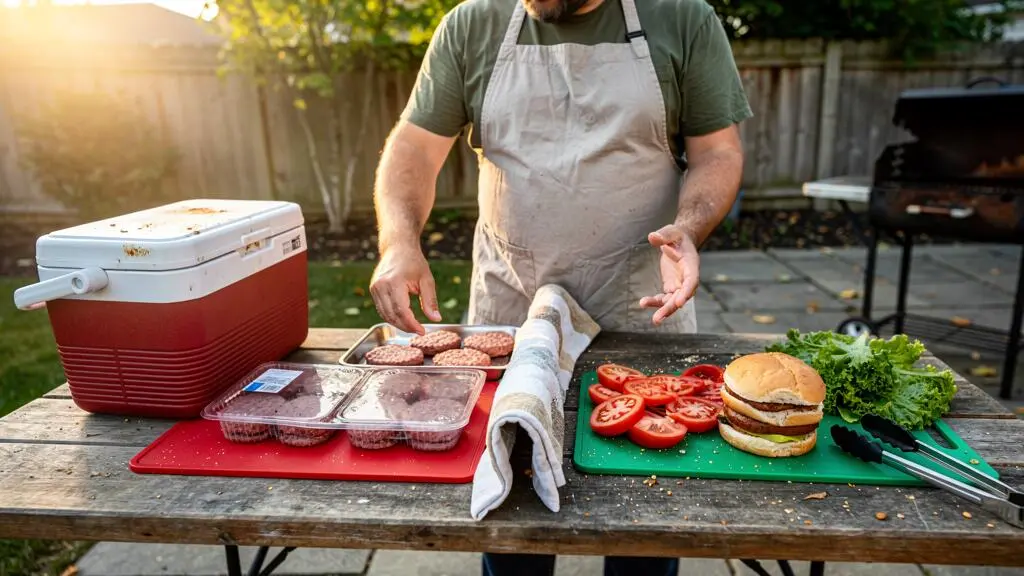
A successful barbecue begins before the charcoal is lit or the gas grill reaches cooking temperature. On a small patio, raw chicken, burger patties, bread rolls and salad ingredients can easily end up sharing the same table. Without a clear preparation system, hands, utensils and serving dishes may transfer contamination between foods.
The solution is not necessarily a larger outdoor kitchen. A compact BBQ prep station can work effectively when it separates raw ingredients from ready-to-eat food, keeps essential hygiene equipment accessible and establishes a consistent direction of movement between the cooler, preparation surfaces and grill.
Start with two dedicated cutting boards, separate utensils, a reliable handwashing arrangement and a suitable waste bin. Then organise the station around the way food will actually move during cooking. This makes preparation more predictable, reduces unnecessary handling and helps protect guests from avoidable food safety risks.
For occasional UK outdoor cooks, the most useful arrangement is one that can be set up quickly, kept clean throughout service and dismantled without bringing contamination back indoors.
BBQ Prep Station Essentials
- Keep raw meat and ready-to-eat foods on separate boards, with dedicated utensils and serving plates.
- Arrange the cooler, raw preparation area, handwashing point and clean serving zone to minimise crossing between tasks.
- Use disposable paper towels for raw-meat spills, keep waste contained and reset contaminated equipment before preparing another batch.
- Why Is Cross-Contamination More Likely at Outdoor BBQs Than in the Kitchen?
- How to Build a Two-Board Prep Station on a Small Patio Table Without Clutter?
- Folding Prep Station or Fixed Counter: Which Fits a Twice-a-Month BBQ Routine?
- The One-Towel Mistake That Spreads Raw Chicken Juice Everywhere
- When Should You Position a Bin and Handwash Bowl So You Actually Use Them?
- How to Build a Two-Board Prep Station on a Small Patio Table Without Clutter?
- Folding Prep Station or Fixed Counter: Which Fits a Twice-a-Month BBQ Routine?
- How to Design an Outdoor Kitchen Layout That Keeps Guests Close Without Crowd Chaos
Why Is Cross-Contamination More Likely at Outdoor BBQs Than in the Kitchen?
Outdoor barbecues can create more opportunities for cross-contamination because the preparation area often lacks the dedicated sinks, refrigeration and separate work surfaces available indoors. Food may also remain outside longer while guests move around the cooking area. These conditions increase the importance of deliberate separation, although they do not prove that every outdoor barbecue is riskier than indoor cooking.
In a conventional kitchen, several protective features are already in place. Running water is readily available for washing hands, refrigeration is close to the preparation counter, and dishes can be cleaned without leaving the room. Even a modest kitchen usually provides more than one practical place to put ingredients.
A patio table rarely offers the same infrastructure. One surface may be used for unpacking raw meat, preparing vegetables, holding seasonings and receiving cooked food. Unless those activities are organised, contamination can spread through ordinary movements rather than an obvious mistake.
Consider a hypothetical burger preparation sequence. A tray containing raw patties is placed on the table. The cook handles the patties, then touches a utensil handle without washing their hands. Another person uses that utensil and subsequently handles burger buns. The raw meat never directly touches the bread, yet the sequence creates a potential route for harmful microorganisms.
The CDC guidance on preventing food poisoning recommends separating raw meat from foods that will not undergo further cooking, washing hands after handling raw ingredients and cleaning contaminated work surfaces.
Cooking does not reverse earlier contamination. Heat can destroy harmful microorganisms in properly cooked meat, but it does not automatically make a contaminated chopping board, towel or serving platter safe.
Physical separation is therefore more reliable than expecting everyone to remember which objects have been touched. A dedicated raw preparation area makes contamination boundaries visible before cooking begins.
Once those routes are understood, a small patio table can be organised into distinct working areas without requiring a permanent outdoor kitchen.
How to Build a Two-Board Prep Station on a Small Patio Table Without Clutter?
Divide the patio table into a raw-food zone and a clean, ready-to-eat zone using two separate cutting boards. Give each board a fixed position, contain raw ingredients on trays and remove unnecessary items from the working surface. A simple boundary between the zones helps prevent accidental mixing while preserving enough room to prepare and serve food.
Begin with two washable, food-safe boards. A red board can identify raw meat, while a green board can identify vegetables, bread and other ready-to-eat ingredients. Colours are organisational cues rather than a formal guarantee of hygiene; consistent use and proper cleaning matter more than the particular colours chosen.
Position the raw board near the chilled meat supply and keep raw packaging within that side of the station. Place the clean board nearer the clean serving area. If both boards cannot fit with sufficient separation, move ready-to-eat preparation to a separate clean surface rather than squeezing everything together.
A shallow tray, upright caddy or compact storage unit can serve as a visual boundary. A towel rail may also mark the division if it is clean, stable and positioned so that contaminated objects cannot touch the clean side. A loose cloth should not serve as a food-contact barrier.
For a cramped patio, make use of vertical storage without placing ready-to-eat food above exposed raw meat. Keep seasoning containers together in a caddy, store clean spare boards away from splashes and bring out only one raw-food tray at a time.
Pre-portioning meat indoors reduces the need for trimming and repackaging outdoors. Keep portions chilled until needed, and avoid leaving an entire batch exposed while the grill is occupied.
Maintain a one-way working sequence: chilled storage, raw preparation, grill, clean serving area. The cook’s hands and utensils must still be cleaned or changed when moving from raw handling to ready-to-eat tasks.
Use a simple reach-across check before starting. If someone must reach over raw meat to retrieve buns, clean tongs or plates, relocate those items. The test identifies an awkward layout; it does not replace handwashing or surface cleaning.
Five Checks Before Lighting the BBQ
- Position two dedicated boards and confirm that each has a clearly assigned food category.
- Place raw ingredients in a contained tray and verify that no juices can reach the clean board.
- Move buns, prepared vegetables and clean serving utensils to the designated clean side.
- Set out soap, a usable water supply and disposable hand-drying materials; confirm hands can be washed without touching food.
- Walk through the full preparation-to-serving sequence and relocate any item that requires reaching across the raw zone.
The result should feel uncomplicated: raw ingredients remain contained, clean food has its own space, and nothing important requires an unsafe shortcut. The next decision is whether that arrangement needs permanent furniture.
Folding Prep Station or Fixed Counter: Which Fits a Twice-a-Month BBQ Routine?
A folding prep station is usually a sensible starting choice for someone who barbecues twice a month, particularly where patio space is limited. A fixed counter becomes more attractive when cooking sessions are lengthy, several dishes are prepared in stages or guests regularly gather near the work area. Both options can be hygienic when their surfaces are stable, washable and properly maintained.
At roughly two BBQ sessions per month, a setup that is inexpensive but difficult to assemble may become frustrating. Equally, an expensive permanent counter may offer little practical value if most ingredients are prepared indoors beforehand.
The comparison should focus on how each option behaves during preparation, cleaning and storage rather than its appearance alone.
| Decision factor | Folding prep station | Fixed outdoor counter |
|---|---|---|
| Setup | Requires unfolding, positioning and stability checks | Usually ready for use after surface preparation |
| Storage footprint | Can be folded and stored between sessions | Occupies permanent patio space |
| Cleaning | Hinges, joints and shelves may need extra attention | Accessible smooth surfaces can be easier to wipe and inspect |
| Stability | Depends on frame quality, locking mechanisms and ground level | Can provide a consistently stable work surface if properly built |
| Cost | Often involves a smaller initial equipment commitment | May require materials, installation and weather protection |
| Suitability | Occasional cooking and limited storage space | Regular, prolonged cooking with dedicated preparation zones |
Folding equipment deserves particular attention around hinges, folding legs and fabric shelves. These components may collect dirt or moisture. A fabric shelf should not be used as a direct food preparation surface, while cutting should take place on a stable, washable board.
A fixed counter avoids assembly but introduces outdoor maintenance. Untreated timber may absorb moisture or deteriorate, and exposed materials may require weather-resistant finishes appropriate for their intended use. Food-contact surfaces must remain cleanable and in sound condition.
There is also a practical middle ground. Use a folding station to handle raw ingredients and a small, dedicated clean cart or counter for finished food. This gives occasional hosts extra separation without committing to a large outdoor installation.
Whichever surface you choose, equipment only works when daily handling habits support it. Towels are one of the easiest ways to undermine an otherwise careful setup.
The One-Towel Mistake That Spreads Raw Chicken Juice Everywhere
Using one towel to wipe raw chicken juices, dry washed hands and handle grilling equipment can transfer contamination between objects that should remain separate. The safer approach is to remove contaminated cloths from use immediately, keep clean hand-drying materials protected and use disposable paper towels for raw-meat spills. A quick rinse does not reliably restore a contaminated towel to a clean condition.
A towel is frequently handled and moved between surfaces. If it absorbs juices from raw poultry, subsequent contact with a tap, cupboard handle, mobile phone or serving plate may create additional contamination routes.
The problem is not that towels are inherently unsuitable for an outdoor cooking station. It is the absence of clear roles and a reliable procedure for dealing with contamination.
Where reusable towels are needed, give them distinct purposes and storage positions. For example, keep a clean towel exclusively for drying already washed hands and a separate heat-resistant grill cloth for appropriate equipment handling. Do not allow a cloth exposed to raw-meat juices to return to either role.
A towel used for contaminated spills should be placed directly into a designated container for laundering. Disposable materials should be discarded after use. Reusable cloths require appropriate washing before they can be returned to food preparation duties.
FoodSafety.gov‘s four food safety steps recommend washing contaminated utensils and preparation surfaces with hot, soapy water and laundering dishcloths frequently. These principles are especially important when working without an immediately accessible kitchen sink.
For a low-water patio setup, absorb raw-meat spills with disposable paper towels and clean the affected surface using an appropriate food-contact cleaning procedure. Where sanitising is necessary, use a product suitable for food-contact surfaces and follow its label instructions, including any required rinsing and contact time.
Surface sanitiser is not a substitute for washing dirty hands. Hand hygiene should rely on soap and clean water wherever possible, especially after handling raw poultry.
The final precaution is often overlooked: clean hands should never be dried on a towel that has already contacted raw food. Otherwise, a successful handwashing step may be immediately undermined.
Consistent towel handling becomes easier when clean water, soap, paper towels and waste disposal are arranged before food preparation begins.
When Should You Position a Bin and Handwash Bowl So You Actually Use Them?
Set up the waste bin and handwashing point before opening any raw-meat packaging. Position the bin beside the raw preparation area and the handwashing station along the route from raw handling to clean food or serving. Both should be easy to reach without crossing food-contact surfaces. Handwashing equipment must provide clean water, soap and a hygienic way to dry hands.
A bin placed at the far end of the garden may encourage cooks to leave packaging on the table temporarily. Similarly, a handwashing station that requires walking through the guest area may be inconvenient during busy cooking sessions.
The objective is to make proper hygiene the easiest available action, not something that interrupts the workflow.
Use a lidded waste bin with a secure liner near the raw-food side, but keep it below or away from the food preparation surface. Packaging and absorbent paper towels should be disposed of without touching ready-to-eat ingredients or clean utensils.
For handwashing, provide a clean water container that allows water to flow over the hands, a soap dispenser, a suitable catch basin and disposable paper towels. A bowl of standing water alone is not an adequate replacement for washing under flowing clean water.
The FDA recommendations for handling food safely outdoors identify a water jug, soap and paper towels as practical hand-cleaning equipment when conventional running water is unavailable.
Wash hands thoroughly with soap and clean water for at least 20 seconds after handling raw meat and after touching rubbish. Dry them using clean disposable materials before returning to food preparation.
For raw-meat packaging, a secure liner that prevents leakage is essential. Double-bagging may be useful when packaging is damaged or particularly wet, but it is not necessary to treat every wrapper as requiring two bags.
Keep the bin covered when not in use, and position it where flies, pets and accidental knocks are less likely to create problems. Wash hands again if handling the bin contaminates them.
Timing matters as much as location. Setting up these facilities midway through cooking creates additional handling and increases the chance that contaminated hands will touch clean equipment.
Once hygiene facilities are established, the next challenge is keeping the two-board arrangement safe while successive batches of food move through the station.
How to Build a Two-Board Prep Station on a Small Patio Table Without Clutter?
Maintaining a two-board station throughout a barbecue requires more than arranging the boards correctly at the beginning. Remove contaminated equipment between tasks, clean affected surfaces and keep ready-to-eat ingredients separate throughout service. When raw preparation finishes, the clean zone should remain protected while the raw zone is cleared and reset rather than casually reused for serving.
The safest system is one in which a board has a single food-handling purpose during a preparation cycle. Do not simply turn over a raw-meat board and assume the reverse side is clean. Edges, hands and the underlying table may already have become contaminated.
When moving from raw preparation to cooked-food service, follow a deliberate reset:
- Return unused raw ingredients promptly to suitable chilled storage.
- Remove the raw cutting board, contaminated utensils, packaging and used paper towels from the work area.
- Wash hands and clean any table surfaces exposed to raw meat or its juices.
- Wash contaminated equipment with hot, soapy water and sanitise food-contact surfaces where appropriate, following the relevant product instructions.
- Introduce clean boards, utensils and serving platters only once the area is ready for their use.
The exact arrangement also depends on the menu. For skewers, contain raw ingredients and marinades within a tray so liquids cannot travel across the table. Any marinade intended for use as a finishing sauce should be reserved separately before raw meat is introduced.
For burgers, make the bread-and-toppings station a dedicated clean area. Raw patties should reach the grill without passing across buns or salad ingredients, and cooked burgers should be collected using clean utensils and platters.
For side dishes, use a separate clean shelf or table if space is limited. Avoid placing uncovered ready-to-eat food directly above raw meat where juices, handling or movement could introduce contamination.
Keep drinks, phones, guest belongings and serving platters for cooked food away from the raw preparation table. A separate clean shelf can hold these objects without increasing clutter around the cooking area.
Preparation speed comes from reducing unnecessary decisions and movements, not from compressing every task onto the same surface.
With a reliable cleaning and reset procedure, even a compact folding table can support several cooking stages. The remaining question is how much effort that equipment demands over an entire barbecue season.
Folding Prep Station or Fixed Counter: Which Fits a Twice-a-Month BBQ Routine?
For a twice-a-month barbecue routine, the better long-term choice depends on the total effort of setup, cleaning, drying, storage and maintenance. A folding station avoids permanent exposure to the weather but requires careful cleaning before storage. A fixed counter saves assembly time yet needs protection against outdoor deterioration. Choose according to the complete seasonal routine, not just the convenience of one cooking session.
At the end of each gathering, folding equipment must be cleaned thoroughly, dried and checked before it is stored. Hinges, shelves and underside surfaces deserve attention because moisture or residue may remain in areas that are less visible during ordinary use.
Putting equipment away while damp can also create storage problems. Moisture may damage the station itself or affect nearby stored items, even when the preparation surface appeared clean after use.
Permanent counters have a different maintenance profile. Their exposure to rain, sunlight and temperature changes can affect finishes, joints and materials. Outdoor surfaces should be inspected regularly for damage that makes cleaning difficult.
Seasonal maintenance may include checking sealed edges, examining timber for deterioration and ensuring the surface remains suitable for food preparation. These needs vary by material and exposure, so maintenance instructions should follow the actual equipment rather than a universal schedule.
For a cautious investment decision, begin with a stable folding table and dedicated preparation boards. Use it through several cooking sessions while observing practical problems.
- If most ingredients arrive pre-prepared and the station is easy to clean, a folding setup may remain sufficient.
- If guests frequently interrupt preparation or cooking continues for several hours, permanent separation may offer operational advantages.
- If equipment storage becomes difficult, a compact weather-resistant cart may be a useful intermediate option.
Count the time spent assembling, sanitising, dismantling and maintaining the equipment across the season. This provides a more meaningful comparison than judging either option by purchase price alone.
Permanent equipment is an upgrade, not a hygiene requirement. A clean, stable portable surface can be entirely appropriate when raw and ready-to-eat ingredients remain properly separated.
Before expanding the furniture, consider how guests move around it. Even a well-maintained preparation station becomes difficult to manage when people repeatedly walk through the cook’s working area.
Key Takeaways Before Planning the Guest Area
- Keep the cook’s raw-food preparation route separate from guest access to drinks and snacks.
- Provide a clean serving destination so finished food never returns to the raw preparation area.
- Increase space or add a separate drinks station when guest traffic begins to interfere with safe food handling.
How to Design an Outdoor Kitchen Layout That Keeps Guests Close Without Crowd Chaos
Design the outdoor kitchen around three distinct areas: a preparation corridor for the cook, a clean serving point and a social space for guests. Keep these areas adjacent enough for conversation but prevent guest movement from crossing raw-food preparation. A clear route from the cooler to the grill and then to serving makes the layout easier to manage as the gathering grows.
On a small patio, the main challenge is rarely the number of people alone. It is the number of competing journeys through the same limited space.
Before arranging the furniture, identify three common paths: guests collecting drinks, the cook reaching the waste bin and finished food moving towards the dining table. If any of these routes passes directly over or through the raw preparation area, reposition the relevant item.
The cook should be able to move between chilled ingredients, the raw board, handwashing facilities and the grill without needing guests to step aside. A separate clean serving route should allow finished food to reach diners without returning through the raw zone.
Use a low planter, bench back or another clearly visible boundary to distinguish the working corridor from the social area. The boundary should not create a trip hazard or obstruct safe access around a hot grill.
For a hypothetical gathering of four people, a small preparation table, dedicated clean serving surface and drinks area may provide enough separation. The arrangement can remain compact if food is prepared in manageable batches.
For a gathering of fifteen, the same principles apply but more space may be needed for queues, drinks and serving dishes. A separate beverage cooler away from raw ingredients can reduce guest traffic around chilled food storage.
Keeping beverages separate from perishable ingredients is also consistent with FDA outdoor food-handling guidance, which explains that frequently opening a drinks cooler can expose chilled food to additional warm air if both are stored together.
As cooking finishes, close the raw-food preparation corridor to casual traffic until contaminated equipment and waste have been removed and the surfaces cleaned. The space can then be reorganised for clean serving if appropriate.
Before the next barbecue, mark out the cook’s route, establish a separate drinks point and walk through the journey a cooked dish will take to the dining table. If those movements remain separate from raw-food handling, the layout is ready for a practical trial.
Can the same BBQ tongs be used for raw and cooked meat?
Use separate utensils for raw and cooked meat whenever possible. Tongs that touched raw meat should not handle cooked food until they have been properly washed with hot, soapy water. Keeping dedicated clean serving tongs beside the grill avoids unnecessary interruptions.
Is hand sanitiser enough when there is no outdoor sink?
Hand sanitiser should not replace proper handwashing after handling raw meat, especially when hands are visibly dirty or greasy. Provide clean flowing water from a suitable jug, soap and disposable paper towels. Wash hands thoroughly for at least 20 seconds. If adequate handwashing cannot be arranged outdoors, handle raw ingredients near a suitable indoor sink instead.
How should raw meat be kept cold during a long barbecue?
Keep raw meat refrigerated or in an adequately chilled cooler until required for cooking. Bring out only the portions needed for the current batch. Avoid leaving perishable food unrefrigerated for extended periods, particularly in hot weather. A separate drinks cooler helps reduce unnecessary opening of the food cooler.
Can raw vegetables and salad ingredients share a cutting board?
Vegetables that will be cooked and salad ingredients that will be eaten raw can be prepared on an appropriately cleaned board, provided there is no contamination from raw meat, poultry or seafood. Wash produce as appropriate and keep ready-to-eat ingredients protected. Use a separate board for raw animal products.
What should happen if raw chicken juice spills onto the clean side of the table?
Stop preparation in the affected area. Remove any food that may have been contaminated, discarding ready-to-eat food exposed to raw poultry juices. Absorb the spill with disposable paper towels, then clean the affected surface thoroughly and sanitise where appropriate with a food-contact-safe product used according to its instructions. Wash hands, replace contaminated equipment and resume preparation only when the clean zone is safe to use.