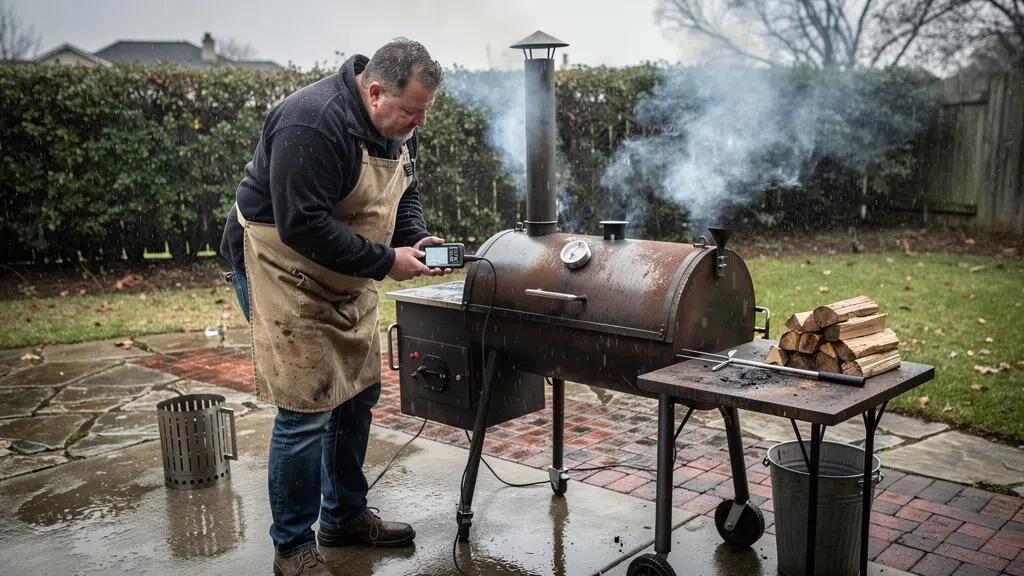
Six hours at a steady smoking temperature is not really a test of how often a pit controller checks the thermometer. It is a test of how consistently the smoker receives oxygen, burns fuel and retains heat while the weather changes around it.
For a UK backyard cook, the difficult combination is familiar: a cool morning, an unexpected crosswind, intermittent drizzle and a charcoal fire that seems to change its behaviour without warning. A smoker can appear perfectly settled at 225 °F (about 107°C), then begin climbing or falling just as the meat enters its longest cooking phase.
The practical solution is to establish a stable fire before loading the food, measure temperature near the cooking grate, make deliberate airflow adjustments and replenish fuel before the fire weakens. Wind protection and sensible lid discipline matter just as much as the vent settings.
The aim is not an absolutely motionless thermometer. It is a predictable cooking environment with manageable fluctuations, clean combustion and enough fuel to finish the session without continual intervention.
Six-hour smoker temperature control: the essentials
- Measure cooking temperature beside the food, minimise lid openings and distinguish brief fluctuations from sustained changes.
- Control combustion through the appropriate vents for your smoker, allowing each adjustment time to work before making another.
- Protect the fire from wind, manage the water pan where fitted and plan charcoal replenishment before temperature begins falling.
- Why Does Smoker Temperature Swing by 30°F After You Open the Lid Twice?
- How to Set Your Vents for a Steady 225°F Without Constant Tweaks?
- Water Pan or No Water Pan: Which Keeps Temps More Stable Over 5 Hours?
- The Vent-Chasing Mistake That Makes Temperature Swings Worse
- When Should You Add Fuel During a Long Smoke to Avoid a 2 pm Temperature Crash?
- How to Set Your Vents for a Steady 225°F Without Constant Tweaks?
- How to Blend Hickory With Fruit Wood Using a Simple 70/30 Mix Without Guessing?
- How to Control Barbecue Temperature Without Buying New Gear or Fancy Controllers
Why Does Smoker Temperature Swing by 30°F After You Open the Lid Twice?
Opening a smoker twice can produce a noticeable temperature swing because lifting the lid releases hot air and changes the oxygen supply to the fire. Once the lid closes, combustion and the smoker’s stored heat may recover at different rates. A 30°F swing is possible, but it is not a predictable result of two openings.
When the lid lifts, hot gases escape immediately. The temperature probe may record a sharp drop, even though the charcoal bed remains hot and the meat, grates and smoker walls have not cooled to the same extent.
At the same time, the sudden supply of fresh oxygen can intensify combustion. After the lid closes, that stronger fire may continue producing heat while the cooking chamber recovers. The result can be a temperature rebound rather than a smooth return to the previous reading.
Air temperature and stored heat are different measurements. Heavy metal surfaces and large cuts of meat respond more slowly than the air around the probe. An indicated 225°F therefore describes the probe’s immediate surroundings, not the temperature of every component inside the smoker.
The response also depends on equipment. A thin-walled offset tends to exchange heat rapidly with its surroundings, while the substantial ceramic mass of a kamado usually changes temperature more slowly. Neither behaviour guarantees a particular size of swing.
A fixed grate-level probe makes it easier to monitor recovery without opening the lid. From outside, watch for changes in smoke output, unexpected thick smoke and the response of an accessible firebox. Thin, relatively clean smoke is generally preferable to persistent heavy smoke, although smoke appearance alone cannot establish temperature or combustion quality.
Weber UK‘s advice on controlling charcoal barbecue temperatures identifies airflow, fuel and lid position as important influences on charcoal heat. It also notes that opening the lid can encourage stronger combustion by admitting more oxygen.
Instead of treating every lid opening as a fixed penalty, make it purposeful. Organise spraying, wrapping or food checks so the lid is open for the shortest practical period. Track the recovery afterwards before adjusting the vents.
The important distinction is between temporary heat loss and a genuine change in combustion. Once that distinction is clear, vent adjustments become much easier to manage.
How to Set Your Vents for a Steady 225°F Without Constant Tweaks?
Set smoker vents for 225°F (about 107°C) by building a controlled fire, approaching the target gradually and changing airflow only after observing a sustained temperature trend. On many dedicated charcoal smokers, the lower intake controls combustion while the exhaust stays open. Exact vent positions and response times depend on the smoker, fuel load and weather.
Air entering beneath or beside the fuel supplies oxygen. More oxygen can increase the burning rate; restricting it generally reduces heat production. The exhaust allows combustion gases to leave and contributes to the smoker’s draft.
Do not assume every smoker uses the same vent strategy. A Weber Smokey Mountain Cooker, for example, is operated with its upper vents open and its lower vents used for temperature adjustments. Some kettle-style charcoal barbecues use a different approach.
For a manual charcoal smoker, a useful trial is to begin with an intake setting around halfway open, provided that agrees with the equipment instructions. Allow the cooker to approach the desired temperature before narrowing the opening. This is an experimental starting position, not a universal 50% rule.
Once the smoker is near 225°F, make relatively small changes rather than shifting a vent from nearly closed to fully open. Changes of roughly 10–15 percentage points of vent travel can serve as a trial method, but vent shape, fuel type and draft determine the actual effect.
The waiting period matters. A relatively responsive charcoal barbecue may show the effect of an adjustment within several minutes, while a heavy smoker may take much longer to settle. A 20–30-minute observation window can be useful when experimenting with a slow-reacting cooker, but it is not a mandatory interval for every model.
UK weather adds another variable. Gusts can force air through an exposed intake, while rain and cold surfaces increase heat losses. Position the smoker so prevailing wind does not blow directly into the intake, without restricting ventilation or placing combustible materials near hot equipment.
Record the conditions during successful cooks: wind exposure, charcoal load, intake position, grate temperature and time between corrections. After several sessions, the record becomes more useful than a generic instruction to open the vent by a certain amount.
Once the airflow is reasonably predictable, additional heat stability may come from managing the smoker’s thermal mass rather than making the fire burn harder.
Water Pan or No Water Pan: Which Keeps Temps More Stable Over 5 Hours?
A water pan can help moderate temperature changes in smokers designed to use one, particularly charcoal water smokers with limited thermal mass. It absorbs heat, supports a relatively low cooking temperature and adds moisture to the chamber. However, a water pan is not automatically better for every smoker, and adding one may increase fuel demand.
Water contributes thermal buffering because it takes energy to heat and evaporate. While water remains in the pan, it can absorb energy that would otherwise raise chamber temperature. This helps explain why water smokers often operate within relatively modest cooking-temperature ranges.
Its humidity effect is separate. Evaporating water increases moisture in the cooking environment, potentially influencing surface drying and cooking behaviour, but greater humidity does not prove better temperature control.
Weber’s explanation of smoking on a water smoker describes a filled charcoal ring and nearly full water pan operating at approximately 225–250 °F for around four to six hours. This is an indicative manufacturer estimate for a particular smoker configuration, not a guarantee for an exposed offset or kamado.
The choice should depend on smoker construction and where the pan sits relative to the fire.
| Smoker type | Water-pan approach | Main consideration |
|---|---|---|
| Vertical charcoal water smoker | Use the pan as designed | Water level and fuel load affect the operating pattern |
| Thin-walled offset | Consider a suitable pan if space and airflow allow | Wind protection and clean fire management remain essential |
| Ceramic kamado | Usually less need for added thermal buffering | Existing ceramic mass already stores substantial heat |
| Pellet or electric smoker | Follow the manufacturer’s configuration | Extra water may affect recovery, humidity and control behaviour |
A pan containing sand or an appropriate heat-resistant solid can also provide thermal mass, without adding water vapour. An empty metal pan may act primarily as a heat shield. These alternatives are not equivalent, and loose bricks, stones or unsuitable containers should never be introduced where thermal shock, breakage, contamination or interference with combustion could create a hazard.
Starting with warm water reduces the energy required to bring the water to operating temperature compared with starting cold. That can shorten initial recovery, although the size of the benefit depends on the cooker.
For a fair comparison, run two sessions with similar charcoal loads, weather and vent positions. Record grate temperature, warm-up time and fuel use, comparing water levels as part of the observations.
Thermal mass may soften temperature changes, but it cannot correct repeated airflow interventions that introduce new disturbances into an otherwise steady fire.
The Vent-Chasing Mistake That Makes Temperature Swings Worse
Vent-chasing happens when a cook adjusts airflow after every small thermometer fluctuation. The smoker responds with a delay, so the next correction may arrive just as the previous one takes effect. Repeating this pattern can create larger temperature swings than leaving the fire to recover naturally from ordinary short-term disturbances.
Imagine a smoker targeting 225°F. Its display briefly shows 215°F after a gust and lid check. The intake is opened immediately. A few minutes later, as the chamber recovers and the charcoal responds to the added oxygen, the reading rises beyond the target. The intake is then closed sharply.
That second correction may take effect after the fire has already begun settling. The cook is no longer responding to the fire’s current condition but to earlier readings.
A single reading is not a trend. Look for a sustained movement in the same direction, rather than reacting automatically to a momentary difference. A small deviation lasting only a few minutes may require observation; a continuing fall combined with weakening embers or depleted fuel may justify intervention.
A practical monitoring rule for an experimental cook is to assess both magnitude and duration. For example, a difference of around 10–15°F that persists while successive readings continue moving away from the target deserves closer attention than a short excursion that immediately reverses. These are working thresholds, not manufacturer-certified limits.
Different smokers require different patience. A small offset may change rapidly with fuel and wind, a ceramic kamado may respond slowly to vent changes, and a pellet or electric model may already be correcting its own temperature through built-in controls.
To establish the behaviour of your own cooker, conduct a supervised trial in safe conditions. Let the smoker operate without unnecessary manual changes for 45–60 minutes, while continuing to monitor temperature and combustion safety. Record the minimum and maximum readings.
Compare those results with a similar session in which more frequent corrections were used. The comparison will not isolate every variable, but it can reveal whether habitual intervention is making control more difficult.
Five actions for a steadier smoking session
- Record the smoker model, fuel arrangement and starting charcoal quantity. Deliverable: a written starting configuration.
- Place a suitable temperature probe near the food, avoiding direct contact with the grate. Deliverable: a consistent measurement position.
- Note the target temperature and starting vent positions before loading the meat. Deliverable: a baseline setting.
- Log temperature readings and every vent adjustment with its time. Deliverable: a chronological temperature record.
- At the end, identify which adjustments produced a lasting improvement. Deliverable: one revised operating rule for the next cook.
Good temperature control is predictive rather than reactive. That becomes especially important as a long cook approaches the point where its initial fuel charge begins running low.
When Should You Add Fuel During a Long Smoke to Avoid a 2 pm Temperature Crash?
Add fuel before the existing charcoal bed loses the ability to maintain the target temperature, rather than waiting for a steep decline. The correct timing depends on the smoker, charcoal load, airflow and weather. For a six-hour cook, previous fuel-consumption records provide a more dependable guide than a fixed clock time such as 2 pm.
Charcoal consumption is not perfectly uniform. A fire may burn faster during a windy period, when the intake admits additional oxygen, or while recovering from repeated lid openings. Cool, wet weather can also increase the energy needed to maintain the chamber temperature.
Start by recording the quantity of charcoal loaded and the time the smoker reaches its operating range. Note when replenishment becomes necessary and how much fuel is added. Record approximate weather conditions and average grate temperature alongside each event.
After several comparable cooks, these observations create a personal consumption history. Suppose, as a purely hypothetical example, that a smoker repeatedly requires fresh charcoal around four hours into a six-hour session. Planning to inspect its fuel condition before that point is more sensible than waiting until the thermometer has already fallen.
Fuel quantity and fuel ignition state both matter. Introducing a large amount of unlit charcoal can temporarily absorb heat and may produce additional smoke before combustion settles. Adding suitably lit charcoal, where appropriate for the equipment, can reduce this interruption.
For an offset smoker, smaller, planned additions may be easier to manage than one large emergency refill. A vertical water smoker with a substantial charcoal ring can operate differently and may need fewer interventions.
Fuel can be prepared in advance, but keep ignition and storage practices safe. Never operate a charcoal chimney indoors, in an enclosed porch or in an unventilated outbuilding. Do not leave combustible charcoal or wood resting against hot exterior surfaces unless the equipment is specifically designed for that use.
Where practical, combine a scheduled fuel check with an existing cooking task such as wrapping the meat. During a stall, the meat’s internal temperature may rise slowly, but that does not mean chamber-temperature control or food safety can be neglected.
It is also important to distinguish cooking fuel from smoking wood. Charcoal maintains the primary heat source in many smokers; a small wood chunk is usually added for smoke flavour. Treating these additions as interchangeable can make both heat control and smoke intensity less predictable.
Fuel timing works best when the baseline temperature measurement and charcoal arrangement are dependable. Otherwise, the recorded consumption pattern may reflect a poorly configured fire rather than the smoker’s normal performance.
How to Set Your Vents for a Steady 225°F Without Constant Tweaks?
A repeatable 225°F vent setting starts with calibration, consistent charcoal arrangement and a controlled warm-up. Check the temperature at cooking-grate level rather than trusting the lid dial alone, and use the vent procedure specified for the smoker. Once the fire is stable, maintain the established airflow pattern instead of repeatedly correcting minor readings.
The first step is verifying what the thermometer actually measures. A lid-mounted dial sits in a different location from the food and may register a different temperature. Position alone can explain a discrepancy, even when the dial itself is functioning correctly.
A reliable ambient probe near the cooking grate gives a more useful reading for low-and-slow cooking. If using a second thermometer, compare readings under steady conditions and check the probe according to its manufacturer’s calibration instructions. Do not assume all built-in thermometers are wrong by a fixed 25–50°F.
Fuel arrangement changes how the cooker responds to airflow. A compact bed of lit charcoal, a ring of gradually igniting briquettes and a Minion-style arrangement do not expose the same quantity of burning fuel to oxygen at the same time.
Consequently, an intake setting that works for one arrangement may behave differently with another. Record the charcoal layout as part of the vent setup rather than copying only the opening position.
For its Smokey Mountain Cooker, Weber UK’s Smokey Mountain Cooker instructions specify leaving the upper vents open and controlling combustion through the lower vents. The same guidance recommends adjusting the starting charcoal quantity for weather conditions and allowing the cooker to settle before adding food.
A practical three-phase routine makes this easier to reproduce:
- Warm up: Establish an adequately burning fuel bed using the manufacturer’s lighting procedure. Use sufficient airflow to bring the smoker towards its target.
- Settle: Reduce the intake progressively as the cooker approaches its intended range, allowing time for the effect to become visible.
- Maintain: Monitor the grate-level reading, combustion quality and fuel condition. Intervene only when the observed trend justifies it.
On gusty UK days, observe whether smoke and chamber temperature change when the wind direction shifts. If the intake faces direct wind, repositioning the smoker or using a stable, non-combustible windbreak at a safe distance may improve consistency. Never enclose a charcoal smoker or obstruct its exhaust: outdoor combustion requires adequate ventilation.
A relatively even ember bed and thin, clean-looking smoke can support the judgement that combustion is behaving normally, although neither replaces temperature measurement.
Once the heat source is predictable, smoking-wood selection can be treated as a controlled flavour variable rather than an unexpected disturbance to the fire.
How to Blend Hickory With Fruit Wood Using a Simple 70/30 Mix Without Guessing?
A 70/30 hickory and fruit-wood blend is a practical starting experiment: use approximately 70% hickory and 30% apple or cherry wood within the smoking-wood portion of the fuel. The mix creates a stronger hickory-led profile with milder fruity notes. It is a flavour preference, not a scientifically established ideal ratio.
Hickory is commonly chosen for a rich smoke character. Apple and cherry produce subtler fruity notes, making them useful companions when a cook wants depth without relying entirely on a strong smoking wood.
For a simple, repeatable preparation, select similarly sized wood chunks and arrange them in a proportion such as seven hickory chunks to three fruit-wood chunks. This creates a 70/30 count ratio, not necessarily a 70/30 weight ratio, because chunks vary in size and density.
If a true weight ratio is important, weigh the two wood types separately. Otherwise, the chunk-count approach is convenient for informal backyard experiments, provided the approximate chunk sizes are kept consistent.
Weber’s smoking-wood pairing recommendations describe hickory as a richer smoking wood and apple and cherry as subtler options. They also distinguish larger chunks, which suit longer smoking intervals, from smaller chips. The guidance does not establish an optimal 70/30 ratio.
The meat matters. Beef can suit a more pronounced hickory character, while pork and poultry often pair well with fruit woods. These are culinary tendencies rather than fixed rules; the quantity of wood and duration of smoke exposure also influence the result.
During an extended cook, avoid adding extra chunks every time visible smoke decreases. Smoke output naturally varies as wood burns, and excessive additions can create an unnecessarily intense flavour, particularly when combustion is poor.
Smoking wood also affects the fire. A fresh chunk may ignite, smoulder or change local combustion conditions, depending on its size, moisture content and position. Use suitable dry, untreated smoking wood and avoid changing the blend and the charcoal arrangement simultaneously when testing temperature stability.
Record the wood species, approximate ratio, chunk size, placement and tasting result. Change one variable in the next session if the flavour needs adjustment.
A repeatable wood blend is useful only when the underlying smoker setup is stable. Before purchasing new equipment to manage the fire, it is worth examining which improvements are already available without additional cost.
What matters before buying temperature-control equipment
- Confirm the cooking temperature at grate level before concluding that the smoker itself is unstable.
- Identify whether wind exposure, fuel arrangement or delayed vent response causes the largest recurring disturbance.
- Use a controlled test cook to establish whether better technique solves the problem before investing in automatic controls.
How to Control Barbecue Temperature Without Buying New Gear or Fancy Controllers
Barbecue temperature can often be controlled more consistently without new equipment by improving smoker placement, using a repeatable charcoal arrangement and reducing unnecessary airflow adjustments. Existing thermometers, safe wind protection and a written fuel schedule provide useful control tools. Automatic controllers add convenience, but they cannot compensate for every problem caused by poor combustion or an exposed smoker.
Begin with the smoker’s location. A position sheltered from direct gusts may reduce forced airflow through the intake. Keep the cooker outdoors on a stable, heat-resistant surface with sufficient clearance from fences, sheds, furniture and overhead structures.
Do not mistake a sheltered location for an enclosed space. Charcoal combustion produces carbon monoxide, so a garage, conservatory, enclosed patio or tent is not an acceptable alternative to open-air operation.
Next, examine how the fuel is loaded. In a charcoal smoker intended for long cooking, a controlled ignition pattern may provide a more gradual supply of burning charcoal than igniting the entire available load at once. The correct approach depends on the firebox and manufacturer’s recommendations.
Ash management is another inexpensive improvement. Accumulated ash can restrict the air reaching the fuel, weakening combustion even when an intake vent appears open. Check and clear airflow obstructions using the procedure appropriate to the cooker.
Thermal buffering is worth considering only when it suits the design. A water pan already supplied with a water smoker may be useful, while introducing random bricks or containers into a compact barbecue can interfere with airflow or create safety problems.
Measurement should come before modification. If a trustworthy grate-level thermometer is already available, use it to log the smoker’s response to wind, fuel additions and vent changes. If only an unreliable lid dial is available, the first necessary expense may be accurate measurement rather than an automatic controller.
For a practical baseline test, run an attended trial under representative outdoor conditions. It can be performed without meat, allowing attention to remain on combustion and temperature behaviour.
| Stage | What to record | What it reveals |
|---|---|---|
| Initial warm-up | Charcoal load, vent settings, time to target | Starting combustion behaviour |
| Early stable period | Grate temperature and weather | Normal fluctuation pattern |
| Middle of the cook | Fuel condition, wind changes, adjustments | Consumption and airflow sensitivity |
| Late cooking period | Temperature trends and replenishment | Ability to sustain the target |
| End of the trial | Temperature range, interventions, remaining fuel | Main limitation to address next time |
The objective is not to prove the smoker can remain at exactly 225°F for every minute. It is to discover whether it can maintain an acceptable low-and-slow range without repeated emergency corrections.
Where the existing setup achieves that result, an automatic fan or controller may offer convenience rather than a necessary performance improvement. Where wind exposure or inconsistent combustion remains the problem, fix that weakness before relying on electronic control.
For the next long cook, choose one improvement, record the results and keep everything else as consistent as practical. That produces a useful operating baseline and makes six-hour temperature control progressively more predictable.
Is 225°F the only suitable temperature for a six-hour smoke?
No. Many low-and-slow cooking methods operate across a range rather than at one exact temperature. For example, Weber specifies an operating range of 95–120°C for its Smokey Mountain Cooker. The appropriate temperature depends on the food, smoker and cooking method. Meat safety must be assessed using suitable food-temperature guidance, not cooking-chamber temperature alone.
Can a charcoal smoker be used safely during light rain?
Light rain does not automatically prevent outdoor charcoal cooking, but conditions must allow safe operation. Keep the smoker stable, maintain unobstructed ventilation and protect electrical accessories from moisture according to their ratings. Never move a burning charcoal smoker indoors or into an enclosed shelter. Stop cooking outdoors when severe wind, lightning or other hazardous weather makes operation unsafe.
Why does the smoker temperature keep falling even with the intake vent open?
An open vent does not guarantee that enough oxygen reaches an adequately burning fuel bed. Depleted charcoal, accumulated ash, blocked air passages and a weak fire can all contribute to falling temperature. Check fuel condition and airflow before opening the vent further. Cold weather and heat loss may also increase the amount of fuel needed.
Should the exhaust vent be fully open during smoking?
That depends on the smoker. Weber instructs users of its Smokey Mountain Cooker to leave the upper vents fully open and regulate heat with the lower vents. Other charcoal barbecue designs may use different control arrangements. Follow the specific equipment instructions rather than applying one exhaust-vent rule to every smoker.
How can you tell whether a six-hour smoking session is genuinely stable?
Measure temperature consistently near the cooking grate and review the complete record rather than one reading. Look at the range of temperatures, the length of sustained deviations, the number of manual corrections and whether fuel was replenished as planned. A repeatable cook with manageable fluctuations is a more meaningful achievement than one isolated thermometer reading at exactly 225°F.