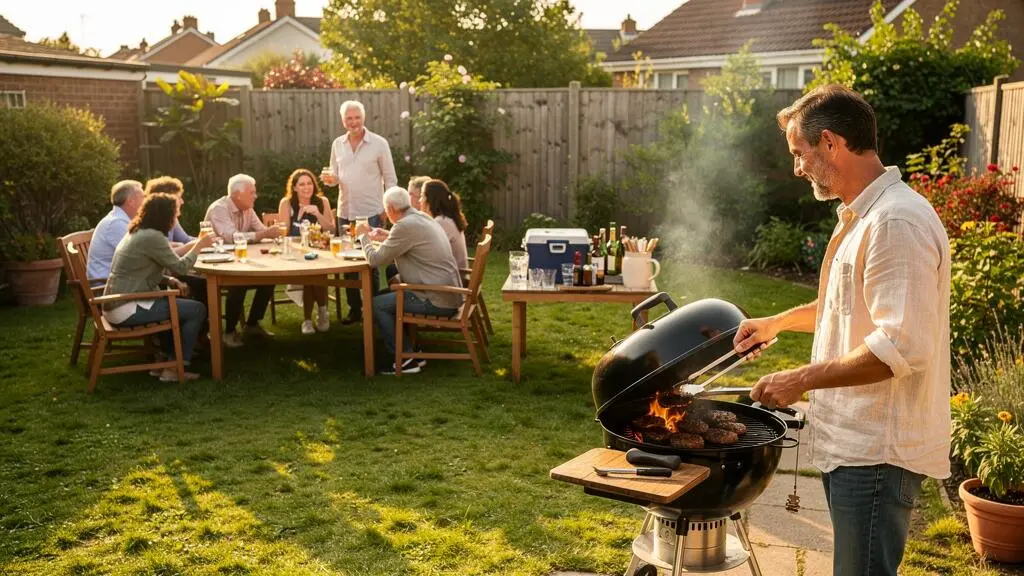
Hosting a barbecue for ten should mean enjoying an afternoon with friends, not spending the entire gathering turning burgers while everyone else catches up. Yet even a modest garden BBQ can become surprisingly demanding when cooking, serving, drinks and guest questions all compete for the host’s attention.
The solution starts before the charcoal is lit. Plan the barbecue around how guests will spend their time, not simply around what you intend to cook. Choose a small number of dishes that genuinely need the grill, prepare everything else in advance, and give guests obvious places to collect drinks, food and cutlery without asking for assistance.
For a typical UK garden, a sensible arrangement is a supervised cooking area, a separate self-service food table and a drinks station near the seating. Combine that layout with batch cooking and a realistic serving schedule, and the afternoon becomes much easier to manage.
The aim is not to eliminate cooking. It is to make cooking one planned part of the gathering rather than the activity that controls the entire day.
How to host a BBQ for 10 without missing the party
- Limit the live cooking. Build the menu around one or two grill-dependent dishes and prepare most sides before guests arrive.
- Separate cooking from socialising. Put drinks, seating and self-service food away from the barbecue so guests can settle in independently.
- Protect a realistic break. Work backwards from serving time, batch your cooking and plan a period when the grill is no longer demanding your attention.
- Why Do You End Up Cooking Non-Stop at a BBQ While Everyone Else Relaxes?
- How to Build a BBQ Menu That Lets You Sit Down for at Least 30 Minutes
- Plated or Self-Serve: Which Works Better in a Small Garden?
- The “Too Many Hot Dishes” Mistake That Makes BBQ Hosting Miserable
- When Should You Set Up Drinks So Guests Stop Hovering Near the Grill?
- How to Build a BBQ Menu That Lets You Sit Down for at Least 30 Minutes
- When Should You Set Up Drinks So Guests Stop Hovering Near the Grill?
- How to Prep for a BBQ So You Don’t Run Inside 12 Times While the Fire Is Lit
Why Do You End Up Cooking Non-Stop at a BBQ While Everyone Else Relaxes?
You end up cooking continuously because your menu requires too many last-minute tasks, guests have no independent place to gather, and you automatically become responsible for every stage of serving. The problem is usually the structure of the barbecue rather than your cooking speed. Changing that structure before guests arrive creates opportunities to leave the grill.
Three arrangements tend to keep a host permanently occupied: several dishes that must come straight off the heat, no prepared drinks or snacks to occupy arriving guests, and an assumption that the person cooking must also assemble plates, fetch condiments and answer every question.
Imagine two hosts preparing essentially the same meal over a two-hour gathering. The first lights the barbecue as guests arrive, starts grilling individual portions and repeatedly interrupts cooking to find drinks, plates and sauces. The second prepares the sides, stocks a drinks station and cooks the main food in planned batches. Both serve a barbecue, but their working afternoons look quite different.
Guest movement can reinforce the problem. A smoking barbecue becomes the obvious centre of attention when the seating area is empty and refreshments have not yet appeared. People gather nearby, ask when the food will be ready and may unintentionally block the cook’s movement between preparation and serving areas.
The simplest first adjustment is to establish a different social centre. Put comfortable seating, ready-to-eat nibbles and drinks where people naturally arrive or settle. Give guests permission to help themselves, rather than making every request pass through the cook.
This also creates a safer circulation pattern. The cooking area should remain clear of unnecessary foot traffic, particularly when children or pets are present. The grill still requires appropriate supervision even when the host is trying to socialise.
Once the barbecue stops being the social headquarters, the next priority is choosing food that does not require you to remain beside it throughout the meal.
How to Build a BBQ Menu That Lets You Sit Down for at Least 30 Minutes
To create a possible 30–minute break, choose one or two dishes that need grilling and surround them with sides prepared before guests arrive. Cook the demanding items in batches, then finish the active cooking before sitting down. Your actual free time depends on grill capacity, preparation and whether the selected foods can be served safely without constant attention.
A useful planning method is to pair every grill-critical dish with one or two dishes requiring no last-minute cooking. For ten people, aim for a menu where most of the components are already finished when the barbecue is lit.
Consider the difference between these categories:
- Grill-critical: burgers, steaks and other items whose appeal depends on being freshly cooked and served hot.
- Prepare-ahead: bread, chopped toppings, prepared dressings, sturdy salads and fully cooked vegetable dishes that are suitable for your intended serving temperature.
- Ready-to-serve: condiments, crisps, pickles and other accompaniments that need little or no work during cooking.
As a practical design target rather than a proven universal rule, make roughly two-thirds of your menu components independent of the grill at serving time. Count the tasks each dish creates, not just the number of dishes. A salad requiring six last-minute additions might still be more troublesome than a simple grilled item.
There is also little advantage in offering four different proteins if your grill comfortably handles only one or two at once. A choice of two proteins, supported by colourful sides, bread and toppings, can feel generous without creating several competing cooking schedules.
To estimate your own potential break, write down the time needed to preheat the barbecue, cook every batch, check doneness and complete any unavoidable final tasks. Compare this with your planned serving time. If a final batch must be cooked halfway through the meal, you do not yet have a protected sit-down period.
Food safety matters when simplifying the menu. FoodSafety.gov’s four-step food-safety guidance recommends refrigeration at 4°C (40°F) or below, hot holding at 60°C (140°F) or above, and prompt refrigeration of perishables. These are US recommendations, not a substitute for applicable UK guidance.
Preparing a dish in advance does not automatically make it safe to leave outside throughout the afternoon. Keep food that requires refrigeration chilled, and bring out manageable portions when guests are ready.
With the cooking workload under control, decide how guests will collect their food without making you responsible for every plate.
Plated or Self-Serve: Which Works Better in a Small Garden?
Self-service usually works better for a barbecue of ten in a small UK garden because guests can collect food without waiting for the host to plate every portion. Plated service is useful when everyone has a proper seat and someone other than the cook can serve. The strongest compromise is often staggered self-service, with prepared sides available first and grilled food added in batches.
A compact garden rarely has space for a cooking queue, a drinks queue and ten people circulating around a central table. The service arrangement should therefore reduce movement instead of creating several competing gathering points.
Plated service provides portion control and a coordinated meal, but it creates a final assembly task. Unless someone else is responsible for serving, the cook may finish grilling only to begin plating.
Self-service transfers much of that work to guests. People can select portions, add their preferred toppings and carry food to a chair or bench without requiring the host to supervise every detail.
The choice becomes clearer when compared against the available space.
| Practical constraint | Plated service | Self-service |
|---|---|---|
| Everyone has a seat at a dining table | Works well with a dedicated server | Also suitable if the serving route is clear |
| Guests eat on benches or with plates on their laps | Requires more coordination | Usually easier to manage |
| Most dishes are ready before serving | Still requires portioning | Guests can serve independently |
| Food must be served immediately after cooking | Useful with someone available to plate | Works when cooked portions are released in controlled batches |
| Limited space around one table | Can reduce queuing if plates are delivered | Needs careful placement to prevent congestion |
For a ten-person gathering, staggered self-service offers a practical middle ground. Place the prepared accompaniments on the serving table before the first batch is finished. Once the grilled food is ready and its safe cooking temperature has been checked, transfer it to the serving area for guests to collect.
Staggering does not mean leaving perishable dishes on an outdoor table indefinitely. Coleslaw and other chilled foods still need appropriate temperature control, especially during warm weather. Keep reserve portions refrigerated or in a suitable cooler until needed.
Finally, divide the garden into separate destinations. A small serving table near the seating and a drinks station elsewhere prevent every guest from converging on one corner. Keep the path between the barbecue and the food table short and unobstructed.
Service becomes easier still when the menu contains fewer foods that must all arrive piping hot at the same moment.
The “Too Many Hot Dishes” Mistake That Makes BBQ Hosting Miserable
Too many hot dishes make barbecue hosting stressful because they all compete for the same final cooking and serving window. Grill space, timing, temperature checks and plating become simultaneous demands. For ten guests, keeping only one or two items dependent on immediate service makes the schedule easier to control and reduces the risk of overcooking earlier batches.
Picture a menu of burgers, sausages, grilled chicken, hot corn, toasted buns and vegetables that must all be served straight from the barbecue. Each item may be straightforward on its own. Together, they create a scheduling problem: different cooking times, limited grill space and several dishes reaching their ideal serving point at different moments.
The final 20 minutes can become particularly demanding. One batch is ready, another still needs cooking, guests begin collecting plates and the host tries to keep the first batch hot without drying it out.
Reduce the number of dishes with a last-minute deadline. Replace freshly grilled corn with a fully prepared vegetable side, offer bread that does not need toasting, and choose salads that are pleasant at their intended serving temperature.
There is an important difference between food that tastes good at room temperature and food that is safe to hold there for an extended period. Cooked vegetables and sturdy salads may suit a short service period, but ingredients, preparation and storage conditions still determine their safety. Dishes containing ingredients requiring refrigeration should remain chilled until serving.
A useful menu audit is to count every item needing the grill, hob or oven during the last 15 minutes before the meal. If the answer exceeds two, reconsider the design. This is a planning heuristic for a ten-person barbecue, not a measured threshold that applies to every grill or menu.
Rather than trying to maintain several cooked batches at an ideal temperature while finishing everything else, simplify the hot-food workload. Cook meat thoroughly, check the appropriate internal temperatures and serve it promptly or use suitable temperature-controlled holding equipment.
Trying to keep every item perfectly hot can also reduce food quality. An early batch of burgers may become dry while the cook finishes chicken, corn and bread. Fewer simultaneous hot dishes make it easier to serve food at its best without rushing.
Once hot-food timing is simplified, guests need an independent way to enjoy the arrival period while the remaining cooking takes place.
When Should You Set Up Drinks So Guests Stop Hovering Near the Grill?
Set up the drinks station completely before the first guest arrives. Include water, glasses, ice and at least one clearly visible alcohol-free choice, and position everything away from the barbecue. Guests who can help themselves have a natural destination other than the cooking area, reducing interruptions while the host prepares the main food.
At the start of a gathering, people look for simple cues about where to stand and what to do. An inviting drinks table beside the seating makes the intended social area obvious. Without one, the grill may become the default meeting point because it is where something is happening.
The first drink should not require the host to stop cooking, search the kitchen for glasses or explain where bottles are stored. A good self-service station makes those answers visible.
For a small garden, prepare a compact table containing:
- A cooler or suitable chilled storage for drinks that need cooling.
- Water and a selection of other drinks, including alcohol-free options.
- Enough accessible glasses or cups for guests to serve themselves.
- Ice managed in a suitable container, with additional supplies kept ready.
- A small space for guests to put down a glass while pouring.
Consider drinks in two phases. During arrival, refreshments help guests settle while the barbecue reaches cooking temperature. During the meal, the station must remain easy to use without requiring the cook to abandon the table or return to the kitchen.
An undersupplied station creates the opposite effect. When glasses disappear, ice runs out or someone needs another bottle from the kitchen, questions return to the person cooking.
Prepare replacements in advance and give one willing guest responsibility for checking supplies if that suits the gathering. This does not require formal hospitality arrangements; it simply prevents the grill operator from becoming the drinks attendant.
With food and drinks organised independently, the next step is building a timeline that protects a genuine period of relaxation.
How to Build a BBQ Menu That Lets You Sit Down for at Least 30 Minutes
A realistic 30-minute break comes from scheduling the cooking backwards from the meal, not simply choosing easy recipes. Complete chopping, sauces, sides and table setup beforehand, then reserve the live-fire period for essential cooking. A protected break becomes possible when all grill-dependent food is finished and the barbecue has been safely dealt with or passed to a responsible supervisor.
Start with the intended serving time and list every remaining job. Mark which tasks can be completed the day before, which fit into the period before cooking begins and which genuinely require active grilling.
Consider a hypothetical barbecue for ten guests with food served at 2:30 pm. The menu includes burgers cooked in two batches, a fully cooked make-ahead vegetarian main kept under appropriate temperature control, and three prepared sides: a potato salad, a dressed vegetable salad and bread.
A workable backwards-planned schedule might look like this:
| When | Main task | What it achieves |
|---|---|---|
| Previous day | Prepare suitable sides, condiments and the make-ahead main; refrigerate as required | Removes most kitchen work from the event |
| 12:30 pm | Set out serving equipment, seating and drinks; keep perishables chilled | Guests can settle without depending on the cook |
| 1:00 pm | Prepare the grill, following its operating instructions | Allows the cooking setup to be ready before service |
| 1:30–2:20 pm | Cook the planned burger batches, check doneness and complete any required safe reheating or holding | Concentrates active cooking into one planned period |
| 2:30 pm | Release food for self-service and safely finish or arrange continued supervision of the grill | Frees the host from plating and routine serving |
| 2:30–3:00 pm | Eat and socialise if no further cooking or safety-critical duties remain | Creates the intended sit-down opportunity |
This is a planning example, not a guaranteed cooking timetable. The actual duration of grilling depends on the equipment, quantities, food thickness and conditions. Adjust the schedule to what your barbecue can safely cook.
Use a simple prep-to-grill ratio as an organisational check: compare the number of tasks completed before lighting the fire with those still requiring attention afterwards. Moving more appropriate tasks earlier reduces the live workload, although the ratio cannot guarantee a particular break length.
Watch for recipes that hide extra jobs. Toasting ten buns, grilling corn individually or assembling every burger on request can quietly turn a manageable meal into a sequence of interruptions. Write these tasks down before deciding that a recipe is convenient.
Be especially careful with advance cooking of meat or poultry. According to USDA FSIS guidance on partially cooking food before grilling, food partially cooked using another heat source should be transferred immediately to a preheated grill to complete cooking. Do not partially cook meat or poultry, refrigerate it and finish cooking it later.
The schedule works only when the menu, equipment and food handling methods support it. Fully prepared dishes, chilled ingredients and properly cooked food are different from unsafe partially cooked items awaiting later grilling.
Once that window is established, the drinks station and garden layout should support it instead of introducing fresh interruptions.
When Should You Set Up Drinks So Guests Stop Hovering Near the Grill?
Set the drinks station away from the grill before guests arrive, check it again immediately before serving food, and plan a final replenishment for later in the afternoon. The station should sit near the garden entrance or seating, where guests naturally gather. This combines convenient access with a clear separation between social activity and the cooking area.
Location matters as much as timing. In a narrow terraced-house garden, a drinks table positioned beside the barbecue may technically be self-service, but it still attracts people directly into the cook’s working space.
Instead, identify the farthest practical gathering point from the grill that guests can reach comfortably. A table beside the seating area, near the garden door or in a sheltered corner often works well. Keep pedestrian routes clear and avoid positioning drinks where people must squeeze past hot equipment.
Organise the station around three deliberate moments:
- Before arrival: put out the complete selection, accessible cups or glasses, water and ice, with additional chilled supplies ready.
- Before the meal: check whether the station has enough water, glasses and drinks to remain usable throughout the main serving period.
- Later in the afternoon: arrange a further top-up so the host does not have to interrupt conversations to collect replacements.
In hot weather, an open table of bottles may quickly become less useful as ice melts and drinks warm up. Use a properly insulated cooler for items that need to stay chilled, and keep the cooler accessible without placing it on the main walking route.
For a relaxed atmosphere, the station should look ready for guests rather than like supplies waiting for a host to distribute them. Visible glasses, water and a recognisable selection of drinks communicate that people can help themselves.
A simple phrase as guests arrive — inviting them to take whatever they prefer — reinforces the layout. The aim is to remove uncertainty, not to impose rules about where everyone should stand.
Separate the refreshments area from the food table whenever the garden layout allows it. Guests collecting a drink should not obstruct people carrying plates, and neither route should pass close to the live barbecue.
With the social spaces established, the final practical safeguard is to make sure everything needed for cooking is already outside before the fire is lit.
Key takeaways before lighting the barbecue
- A simple menu still creates interruptions when essential equipment and ingredients are stored in different places.
- Preparation, cooking and serving should follow a clear route that avoids carrying raw ingredients through the guest area.
- The host’s break must begin only when cooking duties are complete and the grill is safely supervised or shut down as appropriate.
How to Prep for a BBQ So You Don’t Run Inside 12 Times While the Fire Is Lit
Prevent repeated trips indoors by auditing every recipe the day before, collecting equipment into a portable crate and establishing separate preparation, cooking and serving areas. Check the setup before lighting the barbecue, including utensils, seasonings, serving dishes and food-temperature equipment. This reduces avoidable interruptions while helping keep the lit grill properly supervised.
Many forgotten items are small: the second pair of tongs, a serving spoon, salt, foil, kitchen roll or a clean board. Because each item seems minor, it is easy to assume another quick trip inside will solve the problem.
Repeated trips create a cumulative distraction. The cook moves away from the food, guests begin asking for things, and the barbecue risks being left without appropriate attention.
A kitchen audit is more reliable than relying on memory. Read through each recipe and identify everything it requires from preparation to service, including ingredients, clean utensils, protective equipment and equipment needed to check safe cooking temperatures.
Collect non-perishable supplies in a portable crate. Keep raw meat, poultry and other ingredients requiring refrigeration in suitable chilled storage until needed. A crate is an equipment organiser, not a substitute for food-safe storage.
Divide the outdoor setup into three working zones:
- Preparation zone: a stable, clean surface for equipment and ingredients, with separate handling arrangements for raw and ready-to-eat foods.
- Cooking zone: the barbecue and essential cooking tools, positioned clear of guest circulation and combustible hazards.
- Serving zone: a clean food table where guests can collect prepared dishes without entering the cooking area.
In a particularly small garden, these do not have to be three large tables. A narrow preparation surface, a suitably positioned barbecue and a compact serving station can establish the same workflow. Prioritise safety, clear movement and separation of raw and cooked foods over an elaborate layout.
The US Air Force Safety Center’s grilling safety recommendations emphasise keeping grills supervised and establishing a safety zone around the cooking area, particularly where children or pets are present. The specific guidance is American; follow your barbecue manufacturer’s instructions and applicable local fire-safety advice.
Five checks to complete before lighting the barbecue
- Audit every recipe: produce one written list covering ingredients, utensils, cookware, temperature checks and serving equipment.
- Pack the equipment crate: place clean tongs, serving spoons, seasonings, foil, kitchen roll and other non-perishable essentials together; verify each item against the list.
- Stage the three zones: identify a preparation surface, a supervised cooking area and a clean serving station with unobstructed routes between them.
- Check food storage: confirm where raw ingredients, chilled sides and cooked dishes will be safely stored before and during service.
- Complete a doorway check: review the final list before lighting the grill and confirm that the drinks station, serving equipment and essential cooking tools are ready.
Leave the checklist beside the garden door for a final inspection. If something is missing, retrieve it before the grill is operating wherever possible. When another item is needed during cooking, ask a suitable guest to fetch it rather than leaving the live barbecue unattended.
This approach also helps protect food quality. The cook can concentrate on temperature, timing and batch management instead of repeatedly searching for equipment while food remains on the heat.
Before your next BBQ for ten, choose the menu, mark your intended serving time and complete the outdoor equipment check. Make the food and drinks easy for guests to collect, then enjoy the period you have deliberately kept free for sitting down with them.
How many people should help with a BBQ for ten guests?
One person can manage a simple, well-prepared menu, provided the equipment and cooking workload are suitable. Having another willing adult handle drinks, serving or supplies can make the gathering easier. Keep responsibility for supervising the barbecue clear, particularly if tasks are shared.
What should you do if it rains during a UK garden BBQ?
Prepare a sheltered indoor serving and seating alternative, while keeping the barbecue outdoors in a safe, properly ventilated location where its use remains appropriate. Never move a charcoal barbecue into a house, garage, tent or other enclosed space because of carbon monoxide and fire hazards. If conditions make outdoor cooking unsafe, use an indoor cooking method instead.
Can barbecue food stay on a buffet table throughout the afternoon?
Not all barbecue food can safely remain unrefrigerated. FoodSafety.gov’s US guidance recommends refrigerating perishables within two hours, or within one hour when outdoor temperatures exceed 32°C (90°F). The suitability of a buffet arrangement depends on the ingredients, temperature and holding conditions. Keep chilled foods cold, use suitable hot holding where required, and put out smaller portions that can be replenished safely.
Should you start grilling before guests arrive?
Getting the equipment ready before guests arrive can help, but the best cooking start time depends on the menu and planned serving time. Work backwards from when the food will be eaten. Avoid cooking meat far in advance unless you have a safe method for holding it at an appropriate temperature. A protected social break should follow completed cooking, not require leaving an active grill unattended.
How do you accommodate vegetarian guests without adding another cooking session?
Choose a substantial vegetarian main that can be prepared ahead and stored appropriately, then coordinate its serving time with the rest of the meal. Ask guests about dietary requirements before planning. Where necessary, use clean, separate utensils and preparation surfaces to manage cross-contact and prevent raw meat juices reaching vegetarian food.