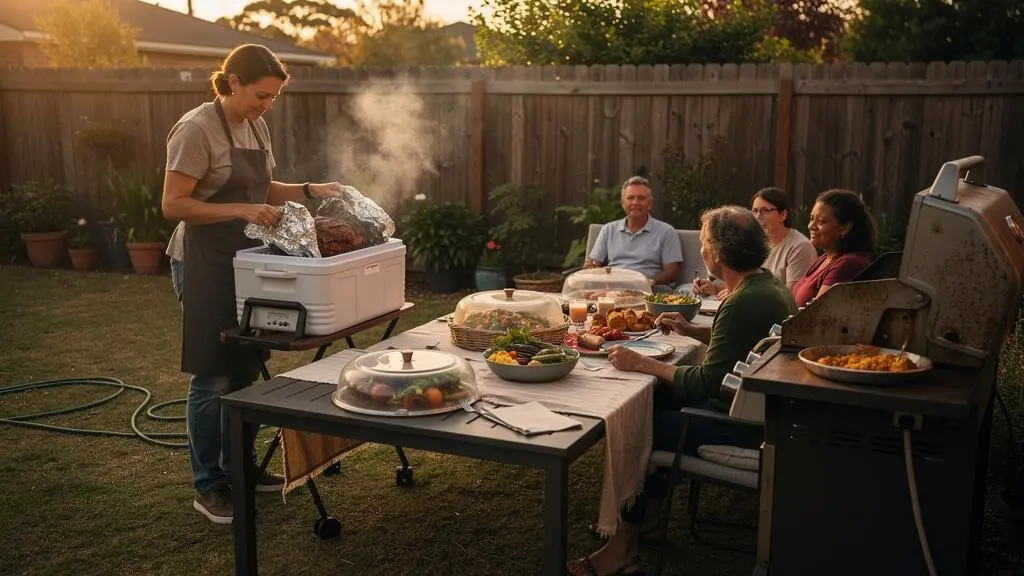
Outdoor meals rarely unfold at exactly the same pace for everyone. Children may need feeding first, some guests arrive late, and others are still chatting when the barbecue is ready. On a cool British evening, a carefully cooked meal can lose its warmth before the last person reaches the table.
The solution is to organise the meal around small serving waves, protected hot holding and well-timed finishing. Instead of putting everything outside at once, keep most of the food in a controlled holding area, bring out only what guests are ready to eat, and finish delicate dishes as close to serving as possible.
That approach protects more than comfort. Cooked food needs suitable temperature control, and methods that preserve heat can sometimes damage texture. Foil can soften crisp skin, insulated boxes cannot generate heat, and a warm-looking platter is no substitute for checking food temperature.
With a clear serving order, practical equipment and a little preparation, guests can enjoy properly hot food without making the host spend the entire evening at the grill.
Outdoor meal service: the essentials
- Keep the main food supply safely hot and bring out smaller portions for each wave rather than exposing the whole meal.
- Match holding methods to food texture: covered containers for moist dishes, gentler ventilation for crisp foods, and active warming when needed.
- Call guests when food is ready to serve, warm the plates beforehand, and coordinate each wave with the grill and the weather.
- Why Does BBQ Food Go Cold So Fast Once It Hits the Outdoor Table?
- How to Keep Food Hot Outdoors Using Foil, Coolers, and Smart Serving Order?
- Platters or Individual Plates: Which Keeps Food Hotter Outdoors?
- The Serve-It-All-At-Once Mistake That Ruins Texture Outdoors
- When Should You Call Everyone to the Table So the Meal Lands at Its Peak?
- How to Keep Food Hot Outdoors Using Foil, Coolers, and Smart Serving Order?
- When Should You Add Blankets or a Heat Source So Guests Stay Out Longer?
- How to Run a Backyard Barbecue for 10 People Without Feeling Stuck at the Grill All Day
Why Does BBQ Food Go Cold So Fast Once It Hits the Outdoor Table?
Barbecue food cools quickly outdoors because heat escapes through contact with cold plates, moving air and evaporation. Wind continually replaces the warm air surrounding the food, while steam carries heat away from exposed surfaces. Small portions and thin slices are particularly vulnerable. When guests eat at different times, these effects compound with every minute the food spends waiting.
Three mechanisms explain why a hot dish can become disappointing surprisingly quickly:
- Conduction: heat transfers from food into a colder plate, metal tray or serving utensil. A heavy, unheated ceramic platter can absorb considerable heat when food first touches it.
- Convection: cooler moving air removes warmth from exposed surfaces. A breezy patio can therefore be more challenging than a sheltered dining area at a similar temperature.
- Evaporation: moisture escaping as vapour removes heat. Wind encourages evaporation, particularly from uncovered meats, sauces and vegetables.
Humidity influences evaporation too: drier moving air generally encourages moisture loss, while high humidity can reduce evaporation under otherwise similar conditions. Neither factor should be used alone to estimate how safely food is being held.
Surface temperature and internal temperature also tell different stories. Crisp chicken skin may soften from trapped steam while the meat remains hot inside. Conversely, a thin slice may lose its appealing surface warmth rapidly even when it has only recently been cut from a larger joint.
The distinction matters because pleasantly warm food is not necessarily safely held food.
140°F / approximately 60°C
The USDA’s recommended minimum hot-holding temperature for buffet food. For a UK household, keeping hot-held food above 63°C provides a more appropriate local benchmark.
USDA household buffet advice also sets a maximum of two hours for perishable food left without suitable temperature control, reduced to one hour when outdoor temperatures exceed 90°F (approximately 32°C). Those are US consumer guidelines, not permission to leave food unrefrigerated until the limit expires under every circumstance. UK hosts should follow applicable Food Standards Agency guidance, including its rules for hot holding and food left outside temperature control.
In wave-based service, the problem is cumulative. A platter placed outside for the first guests continues losing heat while everyone else arrives, collects drinks or finishes conversations. Replenishing from a safely held reserve works better than leaving the same platter on the table throughout the meal.
Once exposure time, wind and serving surfaces are recognised as the main variables, keeping food hot becomes a matter of choosing the right holding method rather than simply cooking everything later.
How to Keep Food Hot Outdoors Using Foil, Coolers, and Smart Serving Order?
To keep food hot outdoors, use foil selectively, hold suitable dishes in monitored insulated containers, and serve only the portions needed for each group of guests. Whole cuts of meat retain heat better than the same meat already sliced. For extended service, use proper warming equipment and a thermometer rather than relying on insulation alone.
Each warming tool has a different job. Aluminium foil can reduce heat loss and retain moisture, but tightly wrapped crisp foods quickly become steamy. An insulated cooler slows cooling without actively heating food. A chafing dish, suitable warming tray or temperature-controlled appliance can provide ongoing heat, provided it maintains a safe food temperature.
Choose equipment according to what is being served:
| Food | Preferred approach | What to avoid |
|---|---|---|
| Large joints and pulled meat | Covered, monitored insulated holding or suitable active warming | Slicing everything before guests arrive |
| Braised dishes and stews | Covered, temperature-controlled hot holding | Leaving shallow uncovered portions outside |
| Roast vegetables and potatoes | Small heated batches with limited waiting time | Long holding that dries or softens the exterior |
| Crisp chicken skin and grilled foods | Short holding, with ventilation where texture needs protection | Tight foil wrapping that traps condensation |
| Hot sauces and gravy | Covered food-safe vessels with suitable temperature control | Open containers exposed to wind and cooling |
For a temporary insulated holding box, preheat a clean, food-safe cooler with hot water, empty and dry it carefully, then place appropriately covered hot food inside. Use a thermometer to check the food itself. An insulated cooler is not a replacement for active warming when safe temperatures cannot be maintained.
The double-buffer method creates two distinct areas: a protected reserve where cooked food remains safely hot, and a smaller serving area where guests collect portions. Keep large pieces intact until they reach the serving station. Slice only what the next group needs, then return the remaining protected food to appropriate hot holding.
This rotation prevents the first guests from determining the quality of every subsequent plate. It also keeps the outdoor table clearer and reduces repeated handling of the main food supply.
Specialist barbecue guidance offers a useful example. AmazingRibs’ outdoor barbecue turkey instructions describe insulated holding as a way to accommodate cooking uncertainty, while warning that it can soften turkey skin and that temperatures still need monitoring.
For anything crisp, a loose cover or a brief uncovered rest in a protected, suitably controlled holding environment may preserve texture better than a tight wrap. However, ventilation must never come at the expense of safe hot holding.
With the reserve protected, the next decision is how to transfer heat efficiently onto guests’ plates without sacrificing the relaxed atmosphere of an outdoor meal.
Platters or Individual Plates: Which Keeps Food Hotter Outdoors?
Large covered platters generally offer better heat retention than individually plated small portions, provided they remain protected and are served promptly. However, a platter left uncovered outside can lose heat rapidly. The most practical arrangement is often hybrid: keep the main food in covered serving vessels and use warmed individual plates as each wave arrives.
The important variables are exposed surface area, portion size, container temperature, handling and distance from the heat source.
A collection of small portions spreads the meal across more surfaces. Each portion has relatively little thermal mass, while the food is repeatedly exposed during plating and movement between grill and table. A larger covered serving vessel can limit those losses, although its performance depends on its shape, contents and exposure.
Cold crockery can undo some of that work immediately. A thick ceramic plate that has been sitting outside draws heat from freshly cooked food as soon as it touches the surface.
Preheat suitable plates safely using warm water or a manufacturer-approved warming method, then dry them before use. Avoid placing ordinary ceramic, glass or plastic plates near an open flame or on hot grill surfaces unless they are specifically designed for that treatment. Sudden temperature changes can crack unsuitable crockery.
For most informal garden meals, the comparison looks like this:
| Criterion | Covered shared platters | Individual plates |
|---|---|---|
| Heat retention | Often better while covered and held together | More sensitive to small portions and cold plates |
| Serving speed | Guests can help themselves simultaneously | Requires someone to portion each serving |
| Portion control | Less predictable | Easier to match each guest’s needs |
| Food exposure | Increases when platters remain on the table | Can be minimised by plating immediately before eating |
| Best application | Hot sides and shared dishes for the current wave | Freshly sliced meats and delicate finishes |
Consider a hypothetical garden barbecue with guests eating in two groups. Rather than filling every plate before anyone sits down, the host could place one small covered serving dish on the table, slice meat for the first group and leave the remaining portions safely hot at the holding station. The second group would receive fresh portions on newly warmed plates.
The choice is therefore not simply between relaxed communal dining and formal plated service. It is about where the food waits and when it becomes exposed.
Even a well-chosen serving format will struggle if every dish arrives at the same moment. The next improvement is to arrange the menu around how different foods tolerate waiting.
The Serve-It-All-At-Once Mistake That Ruins Texture Outdoors
Putting every dish on the outdoor table at once makes texture deteriorate before guests finish eating. Crisp foods absorb trapped moisture, uncovered sides dry out, and hot sauces can thicken or develop a skin. Holding food at a safe temperature does not guarantee that it will retain its original quality. Serve resilient dishes first and finish fragile items in smaller batches.
Heat preservation and texture preservation are related but different objectives. A large braised joint can remain tender in moist, controlled hot holding. Freshly crisped potatoes are less forgiving: steam can soften their surfaces even when the centres stay warm.
The same principle applies to grilled chicken skin, fried foods and delicate vegetables. Sealing them tightly after cooking creates a humid environment. That may help retain moisture in the flesh but works against the crisp surface that makes the dish enjoyable.
Other texture problems arise from the opposite conditions. Uncovered rice or vegetables may dry out in a breeze, while gravy held too long in an open container can lose moisture and thicken.
For a smoother meal, rank dishes by their tolerance to waiting:
- Most tolerant: moist braised meats, stews and other dishes designed for suitable covered hot holding.
- Moderately tolerant: large roasted joints that can rest appropriately before being carved and served.
- Less tolerant: grilled vegetables, sliced meats and cooked sides that dry out or lose their preferred consistency.
- Most fragile: crisp-skinned poultry, chips, fried foods and freshly grilled items intended to be eaten immediately.
This is a practical quality ranking, not a separate set of food-safety rules. Every perishable dish still needs safe time and temperature control.
A sequenced serving method solves much of this. Start with the robust dishes that can wait safely under controlled conditions. Bring out the first small batch of sides, then finish and serve crisp items immediately before the current guests eat.
A second batch of crisp food can be cooked or finished when the next wave is nearly ready, rather than held beside the grill throughout the evening.
Be careful with the opposite mistake: assuming that more heat always improves holding. Leaving cooked meat close to intense radiant heat can continue cooking it, evaporate moisture and dry its surface.
The aim is stable, appropriate hot holding, not continual exposure to the hottest part of the cooking area.
Sequencing only works when guests arrive at the table at the right moment. The timing of the invitation is therefore as important as the timing of the cooking.
When Should You Call Everyone to the Table So the Meal Lands at Its Peak?
Call guests to the table when the food is ready for immediate service, not simply when the clock reaches a planned mealtime. The meat should have completed its necessary cooking and resting, the sides should be ready or safely held, and the table should already be prepared. For staggered meals, invite each group shortly before its portion is served.
A fixed announcement can create unnecessary waiting. Guests may gather around cold plates while meat is still being carved, or sit outside in a chilly breeze while the final vegetables cook.
Instead, use a reverse timeline built around the food.
First, decide which guests are likely to eat together. Families with younger children may form an earlier wave, while adults who prefer a slower evening can follow. Identify any dietary requirements in advance so a later guest is not left with an unsuitable reheated portion.
Next, work backwards from the intended serving moment. Allow for cooking, thermometer checks, required resting, transferring, carving and plating. The resting period for a large joint can overlap with guests collecting drinks and making their way to the table, provided the food remains safely managed.
Do not confuse resting with extended hot holding. Resting serves a cooking and quality purpose; a lengthy delay between waves may require properly controlled warming. A foil wrap or insulated box cannot establish safety without temperature checks.
Five checks before calling the next serving wave
- Confirm who is eating next and record the number of portions required for that wave.
- Check the cooked food with a suitable thermometer and note whether safe hot holding is maintained.
- Prepare the table with clean, suitably warmed plates, cutlery and seating ready for the incoming group.
- Confirm that sides, sauces and the next meat portion can reach the table without an avoidable delay.
- Give guests a clear invitation only when service can begin, with one designated person ready to carry or portion food.
Weather changes the rhythm too. If the temperature drops around sunset, guests may be more comfortable remaining in a sheltered social area until their food is nearly ready. In a breeze, shortening the time between the grill and the plate becomes particularly valuable.
For a large cut, the host can carve the first portions as guests settle, keeping the remainder protected until needed. Smaller foods may be better finished in separate batches.
Once that timing is established, the next challenge is arranging the serving station so every wave can move from hot food to the table efficiently.
How to Keep Food Hot Outdoors Using Foil, Coolers, and Smart Serving Order?
For a meal served in several waves, organise the serving order around a protected hot reserve, a compact distribution station and quick delivery to the table. Keep larger pieces intact until needed, replenish sides in small quantities, and add hot sauces at the end of the serving line. Combine passive insulation with active warming where necessary, checking temperatures throughout.
The key difference between storing food and serving it is exposure. A covered joint in appropriate holding conditions is protected while it waits. Once that joint has been sliced onto an uncovered tray, more surface is exposed to cooler outdoor air.
Build the serving route in this order:
- Protected reserve: keep the main supply in suitable hot-holding equipment or a monitored insulated container for short-term use.
- Carving and portioning point: slice meat close to the moment it will be eaten, using clean utensils and a stable work surface.
- Side-dish station: provide only the amount needed by the current wave and replenish from safely held supplies.
- Final sauce station: add appropriately heated gravy or sauce immediately before the plate leaves the serving area.
- Dining table: keep the final transfer short and use warmed plates where suitable.
Large volumes need particular attention. A broad, shallow vessel exposes more food surface than a deeper container of comparable capacity. Deep, covered food-safe containers can therefore be useful for certain moist foods, although the food’s actual holding temperature still determines whether the arrangement is appropriate.
Passive and active systems serve separate functions. An insulated cooler delays heat loss; it does not replace heat that has escaped. A thermostatically controlled warmer or properly operated chafing dish can supply heat during service, subject to its operating requirements and temperature checks.
University extension guidance provides a practical grilling example. North Dakota State University Extension‘s grilling safety fact sheet recommends keeping cooked meat hot away from direct coals rather than leaving it over intense heat. Its advice also emphasises food thermometer use and clean utensils for cooked food.
Before an important gathering, conduct a simple test of the grill-to-table route. Use an appropriate sample dish, check its temperature at the serving point, complete the normal transfer, and check again on arrival. Observe any quality changes as well.
This test does not establish a universal safe holding time. It reveals practical issues such as unnecessary carrying distance, cold containers, awkward carving space or long delays before food reaches guests.
One person should be responsible for deciding whether a holding method remains suitable. If hot food cannot be maintained at a safe temperature, switch to a properly controlled method or manage it according to applicable food-safety time limits rather than repeatedly returning exposed food to the reserve.
The serving route should also account for the people using it. When guests are cold or uncomfortable, even an efficient food station can struggle to maintain a relaxed dining rhythm.
When Should You Add Blankets or a Heat Source So Guests Stay Out Longer?
Add blankets or suitable outdoor heating when guests begin showing signs of discomfort, especially as wind picks up, moisture increases or daylight fades. Do not rely on a single outdoor temperature reading. Cold hands, guests keeping their coats tightly closed and people repeatedly moving indoors are more useful signals that the seating area needs attention.
For a British garden meal, comfort planning often matters even when the weather forecast looks reasonably mild. A sheltered table on a dry evening can feel very different from an exposed table with persistent wind.
Start with low-complexity measures: move seating away from draughts, offer dry blankets and cushions, and provide a sheltered place where guests can wait between courses. Keeping blankets separate from the serving area also prevents loose fabric from interfering with hot equipment.
If additional heating is appropriate, choose equipment designed for the intended outdoor environment. A patio heater may help a stationary group remain comfortable, while a fire pit can create a separate gathering area away from the dining and food-preparation stations.
There are useful practical signals for making that decision:
- Guests consistently keep heavy outer layers on or leave their seats to find shelter.
- Wind repeatedly disturbs napkins, light tableware or uncovered serving dishes.
- The dining area feels noticeably colder after sunset or when damp conditions develop.
- Guests are cutting their meals short or retreating indoors between serving waves.
Comfort improvements can have an indirect effect on food service. A better-sheltered dining area may reduce wind exposure around plates and serving dishes, although it cannot substitute for properly maintained food temperatures. Outdoor heaters should never be treated as food-holding equipment.
Safety matters more than convenience when adding heat near guests, furniture and textiles.
The NFPA outdoor heater safety fact sheet recommends keeping combustible materials at least three feet (approximately one metre) from heating equipment and switching portable heaters off when areas are unoccupied. The document references US fire-code provisions, so it should not be treated as a complete statement of UK legal requirements.
For home use, follow the appliance manufacturer’s clearance, fuel and ventilation instructions, keep heaters stable, and protect electric equipment from unsuitable weather exposure. Never use outdoor combustion heaters or grills inside enclosed tents, garages or similar spaces because of fire and carbon monoxide hazards.
Position blankets, chairs and pedestrian routes so that guests cannot accidentally bring combustible materials close to a heat source.
Once the seating area is comfortable and the food route is organised, the final task is managing the host’s time so the evening does not become a continuous cooking shift.
Key takeaways before hosting
- Choose a menu with a substantial make-ahead component and only a few foods that require last-minute grilling.
- Assign responsibility for carrying dishes, checking table readiness and announcing each serving wave.
- Keep the grill, hot-holding area and dining table connected by a simple route so the host can supervise service without constantly leaving the cooking station.
How to Run a Backyard Barbecue for 10 People Without Feeling Stuck at the Grill All Day
To host a barbecue for ten without spending the entire meal at the grill, prepare most ingredients in advance, choose dishes that tolerate suitable hot holding, and reserve live grilling for a few quick finishes. Organise guests into manageable serving waves, delegate food transfers and make drinks self-service. The host then coordinates the meal rather than cooking every plate from scratch.
Start with the menu. A large joint, a moist cooked main dish or other food suitable for controlled holding can form the foundation. Prepare cold sides in advance and keep them refrigerated until needed. Add a small selection of freshly grilled vegetables, skewers or other quick-cooking items for the moments when guests are ready to eat.
For example, a hypothetical ten-person barbecue could use two waves of five guests. The precise timing would depend on the menu, cooking method and guests’ needs, but the operating structure could follow this sequence:
| Stage | Host’s priority | Delegated or prepared activity |
|---|---|---|
| Before guests arrive | Complete ingredient preparation and check cooking equipment | Set up drinks, seating, clean utensils and tableware |
| Before the first wave | Finish the main food and establish appropriate holding conditions | Prepare warmed plates and the first serving dishes |
| First serving wave | Carve or finish only the portions required | Carry food, organise sides and seat the first group |
| Between waves | Check holding temperatures and prepare the next fresh batch | Clear used crockery and refresh the serving station |
| Second serving wave | Finish delicate items and portion the remaining safely held food | Deliver plates and distribute hot sauces |
Build the actual timeline backwards from when each group intends to eat. Allocate time for every cooking stage, any required resting, food temperature checks, transfers and plating. Avoid assuming an untested cooking time will be accurate regardless of wind, grill temperature or the thickness of the food.
Delegation makes the difference. One helper can carry dishes and organise the table while the host handles food temperatures and grilling. Another can manage drinks and clear plates. Neither role needs to be complicated, but everyone should know which task they own.
Arrange three zones: cooking and safe hot holding, clean serving and plating, and guest dining. Keep raw-food equipment separate from cooked-food utensils and serving surfaces. Place the drinks station away from the grill so guests do not interrupt the cook whenever they need a refill.
The host should also have a clear way to trigger each wave. A short invitation when food is genuinely ready is better than repeatedly announcing that everything will be ready soon.
Where a guest needs an earlier meal or a different dish, plan that portion deliberately rather than treating it as an interruption. The aim is not to make everyone eat simultaneously but to give each person an appropriately timed meal.
Before the next barbecue, write down the serving waves, assign one food-running helper and test the distance from the holding station to the table. Those small decisions make it easier to serve ten people comfortably while still enjoying the occasion.
Can an ordinary insulated picnic cooler keep cooked meat safely hot?
An insulated cooler can slow heat loss but cannot actively maintain a set temperature. Preheating a clean, food-safe cooler may improve its performance, but only thermometer checks establish whether the food remains within safe hot-holding conditions. Do not assume that a closed lid guarantees safety for a particular length of time.
Should freshly grilled meat be wrapped tightly in aluminium foil?
It depends on the food. Foil can help retain moisture and limit cooling, especially for suitable large cuts, but a tight seal also traps steam. For crisp-skinned poultry and grilled foods with delicate crusts, less restrictive covering and shorter holding may better preserve texture. Safe temperature management remains essential.
What should happen to leftover barbecue food between serving waves?
Keep the untouched reserve under suitable hot or cold temperature control rather than leaving it on the outdoor table. Do not repeatedly mix exposed serving leftovers with protected food. If food will not be served promptly, cool it safely and refrigerate it according to applicable food-safety guidance, rather than allowing it to remain lukewarm.
Are disposable plates a good choice for hot outdoor food?
Disposable plates are convenient, but many are unsuitable for preheating and offer little thermal mass. Use products designed for hot food, serve portions immediately before eating, and avoid placing hot cookware directly on heat-sensitive materials. Suitable reusable plates can be warmed more effectively when their manufacturer permits it.
What if the weather becomes too cold or windy for comfortable outdoor dining?
Move guests to a sheltered or indoor eating area if comfort or equipment safety deteriorates. Hot-holding equipment can remain in a suitable protected location while food is served in small portions. Moving the meal indoors is preferable to using unsafe heaters or leaving food exposed while guests struggle with the conditions.