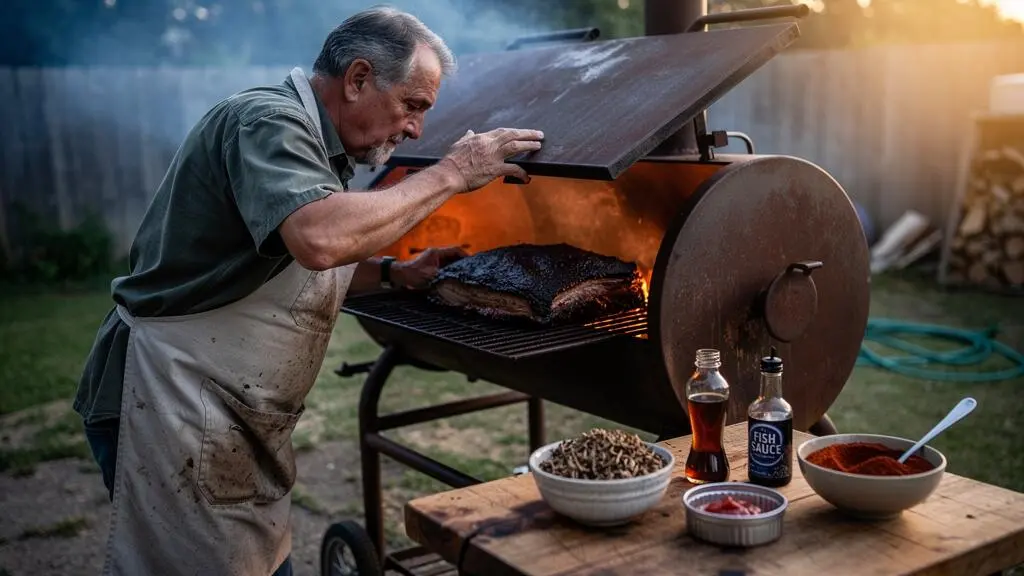
A brisket can spend hours in a smoker, emerge with a beautiful dark crust and fill the backyard with irresistible aromas—yet taste surprisingly flat when sliced. The missing element is often not smoke, salt or spice. It is savoury depth.
To add umami to barbecue without heavy sauces, start with ingredients that naturally contain free glutamate or complementary savoury compounds. Ground dried mushrooms, tomato products and fermented seasonings can enhance the meat’s existing flavour. The technique matters just as much: distribute these ingredients carefully, account for their sodium content and avoid letting the bark become a concentrated layer of salt.
Unlike a thick glaze, a well-designed savoury rub allows the texture of smoked beef, pork or poultry to remain the focus. A restrained finishing layer can then restore complexity that might otherwise disappear beneath smoke and prolonged heat.
The goal is not to make meat taste like a seasoning product. It is to make every bite taste more distinctly like the meat itself.
Better Barbecue Umami at a Glance
- Combine complementary savoury ingredients, such as dried mushrooms and tomato, instead of simply increasing salt or smoke.
- Divide seasoning into an early foundational layer and a restrained finishing layer, using one total salt budget.
- Match seasoning intensity to smoke intensity, and taste the bark separately before adding anything else.
- Why Can Smoked Meat Taste Flat Even When It Smells Amazing?
- How to Add Umami With 3 Pantry Ingredients Without Making Meat Taste « Processed »?
- Worcestershire or Soy Sauce: Which Adds Better Umami on Beef Over 8 Hours?
- The Late-Seasoning Mistake That Makes Umami Taste Salty Instead of Deep
- How to Pair Wood Choice With Umami Seasoning so Flavour Doesn’t Get Lost?
- How to Layer Savoury Seasoning in 2 Stages Without Overdoing Salt?
- How to Build a Savoury Seasoning Crust That Doesn’t Taste Over-Salted After 8 Hours?
- Bringing It Together: Your Umami Barbecue Game Plan
Why Can Smoked Meat Taste Flat Even When It Smells Amazing?
Smoked meat can smell extraordinary but taste flat because smoky aroma and umami are different sensory experiences. Smoke contributes aromatic compounds detected primarily through smell, while savoury depth depends partly on taste-active substances such as free glutamate and certain nucleotides. An intensely smoky brisket therefore does not necessarily deliver an equally rich savoury taste.
The distinction becomes clear when considering guaiacol, one of the compounds associated with characteristic smoky aromas. Research on the chemical compounds responsible for smoky aroma identifies its importance in traditional smoked products. That research concerns aroma chemistry, however, not an ideal seasoning formula or a demonstrated relationship between smoking duration and umami loss.
Umami operates through another mechanism. Glutamate and nucleotides such as inosinate and guanylate interact with taste receptors. A scientific review of umami taste receptors and synergy describes how certain combinations can produce responses greater than their individual components would suggest.
That interaction helps explain why layering different savoury ingredients can be more effective than repeatedly adding the same seasoning. It does not mean that every combination will taste better, or that a measured laboratory response translates directly into a barbecue flavour rating.
Long smoking introduces another challenge. Meat loses moisture, fat renders and surface seasonings become incorporated into an increasingly dry crust. Some seasoning leaves with drippings, while ingredients remaining near the surface can become more concentrated. A rub that tastes balanced before cooking may therefore produce an uneven final result: salty bark surrounding comparatively mild interior meat.
Diagnose the flavour before changing the rub. Taste a small, safely cooked slice after it has cooled enough to reveal its seasoning clearly. Ask three questions:
- Is there enough salt? If not, the meat may simply be underseasoned.
- Is there savoury depth behind the salt? A salty first impression followed by little lingering flavour suggests that more salt is not the answer.
- Is the balance of fat and acidity right? Rich meat can feel heavy without contrast, while very lean meat may seem dry and subdued.
Fat also shapes the eating experience. Marbling, rendered fat and juiciness influence how flavours and aromas are delivered during chewing. This is not evidence that glutamate simply binds to fat, or that fatty meat automatically has more umami. Instead, a juicy, well-rendered cut often provides a more satisfying sensory setting for savoury seasoning.
Once salt, moisture and smoke have been assessed separately, it becomes easier to choose ingredients that solve the actual flavour problem rather than disguising it.
How to Add Umami With 3 Pantry Ingredients Without Making Meat Taste « Processed »?
Three practical pantry ingredients can deepen barbecue flavour without making meat taste heavily seasoned: ground dried mushrooms, tomato powder or paste, and fish sauce. Mushrooms can contribute glutamate and, depending on the variety and preparation, guanylate; tomatoes supply natural free glutamate; fish sauce adds fermented savoury character. The key is restrained dosing and even distribution.
These ingredients work differently, which makes them useful as complementary tools rather than interchangeable substitutes. Scientific literature documents the presence of naturally occurring free glutamate in tomatoes, mushrooms, fish sauce and other everyday foods. A scientific review of naturally occurring glutamate in foods explains the distinction between free glutamate and glutamate bound within food proteins.
Free glutamate contributes directly to umami perception. Certain nucleotides can enhance that response, although their levels vary between ingredients and preparations.
Dried mushrooms are particularly convenient for dry rubs. Grind them finely so they disperse through pepper, salt and other spices rather than forming concentrated patches. Dried shiitake is an interesting option because of its association with guanylate, but not all mushroom powders have identical chemical compositions or flavour intensities.
Tomato powder adds a savoury, gently acidic impression without the moisture of tomato paste. Paste can be useful when blended thinly into a binder, although thick patches may create uneven colour and texture. Neither format needs to contribute noticeable tomato flavour to be useful.
Fish sauce provides fermented depth, but its sodium content requires particular attention. It works best as a measured component of the total seasoning, not as an unrestricted extra splash over an already salted surface.
A processed or ham-like impression can arise when the surface seasoning becomes excessively salty or concentrated. That result should not be attributed to fish sauce or other fermented ingredients alone. Actual curing effects depend on ingredients, concentration, time and processing conditions.
For an exploratory dosing method, begin with the salt quantity planned for the entire cook. Consider a hypothetical trial using a salt-to-mushroom-powder mass ratio of 4:1, with a smaller tomato contribution. Treat this solely as a starting point for sensory testing, not a scientifically established optimum. Fish sauce must be evaluated separately because its salt concentration depends on the product.
Record the ingredient weights, cook conditions and tasting result. On the next cook, adjust only one ingredient. This reveals much more than adding several new seasonings simultaneously.
Finally, consider bark development. Mushroom and tomato powders contribute pigments and solids that can change the colour of the crust. Tomato-derived sugars and other compounds may also react during heating. A darkened bark is not automatically burnt, but harsh bitterness or scorching suggests the formulation or surface temperature needs adjustment.
Dry ingredients make the foundational layer easier to control. Liquid seasonings are another option, but they require a closer look at sodium, acidity and how the surface changes during a long cook.
Worcestershire or Soy Sauce: Which Adds Better Umami on Beef Over 8 Hours?
Neither Worcestershire nor soy sauce is universally better for beef smoked over eight hours. Soy sauce typically brings a direct fermented, salty umami profile, while Worcestershire can add acidity, sweetness and a more complex blend of seasonings. The better choice depends on the beef cut, the existing rub, the specific product and whether the liquid is applied early or late.
These sauces should be compared by their actual ingredients, not by their names alone. Soy sauce is produced through fermentation and can contain substantial free glutamate alongside sodium. Worcestershire formulations vary considerably. Some feature anchovies and tamarind; others use different blends of vinegar, sweeteners and fermented ingredients.
For example, Heinz Worcestershire sauce ingredient and nutrition information lists vinegar, molasses, soy sauce and anchovies among the ingredients of one US formulation. It reports sodium per serving 55 mg per 5 mL serving and does not declare tamarind. Those figures describe that particular product, not every Worcestershire sauce available internationally.
During a long smoke, surface moisture evaporates and the remaining seasoning becomes more concentrated locally. The degree of concentration depends on dripping, surface drying, ingredient placement and whether the seasoning remains attached. There is no established eight-hour threshold at which either sauce becomes inferior.
Use the following decision grid to choose an approach rather than a universal winner.
| Cooking consideration | Soy sauce | Worcestershire sauce |
|---|---|---|
| Primary flavour direction | Fermented savouriness and salt | Savoury notes with acidity, sweetness and spice complexity |
| Fatty brisket or chuck | Useful when controlled salt and straightforward savouriness are wanted | Useful when rich beef needs a sharper, more layered counterpoint |
| Lean beef | Use cautiously to avoid a strongly salty surface | Use cautiously; acidity and sweetness may stand out more clearly |
| Bark formation | Concentrated application may increase surface saltiness | Sweeteners and other solids can affect colour and surface reactions |
| Late finishing | Dilute or blend into unsalted juices | Use a light touch to avoid overwhelming the meat with acidity |
A practical third option is to use a small quantity of liquid as a carrier for dry umami ingredients. Instead of coating the brisket with soy sauce, mix a measured amount into an otherwise lightly salted binder and apply a thin film. Add finely ground mushrooms through the dry rub.
This approach separates the work: the liquid helps distribute seasoning, while the mushroom powder supplies another savoury component. It does not eliminate sodium, so the liquid still belongs in the overall salt calculation.
Alternatively, reserve the liquid for after slicing. Blend a few drops into unsalted meat juices or rendered fat, taste the mixture, then apply it only if the meat needs additional depth.
The next decision is when to add flavour. Even a well-chosen sauce can disappoint when applied on top of an already complete seasoning layer.
The Late-Seasoning Mistake That Makes Umami Taste Salty Instead of Deep
The common late-seasoning mistake is adding salty umami ingredients after the meat’s surface has already concentrated its original seasoning. Soy sauce, fish sauce or another savoury liquid may seem like an easy finishing boost, but when layered onto fully salted bark, the first bite can register predominantly as salt rather than deeper meat flavour.
Salt and umami interact in perception, but that relationship is not a licence to increase both indefinitely. Moderate salt can make savoury food more satisfying; excessive salt can dominate the balance. A strong umami ingredient may also contribute its own sodium, making the problem harder to recognise before tasting.
Consider the difference between early salt and late salt.
Early salt can dissolve in surface moisture and redistribute through some of the meat over time. The extent depends on the cut, thickness, temperature, concentration and duration. Large glutamate-rich molecules and seasoning mixtures should not be assumed to penetrate at the same rate or depth as salt.
Late salt, especially from a finishing dust or concentrated liquid, remains more prominent at the eating surface unless enough moisture and time allow it to redistribute. That surface is precisely what reaches the tongue first.
Two useful warning signs are a rub that tastes overwhelmingly salty even before cooking and bark containing obvious accumulations of salt crystals. Neither is a reliable laboratory measurement, but both justify checking the formulation before adding more seasoning.
At a safe tasting point, compare the bark with a slice containing both crust and interior meat. If the bark is already aggressive while the centre tastes mild, adding another salty finish will usually amplify the contrast rather than solve it.
Once a bark is over-salted, there is no reliable way to remove all the absorbed salt. Instead, adjust the experience around it. Serve thinner bark portions with unsalted meat juices, rendered fat where appropriate, or a low-sodium acidic accompaniment. Acidity can provide contrast, but it does not chemically neutralise sodium.
A particularly salty crust can also be trimmed selectively when necessary. That sacrifices some bark but may produce a better overall plate than covering the problem with more sauce.
Once that balance is under control, smoke intensity becomes the next major variable. Even carefully layered savoury ingredients can disappear beneath an overpowering aromatic profile.
How to Pair Wood Choice With Umami Seasoning so Flavour Doesn’t Get Lost?
Pair wood and umami seasoning by balancing their sensory intensity rather than following a rigid wood chart. Mild, clean smoke makes subtle mushroom and fermented notes easier to notice, while stronger smoke may require a more assertive savoury foundation. Wood species matter, but combustion quality, airflow, smoke exposure and personal preference matter just as much.
Smoke introduces powerful aromatic compounds that can dominate the flavour experience. The chemical research discussed earlier identifies phenolic compounds among the contributors to smoky aromas, but it does not establish a universal ranking of smoking woods or prove that a particular wood suppresses a particular umami ingredient.
For practical cooking, begin by classifying the intended result as delicate, balanced or smoke-forward.
- Delicate: Use restrained smoke exposure and clean combustion when the goal is to showcase natural beef flavour, mushrooms or subtle fermented notes.
- Balanced: Build a modest umami base and allow smoke to provide an identifiable but secondary aromatic layer.
- Smoke-forward: Choose a more robust savoury profile without automatically adding more salt. Pepper, unsalted aromatics and carefully measured mushroom powder can provide flavour complexity.
Woods such as apple or cherry are often selected for gentler smoking styles, while hickory and oak are commonly associated with stronger barbecue profiles. These are culinary starting points, not guaranteed sensory rankings. The amount of wood, smoker design and combustion conditions can change the experience substantially.
Clean combustion is especially important. Excessive smouldering and poor airflow can produce harsh smoke character that distracts from the meat. More smoke is not necessarily more flavour in a positive sense.
Timing also changes the result. Seasoning before cooking creates an integrated surface layer that develops alongside the bark. Applying a savoury finish after cooking preserves more of the finishing ingredient’s original aroma and character, particularly when it contains delicate volatile compounds.
However, the simple rule that smoke deposits only early and seasoning penetrates continuously is too absolute. Smoke deposition depends on ongoing exposure and surface conditions, while seasoning movement depends on time, moisture and the specific compounds involved.
Very light smoking introduces the opposite problem: the meat may taste pleasantly savoury but lack the aromatic contrast expected from barbecue. Before increasing smoke intensity on the next cook, consider a restrained finishing element, such as warm unsalted beef juices carrying a little mushroom powder.
Matching smoke and seasoning creates a clear flavour direction. The remaining challenge is delivering that flavour at different moments without salting the meat twice.
How to Layer Savoury Seasoning in 2 Stages Without Overdoing Salt?
Layer savoury barbecue seasoning in two stages by applying a measured foundational rub before cooking and reserving a smaller, carefully controlled finishing layer for resting or serving. The first stage establishes salt and durable savoury flavours; the second adjusts aroma, richness and final balance. Both stages must share one salt budget rather than functioning as separate complete seasonings.
The process is easier when each layer has a specific job.
Stage one: Build the foundation. Combine the planned early salt with pepper and finely dispersed dry savoury ingredients. Ground mushrooms and modest quantities of tomato powder are suitable candidates. Apply the mixture evenly to reduce concentrated patches.
Allow the salt adequate contact time according to the cut and cooking method. During cooking, the meat develops its crust while moisture loss and rendering change how the seasoning is perceived.
Stage two: Adjust the finished flavour. After cooking, taste safely cooked meat before adding a finishing component. A small quantity of mushroom powder, aromatic spice, unsalted rendered fat or diluted fermented seasoning can contribute flavour without requiring a thick sauce.
A practical salt-allocation exercise makes this concrete. Suppose a cook has already decided on a total salt quantity based on the meat’s weight and the desired seasoning level. As a hypothetical starting distribution, reserve roughly four-fifths for the initial rub and up to one-fifth for any later adjustment.
That is an organisational method, not a validated optimum. The finishing allowance can remain unused entirely. If fish sauce or soy sauce enters either stage, its sodium contribution should be accounted for rather than treating it as a salt-free flavour enhancer.
For packaged liquids, compare nutrition labels carefully. Sodium is not identical to the mass of salt, and labels in different countries may report sodium or salt using different conventions. The aim is consistent accounting, not false precision.
A useful verification step is to taste each prepared component separately before combining them. This will not predict the final meat perfectly, but it can expose a finishing mixture that is already too aggressive. Then test that mixture on a small portion of cooked meat before seasoning the whole batch.
Delicate finishing ingredients deserve particular restraint. A savoury dust that improves one slice may become distracting when spread across an entire brisket.
With the seasoning divided deliberately, attention can shift to the crust itself, where concentration and texture become especially important over a long smoke.
How to Build a Savoury Seasoning Crust That Doesn’t Taste Over-Salted After 8 Hours?
A savoury barbecue crust stays balanced after eight hours when its seasoning is designed for the cooked bark rather than the raw rub. Surface moisture evaporates, fat renders and seasonings redistribute or become concentrated in remaining surface material. Control the total salt, use non-salty ingredients for complexity and taste the bark itself before applying a finishing layer.
Imagine a wet seasoning film containing a fixed amount of salt. As water evaporates, the salt concentration in the remaining liquid rises if the salt stays in place. Real barbecue bark is more complicated because drippings remove material, salt may migrate and the surface is not a uniform solution. Nevertheless, evaporation explains why judging a rub solely before cooking can be misleading.
The target is a crust with several distinct contributions: savoury depth from the underlying ingredients, aromatic complexity from smoke and spices, and an appropriate amount of salt that does not dominate.
Particle size affects this balance. Finely ground mushroom powder disperses more evenly through a rub, while coarse particles create local differences in texture and concentration. Coarse pepper may contribute an appealing bark texture, but large salt crystals can produce sharper isolated salty bites when unevenly distributed.
Sugar also deserves attention. Some sweetness can balance smoke and bitterness, but sugar-containing ingredients influence browning and can scorch when the surface becomes sufficiently hot. An eight-hour cooking duration does not alone determine whether sugar burns; the meat’s surface temperature and cooking conditions are more important.
Rendered fat changes the crust’s texture and mouthfeel. Some fat can make bark more satisfying, while excessive surface moisture or fat can soften it. These effects vary by cut and cooking method.
When a dry brine is used beforehand, include its salt in the same calculation as the rub. Pre-salting followed by a fully salted seasoning blend is one of the simplest ways to create an unintended double dose.
The most informative tasting comparison is between a small portion of bark and a full slice containing both crust and interior. The bark reveals concentrated seasoning; the full slice shows how that concentration behaves in an actual bite.
A midpoint bark inspection can help identify an emerging problem, but tasting during cooking requires food-safety precautions. Do not taste undercooked meat. For large cuts, assess the bark visually and wait until a safely cooked sample is available, or use a separate small test piece that has reached a safe cooking endpoint. Avoid unnecessary opening of the smoker, which can affect the cooking process.
Five Checks for a Deep, Balanced Barbecue Bark
- Record every salt-containing ingredient, including any dry brine, rub and liquid seasoning. Deliverable: one complete seasoning inventory.
- Weigh the dry rub components and mix until evenly dispersed. Deliverable: a repeatable rub formula with no obvious concentrated pockets.
- Identify the wood, smoke exposure and intended bark profile before cooking. Deliverable: a written smoke-and-seasoning plan.
- Inspect the crust during the cook and taste a safely cooked sample when available. Deliverable: separate observations for bark saltiness and interior flavour.
- Test any finishing seasoning on one slice before applying it broadly. Deliverable: a recorded decision to add, reduce or omit the finishing layer.
This five-part check reduces guesswork without pretending that every cut, smoker and rub requires the same formula. A well-balanced bark is judged by the finished eating experience, not by how intense the raw seasoning tastes.
Once the bark tastes balanced, the method is ready to become a repeatable process rather than a different experiment at every barbecue.
Key Takeaways Before Your Next Cook
- Identify whether the missing element is salt, savoury depth, moisture balance or smoke character before altering the recipe.
- Choose complementary ingredients with distinct roles, and calculate all salt-bearing additions together.
- Evaluate the finished crust and a complete slice separately, then change only one variable on the next cook.
Bringing It Together: Your Umami Barbecue Game Plan
Better barbecue umami comes from a deliberate sequence: diagnose the missing flavour, choose complementary savoury ingredients, divide seasoning between cooking and finishing, match the smoke intensity, and evaluate the final bark. This approach builds complexity without depending on sticky sauce, excessive salt or a large dose of any single flavour enhancer.
Start with a familiar cut and a seasoning formula that already produces acceptable results. That baseline matters. Without it, changing mushrooms, liquids, wood and timing at once makes the outcome difficult to interpret.
First, identify the problem. If the meat is simply underseasoned, an umami ingredient may not replace the need for appropriate salt. If it is already salty but tastes shallow, look for complementary savoury ingredients rather than adding more sodium. If smoke overwhelms everything, reconsider the combustion and smoke exposure.
Second, choose the ingredient strategy. A mushroom-and-tomato dry rub offers convenient distribution and little added moisture. A measured fermented liquid can contribute another flavour dimension. Combining a restrained amount of liquid with a dry ingredient may help distribute flavour without making the liquid the dominant component.
Third, set the salt budget before cooking. Account for any dry brine, commercial sauce and finishing mixture. Keep the second-stage allowance optional rather than treating it as seasoning that must be used.
Fourth, choose smoke intensity to complement—not compete with—the planned savoury profile. Make the initial cook as consistent as practical, so any change in flavour can be evaluated meaningfully.
Finally, taste before correcting. Compare bark and interior meat, assess aroma separately from saltiness, and decide whether the finish needs additional savouriness, acidity, moisture or nothing at all.
Three combinations deserve particular attention: a fully salted rub followed by a salty liquid finish; heavy smoke paired with extremely subtle umami seasoning; and a salted dry brine followed by another full salt application. Each makes the result less predictable and can obscure the natural flavour of the meat.
For ongoing improvement, keep a short cooking record with the meat cut, seasoning weights, wood, cooking conditions, application times and final tasting notes. Change one factor on the next cook—ingredient dose, timing or smoke level—and compare the result against the previous version.
For the next barbecue, start with a familiar dry rub, add one modest umami ingredient, reserve any finishing seasoning until after tasting, and record the outcome. A single controlled improvement is more useful than a complicated mixture that cannot be repeated.
Can barbecue have strong umami without added MSG?
Yes. Mushrooms, tomatoes, fish sauce and soy sauce naturally contain free glutamate, which contributes to umami taste. Certain nucleotides can enhance its sensory effect. Using these ingredients does not make the glutamate chemically different from glutamate supplied as MSG; it simply introduces additional flavours and textures through whole ingredients or fermented seasonings. Avoiding added MSG is a culinary preference, not a requirement for building savoury flavour.
Will mushroom powder make smoked brisket taste like mushrooms?
It can if the quantity is high enough or the mushroom variety has a particularly distinctive aroma. Finely ground powder used in moderation may contribute savoury depth without producing an obvious mushroom flavour. Start with a small test batch, keep the salt constant and increase the mushroom component gradually until the desired balance is achieved.
Can low-sodium soy sauce prevent an over-salted bark?
Low-sodium soy sauce can reduce sodium compared with a conventional version, but it still requires measurement. The reduction varies by product, and existing salt from dry brining or rubs must be included. A lower-sodium label does not guarantee that the finished bark will taste balanced.
Is it better to put umami seasoning beneath the bark or add it after smoking?
Both approaches have different purposes. Early seasoning integrates with the developing crust, while a restrained finish can preserve delicate aromatic character and allow adjustment after tasting. Early application does not guarantee deep penetration of every savoury compound. A two-stage approach offers flexibility, provided the total salt content remains controlled.
Does resting smoked meat increase its umami content?
Resting is primarily useful for managing temperature, moisture movement and the texture of the finished meat. It should not be treated as a proven method for increasing glutamate or nucleotide concentrations. Resting can nevertheless influence the eating experience by changing juiciness and serving temperature, which affect how strongly flavour and aroma are perceived.