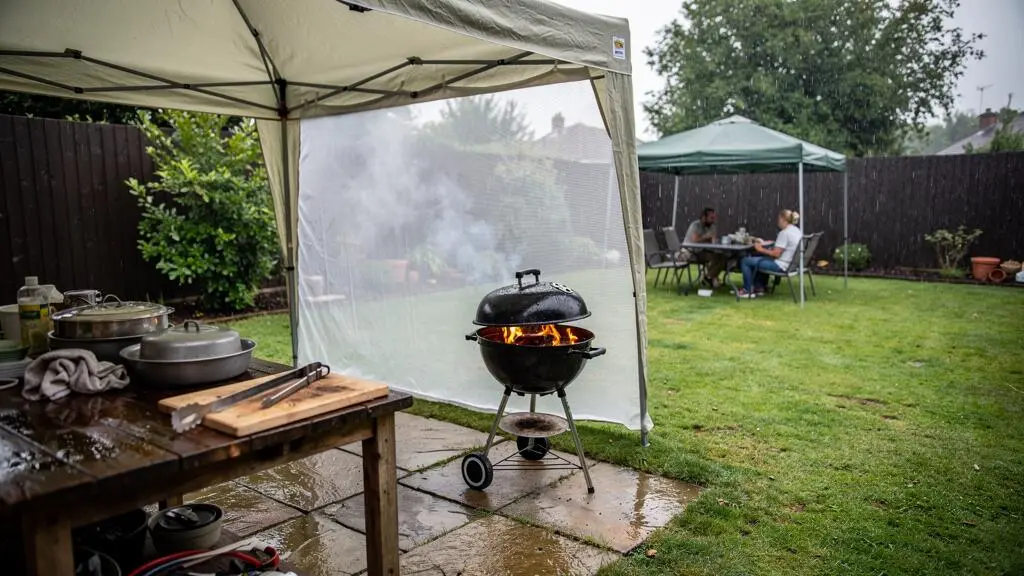
A British barbecue rarely enjoys predictable weather. A calm afternoon can turn breezy halfway through cooking, while light drizzle makes guests retreat beneath the nearest gazebo. The temptation is to move the barbecue under the same roof, but doing so can introduce far more serious problems than a damp burger bun.
The safest approach is to protect the cooking area from disruptive wind without enclosing the barbecue. Keep the appliance in a well-ventilated outdoor position, use a stable windbreak where appropriate, and put weather cover over guests and food preparation rather than directly over the heat source.
Wind affects combustion and temperature control, while overhead shelter introduces fire, smoke and carbon monoxide hazards. Getting the layout right means considering all three, especially when charcoal is burning or a gas grill is operating at high heat.
The following guidance explains how to position windbreaks, choose rain shelter, protect a long smoking session and recognise when the weather makes cooking impractical. It is intended for UK gardens, patios and suitable outdoor cooking spaces, with safety taking priority over keeping every part of the barbecue completely dry.
BBQ weather protection: the essentials
- Keep the grill in open air. Do not move it beneath a gazebo, awning or other unsuitable roof to escape drizzle.
- Control gusts, not combustion air. Use a secure, appropriately positioned windbreak without obstructing the barbecue’s vents.
- Shelter people separately. Position covered seating and food preparation away from smoke, heat, embers and the grill’s working area.
- Why Does Wind Make Your Grill Run Hot One Minute and Cold the Next?
- How to Set Up a Windbreak Without Starving the Fire of Oxygen?
- Gazebo or Canopy: Which Is Safer When You’re Grilling in Light Rain?
- The « Too Close to Cover » Mistake That Turns Weather Protection Into a Fire Hazard
- When Should You Separate Cooking Cover From Guest Cover for a Safer BBQ Setup?
- How to Set Up a Windbreak Without Starving the Fire of Oxygen?
- Gazebo or Canopy: Which Is Safer When You’re Grilling in Light Rain?
- How to Keep Smoking Temperature Stable for 6 Hours When the Weather Keeps Changing
Why Does Wind Make Your Grill Run Hot One Minute and Cold the Next?
Wind makes barbecue temperatures unpredictable because it changes how combustion air reaches the fuel and how quickly heat escapes. A gust can intensify charcoal combustion or disturb gas flames, while moving air simultaneously cools the cooking chamber. The resulting temperature changes depend on the grill’s design, vent settings, fuel and exposure.
On a charcoal barbecue, oxygen enters through intake vents and supports combustion beneath the cooking grate. When wind increases airflow through those openings, charcoal may burn more vigorously. When the same wind removes heat from the body of the barbecue, the thermometer can instead register a falling temperature.
These effects can occur together. One part of the charcoal bed may burn faster while another receives less effective airflow. Food positioned over the more active coals can brown quickly, even as food elsewhere cooks more slowly.
A gas barbecue behaves differently. Wind may disturb burner flames, interfere with the air-fuel mixture or increase heat loss through the cooking chamber. Depending on the burner design, strong gusts may create uneven heating or even extinguish a flame.
Useful warning signs include:
- Charcoal: irregular burning, changing smoke production or an unexpectedly rapid loss of fuel.
- Gas: flames that visibly lift, flicker excessively, change appearance or go out.
- Food: one side browning much faster than the other despite similar cooking conditions.
- Temperature: repeated fluctuations that coincide with gusts rather than deliberate vent adjustments.
These observations help identify a problem but do not replace a reliable cooking thermometer. Flame colour, sound and ash patterns alone cannot establish combustion safety or an accurate cooking temperature.
According to Weber‘s charcoal barbecue temperature-control guide, strong winds may increase fuel consumption or cause temperature fluctuations. The guidance also explains the importance of charcoal quantity, ventilation and allowing time for adjustments to take effect.
Trying to compensate for every gust by continually changing the vents can make matters worse. On charcoal equipment, allow the temperature to respond to a small adjustment before making another. Weber suggests giving adjustments several minutes to settle.
Wind can also increase the amount of fuel needed to maintain cooking temperature. That matters during a long British afternoon when the weather deteriorates and the available charcoal or gas supply is limited.
Before increasing fuel or burner output, check whether the grill is exposed to direct gusts. A safer outdoor position and a suitable windbreak may solve the underlying problem without sacrificing ventilation.
How to Set Up a Windbreak Without Starving the Fire of Oxygen?
A barbecue windbreak should slow disruptive gusts while preserving the appliance’s intended airflow. Place a stable, non-combustible screen outside the manufacturer’s required clearances, keep intake and exhaust openings unobstructed, and avoid enclosing the cooking area. The best position depends on whether the barbecue uses charcoal, gas or a dedicated smoker.
Charcoal equipment normally draws combustion air through lower vents and releases hot gases through upper openings. A solid barrier positioned too close to an intake can interfere with this draft. Instead of stabilising the fire, it may make the charcoal burn unevenly and produce more smoke.
A gas barbecue needs adequate ventilation around the burners, combustion-air openings and gas components. A screen that works with a charcoal kettle may be inappropriate for a gas appliance with different airflow requirements.
Windbreak material also makes a difference.
| Windbreak type | Potential benefit | Main limitation |
|---|---|---|
| Solid non-combustible panel | Blocks direct gusts effectively | May redirect wind over or around the panel, creating turbulence |
| Heat-suitable perforated screen | Reduces wind speed while allowing some air passage | Performance depends on its openness, position and stability |
| Adjustable louvred screen | Allows some control over wind direction | Incorrect settings may obstruct airflow or direct heat towards the screen |
| Existing garden wall | Provides a substantial fixed barrier | May create turbulence or place the grill too close to a structure |
Whatever the design, combustible fence panels, plastic screens and ordinary garden fabrics should not be treated as suitable heat shields. Keep the barbecue clear of anything that could ignite, melt or be damaged by heat.
For a charcoal kettle, identify the lower intake and upper exhaust positions before placing a screen. A partial barrier on the exposed side may help, but it must not prevent air entering the fire. Leave enough clearance for safe operation, maintenance and access to the lid.
An airflow check is useful after setting up the screen. With the barbecue cold and unlit, a purpose-made, non-flame smoke pencil can help show how air moves near the vents. This is an illustrative diagnostic technique, not a validated safety test or proof of adequate combustion ventilation. Do not use a lit match or open flame near a gas barbecue to test airflow.
Stability is equally important. A screen should be secured according to its design and the conditions, using suitable fixings or supports. Its position should prevent it from tipping or blowing towards the barbecue. Loose panels, ropes and weights must not obstruct the operator’s walking route.
If the barrier cannot remain stable in changing wind, remove it and reconsider the cooking position rather than relying on improvised restraints close to hot equipment.
Once the screen is installed, continue checking the fire’s behaviour and the manufacturer’s ventilation requirements. Wind protection is only useful when the appliance remains safe to operate.
Gazebo or Canopy: Which Is Safer When You’re Grilling in Light Rain?
Neither a standard gazebo nor an ordinary garden canopy should be assumed safe for grilling underneath. An open-sided canopy can ventilate better than an enclosed gazebo, but its roof still creates potential fire and heat hazards. For a typical UK garden barbecue, keep the grill outside the covered footprint and use the shelter for guests and food preparation.
Pop-up gazebos are familiar at British garden parties and campsites. They provide convenient rain cover, but lowering the sides to keep out wind can create a semi-enclosed space where smoke and combustion products accumulate.
Carbon monoxide is particularly concerning because it cannot be identified by smell or appearance. The NHS guidance on carbon monoxide poisoning explains the danger from fuel-burning equipment, including barbecues used in enclosed spaces.
Even if smoke appears to escape beneath an open-sided roof, that observation does not prove the space is safe from carbon monoxide.
The important considerations are roof position, side openness and where the appliance actually sits.
| Arrangement | Ventilation and heat concerns | Practical decision |
|---|---|---|
| Grill beneath a low gazebo roof with side panels | Restricted ventilation, overhead heat and combustible materials | Do not use this arrangement |
| Grill beneath a high open-sided fabric canopy | Potentially better airflow, but overhead heat and fire hazards remain | Do not assume it is safe; use the grill outside the canopy |
| Grill immediately beside the canopy edge | Heat may reach the fabric; smoke may travel beneath the roof | Increase separation until manufacturer requirements and safe operation are satisfied |
| Grill fully outside the covered area | No roof directly over the appliance, provided adequate separation is maintained | Preferred general arrangement |
| Covered guests and food preparation, with separate open-air cooking | Reduces rain exposure without requiring enclosed combustion | Practical layout for changeable weather |
Roof height alone cannot make a gazebo safe. No universal safe height can be established from the supplied UK guidance, and a higher roof does not automatically remove the risks of heat accumulation, fabric ignition or poor ventilation.
Drizzle introduces another complication. Water can cool the appliance, affect exposed charcoal and create slippery ground around the cooking area. A waterproof preparation table cover and a separate guest canopy address those problems without placing a combustible roof over the barbecue.
Keep the covered area far enough away that wind cannot carry significant heat, sparks or greasy smoke beneath it. If the weather makes open-air cooking impractical, postpone the cook rather than moving the appliance into an unsuitable shelter.
With the grill safely outside the shelter, the next consideration is how much separation is needed to prevent heat damage to nearby materials.
The « Too Close to Cover » Mistake That Turns Weather Protection Into a Fire Hazard
Weather protection becomes a fire hazard when a barbecue is placed close enough to a roof, awning or screen for radiant heat, flames or embers to reach it. Fabric can scorch, melt or ignite, even without direct flame contact. Follow the appliance manufacturer’s clearances and keep ordinary combustible covers away from the cooking zone.
Barbecues release heat in several directions. Radiant heat warms nearby objects, hot gases rise above the cooking chamber, and sudden flare-ups can extend beyond the normal cooking area.
Under a low fabric roof, heat may accumulate around the canopy material and structural components. A polyester cover can deform under heat and, if sufficiently exposed, melt or ignite. Molten material can fall onto the barbecue, food or people below.
Charcoal introduces additional risks from sparks and embers, particularly during lighting, when flames and burning particles may be more exposed. Gas equipment can concentrate substantial heat around burners, cooking surfaces and exhaust areas. Neither fuel type should be regarded as safe beneath an unsuitable roof.
Scorch marks, discolouration, unusual heat around a roof panel and damaged fixings are warning signs of excessive exposure. They are not a substitute for a clearance assessment: damage may occur before these signs become obvious.
Likewise, holding a hand near a hot roof or relying on an improvised temperature reading is not a reliable method of proving a setup safe. Do not enter or reach into an unsafe overhead cooking arrangement to test it. Relocate the barbecue before use.
For the UK context, UK government outdoor fire safety guidance explicitly advises against using barbecues under awnings and recommends keeping them well away from combustible garden features, including fences, sheds and vegetation.
The guidance does not provide a universally safe distance between a barbecue and a gazebo roof. Clearance requirements therefore need to come from the appliance instructions and the characteristics of nearby structures, not an invented rule of thumb.
Repeated heat exposure may also weaken a shelter. Fabric coatings, seams and frame components can deteriorate without a dramatic flare-up. A gazebo that survived previous barbecues should not be considered safe on that basis.
Once the cooking area has adequate separation from combustible structures, it becomes easier to organise a comfortable seating area without bringing guests near hot surfaces.
When Should You Separate Cooking Cover From Guest Cover for a Safer BBQ Setup?
Separate the cooking and guest areas whenever a shared shelter would expose diners to smoke, embers, hot surfaces or restricted movement. Keep the barbecue in open air and position covered seating and preparation spaces outside its heat and smoke path. This creates a more comfortable gathering without compromising the cook’s working space.
When rain starts, guests naturally move towards shelter. If that shelter also contains the grill, everyone may end up standing close to hot equipment while carrying plates, drinks or umbrellas.
A separate seating canopy avoids concentrating those activities around the barbecue. It also allows the cook to open the lid, turn food and handle fuel without people passing immediately behind them.
Wind direction helps determine where the guest area should go. Position seating upwind or suitably crosswind of the cooking area where practical, so smoke and greasy vapour are less likely to move towards diners. Placing guests directly downwind can have the opposite effect.
Because wind changes direction, the layout should also accommodate occasional shifts rather than depending on smoke travelling along one fixed path.
Consider a hypothetical garden with a patio, a small lawn and a pop-up gazebo. A practical layout would place the barbecue on a suitable stable outdoor surface, clearly separated from the gazebo, while covered seating occupies another part of the garden. The precise separation must respect the appliance manufacturer’s requirements and actual exposure to heat and embers.
A direct circulation route between the two areas reduces awkward movement. It should not run through the grill’s operating space or force children and guests to pass in front of the barbecue.
Five checks before guests arrive
- Mark the cooking position: identify a stable outdoor location with no unsuitable roof overhead and confirm that the appliance’s required clearances can be maintained.
- Check wind exposure: note the prevailing direction and identify a safe location for a stable windbreak, if needed, without blocking vents.
- Position guest shelter: place seating outside the grill’s heat, ember and likely smoke paths; verify that no canopy material is exposed to cooking heat.
- Clear the walking route: establish an unobstructed path between preparation, cooking and dining areas that does not cross the hot working zone.
- Inspect the finished layout: confirm that shelter fixings are secure, wet surfaces are manageable and guests can reach their seats without approaching the barbecue.
Separation is also a hospitality improvement. Guests can stay dry without breathing smoke or dodging cooking equipment, while the host has room to work safely.
Once the people and cooking zones are organised, the remaining challenge is adapting that layout to different barbecue designs and changing wind conditions.
How to Set Up a Windbreak Without Starving the Fire of Oxygen?
For compact gas barbecues and portable charcoal grills, windbreak placement must follow the appliance’s specific ventilation design rather than a universal screen arrangement. Shield only the necessary exposed area, maintain the manufacturer’s clearances, and keep every combustion-air and exhaust opening unobstructed. If safe ventilation cannot be maintained, do not cook in that position.
A compact gas barbecue may have air openings beneath or around its burner compartment. Its body can also sit closer to surrounding surfaces than a large freestanding kettle, making improvised wind protection more hazardous.
Before installing a screen, identify the appliance’s air openings, exhaust paths and required operating clearances. A solid barrier that obstructs these areas could interfere with combustion. Never modify the barbecue’s built-in ventilation system to make a windbreak fit.
Portable gas grills are sometimes used at campsites or in small outdoor spaces. On a campsite, the grill must remain outside tents and awnings, with sufficient separation from combustible camping equipment. On balconies, building rules, fire restrictions, ventilation and the manufacturer’s instructions may make barbecue use unsuitable altogether.
The partial-windbreak principle can help with exposed outdoor setups. Instead of enclosing the grill, screen one side or, where safe, two sides to reduce disruptive gusts. The remaining open space must still allow sufficient air circulation and free exhaust of combustion products.
However, leaving one particular side open is not proof of safety. On some appliances, the windward side contains an important air intake; on others, airflow enters elsewhere. Check the actual design rather than assuming that all barbecues draw air in the same direction.
Over-sheltering is especially risky because restricted combustion air can contribute to incomplete combustion. This may increase smoke and carbon monoxide production. Excessive smoke can also leave food with an unpleasant bitter or sooty flavour, although smoke appearance is not a dependable measure of carbon monoxide.
For charcoal cooking, sluggish burning and persistent smoke after installing a screen should prompt a review of airflow and fuel condition. With a gas grill, abnormal burner behaviour or flame extinction requires following the manufacturer’s shutdown and relighting procedures, rather than experimenting with the screen while burners are operating.
British weather often changes during a long afternoon, so the first windbreak position may not remain useful. Check the wind direction periodically, particularly after showers or when gusts strengthen. Reposition portable barriers only when it is safe to do so, keeping hands, materials and equipment away from the hot cooking area.
Do not attempt to compensate for severe wind by building an increasingly enclosed arrangement. When gusts threaten screen stability or the grill’s normal operation, stopping the cook is safer than adding more barriers.
The same appliance-specific approach matters when choosing rain protection, particularly when lightweight shelters are exposed to both drizzle and gusts.
Gazebo or Canopy: Which Is Safer When You’re Grilling in Light Rain?
For light rain accompanied by gusts, the better shelter is one that protects people without compromising the barbecue’s open-air position. A securely anchored, open-sided canopy can serve guests and food preparation, but its fabric rating does not make cooking underneath safe. Wind resistance, drainage and adequate separation from the grill all matter.
Standard polyester pop-up gazebos and specialist flame-retardant fabrics may behave differently when exposed to heat. Flame-retardant treatment can alter ignition behaviour, but it does not make fabric non-combustible or remove restrictions on heat exposure.
Check the shelter manufacturer’s instructions, including its stated wind limitations and restrictions on heaters, barbecues and naked flames. Do not assume that a fabric rating authorises use directly above a hot barbecue.
A useful hybrid arrangement separates rain protection into two jobs: the gazebo protects guests and the preparation area, while the barbecue remains fully outside the roof footprint. Any supplementary rain protection around the cooking area must be designed and approved for the particular appliance, remain outside required clearances and preserve ventilation.
A normal garden umbrella or improvised splash shield should not be placed over the grill. Ordinary umbrellas and fabric shields can introduce the same overhead heat and ignition hazards as a gazebo.
Rainfall and wind also affect shelter stability. A pop-up gazebo presents a substantial surface to gusts, particularly when side panels are fitted. Suitable leg weights, stakes and manufacturer-approved anchoring help stabilise the structure within its rated operating conditions, but cannot make it safe in unlimited wind.
If gusts exceed the shelter’s limits, dismantle or secure it as instructed. Do not remove roof fabric from an erected shelter in strong wind unless the manufacturer’s procedure permits this and conditions are safe.
Water management deserves attention too. Rain dripping from canopy edges can form puddles on paving or direct water towards an electrical connection. Position the shelter so runoff does not fall into the principal walking route, onto hot cooking equipment or towards electrical leads and sockets.
Keep outdoor electrical equipment appropriately rated and protected, with connections away from wet ground. Avoid trailing extension leads across routes used by guests or anyone carrying hot food.
A waterproof mat may protect equipment from splashes, but it should not create a slippery surface or introduce combustible material near the grill.
For UK gardens with limited space, the deciding factor is whether all these conditions can be met simultaneously. A shelter that can only be accommodated by crowding the barbecue is not a suitable solution.
Once rain shelter and ventilation are properly organised, longer barbecue sessions require another kind of protection: keeping fuel and cooking temperature consistent as conditions change.
Key takeaways for longer cooks
- Prepare a safe, open-air smoker position before lighting rather than trying to reorganise shelter around a hot appliance.
- Expect weather conditions to change during a six-hour cook and monitor fuel, airflow and cooking temperature at regular intervals.
- Correct the cause of a temperature change instead of repeatedly adjusting vents in response to individual gusts.
How to Keep Smoking Temperature Stable for 6 Hours When the Weather Keeps Changing
To keep a smoker stable for six hours in changeable weather, start with adequate fuel, unobstructed airflow, suitable wind protection and reliable temperature monitoring. Check conditions regularly, make small adjustments and replenish fuel before the fire weakens significantly. Keep the smoker outdoors, away from combustible shelter, and never sacrifice ventilation for temperature stability.
A six-hour smoking session is not simply an extended version of a short barbecue. Over that period, wind can change direction, drizzle can intensify and the outdoor temperature may fall. Each change affects how the smoker loses heat and how effectively fuel burns.
The first step is preparation. Choose a stable cooking surface and orient the smoker according to its design and the manufacturer’s instructions. A suitable wind screen may reduce direct gusts, but it must remain outside required clearances and must not interfere with the firebox, vents or chimney.
For an offset smoker, the movement of air from the intake through the firebox and out of the exhaust is fundamental to operation. Blocking either opening in an attempt to stop rain can cause poor combustion and unstable temperatures.
Use the manufacturer’s approved rain-management accessories, if available, rather than wrapping the firebox or improvising covers around hot exhaust components.
Adequate fuel provides a buffer against changing conditions. Charcoal briquettes can offer a relatively predictable burn when used in an appropriate smoker, although actual duration depends on fuel, appliance design, airflow and weather.
Prepare sufficient fuel for the planned cooking period and keep additional fuel available for safe replenishment. A water pan, where recommended by the smoker manufacturer, may contribute thermal mass and moderate some temperature fluctuations. It does not eliminate heat loss or replace fuel management.
Monitoring should follow both cooking progress and weather conditions. At the beginning, check that the smoker has settled near the desired cooking temperature. During the main burn, watch the temperature trend and fuel supply. Later in the session, pay attention to declining embers, incoming rain and changing wind exposure.
A practical routine is to monitor the cooking temperature at regular intervals, with additional checks when the weather changes or when fuel is likely to need replenishing. Use an appropriate chamber thermometer and a food probe rather than depending exclusively on the smoker’s lid gauge.
When temperatures drift, identify the likely cause before intervening.
| Observed problem | Possible cause | Practical response |
|---|---|---|
| Temperature rises after gusts | Increased combustion airflow or altered draft | Check intake exposure and make small, manufacturer-compatible vent adjustments if appropriate; allow time for the result |
| Temperature falls during drizzle | Increased heat loss, reduced fuel output or moisture exposure | Check fuel condition and safe rain protection; replenish fuel as required |
| Heavy smoke and weakening heat | Restricted airflow, damp fuel or incomplete combustion | Check for obstructed vents and unsuitable shelter; restore the manufacturer’s intended operating conditions |
| Temperature continues falling late in the cook | Fuel supply declining | Add suitable fuel safely, following the appliance instructions |
| Sudden changes despite stable vent settings | Wind shift, unstable combustion or thermometer variation | Recheck exposure, fuel and the thermometer before changing settings |
Opening vents wider is not a universal response to high temperatures; it may increase combustion and make overheating worse. Likewise, banking coals is only appropriate where the smoker’s design and operating instructions support that method.
Consistency matters more than constant adjustment. Frequent unnecessary changes can make a charcoal smoker harder to control because the effects of airflow and fuel changes take time to appear.
For food safety, maintain suitable cooking conditions and check the internal temperature of the food using a reliable probe. Time spent in the smoker alone does not establish that meat is safely cooked.
If severe wind threatens the smoker’s stability, heavy rain affects essential components or shelter would be needed directly over a hot appliance, suspend the cook rather than compromise safe operation.
Before the next six-hour session, prepare the smoker’s position, check the weather forecast, inspect the fuel supply and organise a separate sheltered preparation area. Those steps make it easier to react calmly when conditions change without bringing smoke, flames or hot equipment beneath an unsuitable cover.
Can you use a charcoal barbecue under a gazebo if all four sides are open?
An open-sided gazebo generally provides better ventilation than an enclosed one, but that does not make it suitable for charcoal cooking underneath. Heat, sparks and embers may still reach the roof, and adequate ventilation cannot be assumed from open sides alone. Keep the barbecue outside the covered footprint and follow the manufacturer’s clearance requirements.
Is it safe to use a barbecue in light rain?
Light rain does not automatically prevent outdoor barbecuing, provided the appliance is suitable for those conditions, remains stable and can be operated safely in open air. Follow the manufacturer’s guidance and avoid water reaching gas or electrical components that require protection. Do not move the barbecue beneath a combustible roof simply to keep it dry.
Does flame-retardant gazebo fabric make grilling underneath safe?
No. Flame-retardant fabric may resist ignition differently from untreated material, but it can still suffer heat damage and does not remove smoke or carbon monoxide hazards. A fabric rating should never be interpreted as permission to operate a barbecue beneath the roof unless the complete shelter and appliance arrangement is explicitly designed and approved for that use.
What should you do if barbecue smoke keeps blowing towards the neighbours?
Check the wind direction and consider moving the barbecue to a suitable open-air position that preserves all required clearances. Avoid placing the grill close to fences or buildings to redirect smoke, as this creates additional hazards. If the wind repeatedly carries smoke into neighbouring homes or gardens and no suitable position is available, postpone cooking until conditions improve.
Can a barbecue be left outside in the rain after cooking?
Follow the appliance manufacturer’s shutdown, cooling and storage instructions. Never move lit charcoal indoors or beneath an awning, and do not fit an ordinary protective cover over a hot barbecue. Allow charcoal and ash to become completely cold before safe disposal or storage. Once the appliance has cooled fully, use a suitable weatherproof cover if the manufacturer permits outdoor storage.