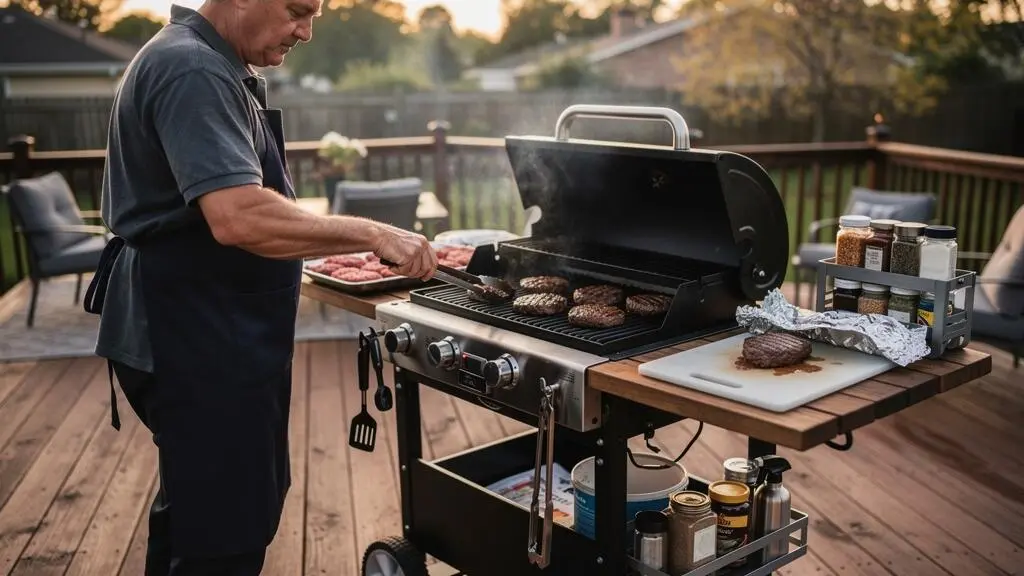
The grill is hot, the burgers need turning, and the thermometer is somewhere in the kitchen. By the time it is found, the next batch is cooking faster than expected. The problem is not necessarily grilling technique. It is the arrangement of everything around the barbecue.
A well-designed barbecue cooking station gives every essential item a fixed position. Raw ingredients enter from one side, cooking happens in the middle, and finished food leaves through a separate clean area. Tongs, thermometers and other frequently used tools remain close enough to reach without abandoning the grill.
Creating this workflow does not require a permanent outdoor kitchen. A stable trolley, an appropriate folding table or existing grill shelves can provide the necessary working space, even on a modest British patio.
The aim is to remove unnecessary movements while maintaining food hygiene, fire safety and control over cooking. Start with the workflow rather than shopping for equipment, and the right layout becomes much easier to identify.
BBQ Cooking Station Essentials
- Arrange raw preparation, active cooking and finished-food handling in a one-way sequence, with dedicated clean utensils and surfaces.
- Keep frequently used tools within arm’s reach and choose a stable work surface suited to its actual load.
- Clean, dry, reposition and restock equipment after each session so the next barbecue starts with minimal preparation.
- Why Does a Proper Cooking Station Make Your BBQ Results More Consistent? (50.1)
- How to Build a 3-Zone Cooking Station in a 1 m Wide Space Without Clutter? (50.2)
- BBQ Trolley or Folding Table: Which Makes More Sense if You Grill Weekly? (50.3)
- The Unstable-Surface Mistake That Leads to Spills, Burns, and Dropped Knives (50.4)
- When Should You Reset Your Cooking Station So Next BBQ Starts in 3 Minutes? (50.5)
- How to Build a 3-Zone Cooking Station in a 1 m Wide Space Without Clutter? (50.2)
- How to Build a One-Reach Tool Zone So You Never Leave the Grill Unattended? (42.2)
- How to Design an Outdoor Kitchen Layout That Keeps Guests Close Without Crowd Chaos (39)
Why Does a Proper Cooking Station Make Your BBQ Results More Consistent? (50.1)
A proper BBQ cooking station improves consistency by removing interruptions from the cooking process. When ingredients, utensils, seasoning and clean serving equipment occupy predictable positions, the cook can repeat the same sequence without unnecessary movement. This helps maintain attention on cooking times, food temperatures and heat management, although the layout cannot compensate for incorrect cooking technique.
The principle comes from mise en place, the professional kitchen practice of preparing and positioning everything needed before cooking begins. Applied to a barbecue, it means arranging the workspace around the order in which food moves.
Imagine preparing burgers, sausages and vegetables simultaneously. Without an organised station, each missing plate or utensil creates another interruption. These interruptions can complicate the timing of several foods that require different levels of attention.
A fixed layout makes the process more predictable:
- Raw staging: ingredients and dedicated raw-food utensils are prepared before cooking.
- Active cooking: essential tools and a food thermometer remain accessible beside the grill.
- Finished-food handling: clean plates, serving utensils and resting space are ready before food leaves the cooking surface.
This separation also has a hygiene purpose. The Food Standards Agency’s BBQ food safety guidance recommends using different utensils, plates and chopping boards for raw and cooked foods, as well as washing hands after handling raw meat.
Before lighting the grill, check whether reaching the thermometer, clean serving plate, tongs or seasoning would require leaving the cooking position. Place missing essentials where they can be accessed safely, without exposing handles or supplies to heat.
Efficiency and consistency are different outcomes. Better organisation directly reduces searching and unnecessary movement. More consistent cooking is a potential secondary benefit because the cook can concentrate on temperature, turning and timing instead of locating equipment.
Once the working sequence is established, the next challenge is fitting it into the available space without allowing raw and cooked foods to overlap.
How to Build a 3-Zone Cooking Station in a 1 m Wide Space Without Clutter? (50.2)
Build a compact three-zone BBQ station by assigning separate positions to raw ingredients, the cooking area and finished food, then arranging them in a single direction. Use vertical storage for tools, retain only frequently needed items on the worktop, and keep raw-food equipment separate. A one-metre layout is a planning example, not a universal safe minimum.
First, distinguish the grill itself from the supporting preparation space. A compact grill with appropriate side shelves may offer enough usable landing space, while a larger barbecue may need an additional trolley. The available footprint must accommodate safe access, ventilation and the manufacturer’s required clearances.
For a practical left-to-right workflow, arrange the station as follows:
- Raw staging zone: a dedicated tray or board for uncooked ingredients, positioned where raw juices cannot reach finished food.
- Active cooking zone: the grill, supported by a heat-resistant landing area and accessible cooking tools.
- Finished-food zone: a clean plate or board reserved for cooked food and resting.
The direction can be reversed to suit the patio. What matters is that raw ingredients never travel back across the finished-food area.
Reduce clutter by moving tools off horizontal surfaces. Hooks can hold tongs and spatulas, while a compact container can store seasonings. Containers should remain stable and must not be stacked where heat could damage them or make their contents unsafe.
A useful filtering rule is to keep an item within the active station only when it is needed repeatedly during the cook. Occasional accessories can remain in a nearby storage box or indoors.
Space-saving must never override food safety. Assign distinct boards and utensils to raw and cooked food, using clear labels, different colours or permanently separate positions. A utensil that has handled raw meat must not be used for cooked food unless it has been properly washed.
Compact layouts also require attention to fire safety. Do not position fuel containers, combustible packaging or spare ignition supplies against hot equipment. Follow the grill manufacturer’s clearance requirements.
Importantly, a small footprint does not make balcony grilling acceptable. London Fire Brigade advises against using barbecues on balconies, so this arrangement is intended for a suitable outdoor location where grilling is permitted and safe.
With the zones defined, equipment selection becomes a practical question of stability, cleaning and how often the station needs to be assembled.
BBQ Trolley or Folding Table: Which Makes More Sense if You Grill Weekly? (50.3)
A BBQ trolley generally makes more sense for weekly grilling when the patio has room for permanent equipment storage. A folding table is often more practical when outdoor space must be cleared after cooking. The better option depends on stability, verified load capacity, weather resistance and cleaning requirements rather than price or appearance alone.
For regular grilling, the largest operational difference is readiness. A trolley can keep suitable accessories organised between sessions. A folding table must usually be unfolded, positioned, checked and packed away again.
The comparison below focuses on features that affect actual barbecue work.
| Criterion | BBQ trolley | Folding table |
|---|---|---|
| Setup effort | Can remain assembled and stocked | Usually requires setup and removal |
| Load capacity | Depends on the rated construction and shelves | Varies considerably; lightweight models may have limited capacity |
| Stability | Rigid frames and locking castors can help when properly secured | Depends on leg design, locking mechanisms and ground conditions |
| Weather exposure | Requires suitable outdoor materials and protection | Can be stored indoors between sessions |
| Storage footprint | Occupies space continuously | Can fold into a smaller storage area |
| Food-contact cleaning | Depends on surface finish and material | Depends on surface finish and material |
| Hot cookware | Only suitable where the manufacturer permits the temperature and weight | Requires verified heat and load resistance; many general-purpose tables are unsuitable |
Consider an explicitly hypothetical weekly grilling routine. If assembling and clearing a folding table takes five additional minutes per session, that represents 260 minutes across 52 sessions. This is simply an illustration of how small repeated tasks accumulate, not a measured average for folding tables.
Neither format should be assumed capable of holding hot cast iron. Check the manufacturer’s load rating and heat-resistance instructions before placing hot cookware on any work surface. Use an appropriate heat-resistant support only when the underlying surface is suitable.
Intermediate options may provide a better compromise. A grill’s existing side shelves can reduce additional furniture requirements. A narrow trolley with locking castors offers movable storage. A properly rated wall-mounted fold-down surface may preserve floor space, provided its mounting and location are suitable.
Before purchasing, check the locking mechanisms and inspect for flex, rocking or movement under a safely distributed test load that remains within the manufacturer’s rating. Do not test stability using hot cookware.
Whichever option you choose, the surface must remain stable when you cut, serve or move equipment. Otherwise, any convenience gained through faster setup can disappear during cooking.
The Unstable-Surface Mistake That Leads to Spills, Burns, and Dropped Knives (50.4)
An unstable BBQ work surface creates hazards when weight shifts, equipment moves or the cook applies cutting pressure. Uneven ground, unsecured wheels, overloaded edges and unsuitable furniture can contribute to spills, burns and knife accidents. Inspecting the surface before cooking helps identify problems while all equipment is still cool and safe to adjust.
Three failure patterns deserve particular attention.
- Liquid spills: a rocking table can send marinades, grease or other liquids towards hot equipment, electrical connections or walking areas.
- Contact burns: a tipping pan, tray or hot utensil can expose hands and legs to heated contents or surfaces.
- Knife injuries: a moving cutting board or collapsing surface can interrupt controlled cutting movements.
These incidents share a practical cause: the surface fails to provide a predictable working platform. It also consumes attention. Instead of monitoring the grill, the cook must compensate for movement under their hands.
The Scottish Fire and Rescue Service’s barbecue safety guide recommends placing barbecues on flat sites, keeping them away from combustible materials and maintaining supervision throughout cooking.
For a separate preparation surface, use a simple pre-session inspection. Confirm that every foot or wheel makes reliable contact, that castors are locked where applicable, and that the surface does not rock under a suitable load. Ensure equipment stays inside the table edges and that the station does not obstruct pedestrian access.
On uneven patios, compatible adjustable feet or manufacturer-approved levelling accessories may help. A properly supported, level, non-combustible base is preferable to soft grass that can shift under load. Avoid balancing furniture on improvised stacks of loose paving slabs, and never rely on unsupported weights or makeshift clamps to compensate for an unsuitable frame.
These adjustments must be distinguished from structural repairs. If joints are loose, legs are damaged or a table cannot remain stable under its rated load, remove it from service rather than attempting to compensate by adding weight.
Five Checks Before Lighting the BBQ
- Confirm the ground: identify a flat, suitable location and verify that the grill and preparation station are independently supported.
- Secure the furniture: lock castors and folding mechanisms, leaving no unsecured moving parts.
- Test stability: apply a controlled load within the manufacturer’s rating and confirm that the surface remains steady.
- Check placement: move utensils, trays and containers fully inside the worktop edges, leaving a clear working area.
- Clear the route: inspect the path between the grill, preparation station and serving area, removing obstacles and keeping guests outside the hot working zone.
Once the physical setup is secure, maintaining its readiness between sessions is the next opportunity to remove unnecessary work.
When Should You Reset Your Cooking Station So Next BBQ Starts in 3 Minutes? (50.5)
Reset the cooking station after each barbecue, then perform a deeper stock and equipment check before the next session or as part of a weekly routine. Clean contaminated surfaces, return utensils to their assigned positions and replenish essential supplies. A three-minute preparation target may be achievable for some setups, but it is not a guaranteed startup time.
There are two distinct reset periods. The first begins after food preparation and serving have ended. The second happens when equipment and consumables are checked ahead of another barbecue.
The immediate reset should follow hygiene and equipment-safety priorities:
- Remove raw-food residues and clean and sanitise food-contact surfaces using appropriate products and instructions.
- Deal with grease and cooking residues when equipment has reached a safe temperature for handling and cleaning.
- Wash utensils and reusable containers, then dry them before storage.
- Return clean tools to their designated positions.
- Allow the barbecue to cool completely and follow the manufacturer’s shutdown, fuel-disposal and storage instructions.
Do not attempt to clean dangerously hot components simply to make grease removal easier. The shutdown procedure must always take priority over convenience.
The deeper reset focuses on readiness: checking fuel availability, replacing consumables, inspecting tool condition and ensuring storage containers remain clean and usable. Some fuel types require additional pre-session checks that cannot be eliminated through organisation.
To understand whether a three-minute target is realistic, measure only the time spent arranging the station before ignition, not the time required to light or preheat the barbecue. Record where delays occur over several sessions.
If the same missing gloves, utensils or serving plates repeatedly slow the setup, assign them a permanent accessible location. This is more useful than attempting to move faster through an inconsistent routine.
The FDA guidance on handling food safely outdoors reinforces the importance of having a food thermometer and clean serving equipment ready while grilling. Its practical food-handling principles complement the UK guidance, although American temperature recommendations should not automatically replace UK-specific advice.
The purpose is not to establish a universal speed record. It is to restore the same safe working conditions every time, making the layout and habits developed earlier genuinely repeatable.
How to Build a 3-Zone Cooking Station in a 1 m Wide Space Without Clutter? (50.2)
For a narrow BBQ workspace, preserve the three-zone system by moving storage vertically and reducing the number of items left on the work surface. Use the grill’s suitable existing shelves wherever possible, arrange raw and cooked food handling in one direction, and remove occasional accessories from the active station. Safe separation matters more than fitting everything into exactly one metre.
Start by treating the available width as a limited resource. If the grill includes a suitable side shelf, this can serve as a landing area for cooking accessories, leaving a separate stable work surface for ingredient staging and plating.
A compact arrangement may place raw ingredients at one end of the preparation line and clean finished-food equipment at the opposite end, with the cooking area between them. The layout should not require a raw-food tray to pass above a clean serving plate.
Next, audit the equipment already stored beside the grill. Sort it into three categories:
- Used last session: consider whether each item needs a fixed position in the active station.
- Used occasionally: store it in a labelled container outside the working area.
- Never used: remove it from the station and reassess whether it is worth retaining.
This exercise often reveals duplicated utensils, oversized storage boxes and specialised gadgets that occupy space without improving the active cooking workflow.
For vertical storage, use manufacturer-approved hooks, rails or compatible tool holders. Magnetic strips can work for suitable metal accessories, but should not be attached to heat-sensitive surfaces or positioned where tools can fall onto the grill.
Stackable, lidded containers can organise cool, clean accessories. Their lids should not be treated as load-bearing preparation boards unless the manufacturer explicitly approves that use. Choose storage materials for their intended exposure to moisture, grease and cleaning products.
Keep fuel and ignition supplies separate from the cooking line and away from heat sources. Spare fuel must not be squeezed beneath or against the grill merely to achieve a smaller footprint. The correct clearance depends on the equipment and its instructions.
Space constraints do not justify reducing safe access or positioning a barbecue in an unsuitable location. If the grill and its necessary clearances do not fit safely, the station needs a larger location rather than a tighter arrangement.
Once the surfaces are simplified, the final improvement for active cooking is positioning the handful of tools needed most frequently within one comfortable reach.
How to Build a One-Reach Tool Zone So You Never Leave the Grill Unattended? (42.2)
A one-reach BBQ tool zone places the essential cooking utensils close enough to retrieve without moving your feet or turning away from the grill for more than a moment. Position tongs, a spatula and a food thermometer on secure, heat-safe holders beside the cooking position. Keep preparation and serving equipment elsewhere to prevent crowding.
Test the arrangement while standing where you normally cook. Without stepping sideways or leaning across a hot surface, try reaching each item you use during active grilling.
The most useful candidates are:
- Tongs appropriate for handling and turning food.
- A spatula suited to the food and grill surface.
- A food thermometer with a convenient, protected storage position.
- A suitable brush or additional frequently used utensil, where needed.
- A spray bottle only when its contents and intended use are compatible with the barbecue manufacturer’s instructions.
Not every tool belongs beside the heat. Raw-food plates and marinades should remain in their designated staging area. Clean serving plates and ready-to-eat items belong in the finished-food zone, protected from raw-food contamination.
Position hooks or holders around normal hand height where their location permits safe retrieval. Handles should remain away from direct heat, hot exhaust and grease. Avoid hanging tools on unstable shelves or obstructing lids, vents and controls.
A magnetic holder may suit compatible steel utensils. A dedicated thermometer holder can prevent the instrument from becoming buried beneath trays or packaging. Neither solution should force the cook to reach across the cooking surface.
This design also supports supervision. The Scottish Fire and Rescue Service advises never leaving a barbecue unattended and recommends that another responsible adult supervise it if the cook must step away.
Keeping tools accessible reduces avoidable reasons to leave, but it does not remove every possible interruption. If an essential task requires leaving the barbecue, arrange responsible supervision rather than relying on the layout alone.
Children and pets should remain outside the hot cooking area regardless of how efficiently the station is organised.
The same principle becomes particularly important when more people share the patio, because guest movement can obstruct even a carefully designed working area.
Key Takeaways for a More Efficient BBQ Layout
- Protect a clear working route between ingredient staging, the grill and clean serving space.
- Choose furniture and tool storage that preserve safe access rather than simply maximising available surfaces.
- Provide guests with an obvious gathering or serving area away from heat, sharp utensils and raw-food preparation.
How to Design an Outdoor Kitchen Layout That Keeps Guests Close Without Crowd Chaos (39)
An outdoor kitchen layout works best when the cook’s preparation-to-serving route stays separate from guest circulation. Position raw-food staging, the grill and clean plating areas in a logical sequence, then provide a dedicated place for drinks or socialising beyond the hot working zone. Guests can remain involved without blocking food handling or approaching dangerous surfaces.
This is the same three-zone system used in a compact barbecue station, applied to a larger outdoor space. Additional counter space should support the workflow rather than create unnecessary movement between distant work areas.
Provide suitable landing space beside the grill for the equipment and food containers needed during cooking. Any surface intended for hot cookware must have appropriate heat resistance and load capacity.
Three layout patterns suit different spaces.
- Straight-line layout: position staging, cooking and clean plating areas along one continuous working run. Keep seating and guest circulation in front of, but safely separated from, the active working area.
- L-shaped layout: use one side for preparation and grilling, with the other functioning as a separate serving or drinks counter where spacing and access permit.
- Compact patio layout: arrange a suitable grill and minimal preparation station against a practical working edge, preserving clear pedestrian access and the required distance from combustible structures.
These patterns are planning concepts rather than universal dimensional specifications. Grill type, ventilation, nearby buildings, property rules and manufacturer instructions determine whether a particular position is acceptable.
London Fire Brigade’s BBQ safety guidance recommends keeping barbecues away from combustible structures, avoiding distractions and maintaining supervision. It also advises against balcony barbecue use and recommends placing barbecues on level ground rather than decking.
Guest behaviour is easier to manage when the layout offers an inviting alternative to gathering immediately beside the grill. Place drinks, snacks and seating where people can converse with the cook without crossing the route used for moving hot pans, sharp tools or food trays.
For example, in a hypothetical L-shaped patio arrangement, guests might collect drinks at the shorter counter while the cook uses the longer run for staging and grilling. Finished food can then move to a designated serving point without guests entering the raw preparation area.
Keep the route from grill to serving space unobstructed and avoid seating arrangements that force guests to walk behind someone handling hot equipment.
Before your next barbecue, mark out the raw-food area, the cooking position and the clean serving route. Then stand at the grill and check which essential tools can be reached safely, where guests will naturally gather, and whether anything needs moving before the heat is switched on.
Can a barbecue cooking station work without a dedicated outdoor kitchen?
Yes. A suitable grill with existing shelves and a stable, easy-to-clean preparation surface can provide the essential functions. Prioritise separate raw and cooked food handling, safe tool storage and an unobstructed working position. A permanent outdoor kitchen is not required.
Is it safe to keep raw meat beside cooked food on a small BBQ station?
Only when raw and cooked foods are kept properly separated, with no risk of raw juices contaminating cooked food or clean equipment. Use different plates, utensils and chopping boards, and wash hands after handling raw meat. If the workspace cannot maintain that separation, move one stage of food handling to another suitable area.
What surface materials are suitable for a BBQ preparation station?
Choose a stable surface that can be cleaned effectively and is appropriate for its intended outdoor exposure. Food-contact materials should be suitable for food preparation. Heat resistance, load capacity and weather durability depend on the specific product, so check manufacturer specifications rather than assuming that all metal, plastic or wooden surfaces perform alike.
Should cooking utensils stay outdoors between barbecue sessions?
Only when they can be kept clean, dry and protected from contamination and weather damage. Wash and dry tools after use, then store them in an appropriate protected location. Inspect and clean equipment as necessary before the next session.
What should happen if the cook needs to leave the barbecue?
Arrange for another responsible adult to supervise the barbecue. Fire-safety guidance advises against leaving an active grill unattended. A well-organised station reduces unnecessary departures, but it does not replace continuous supervision or the need to keep children and pets away from the cooking area.