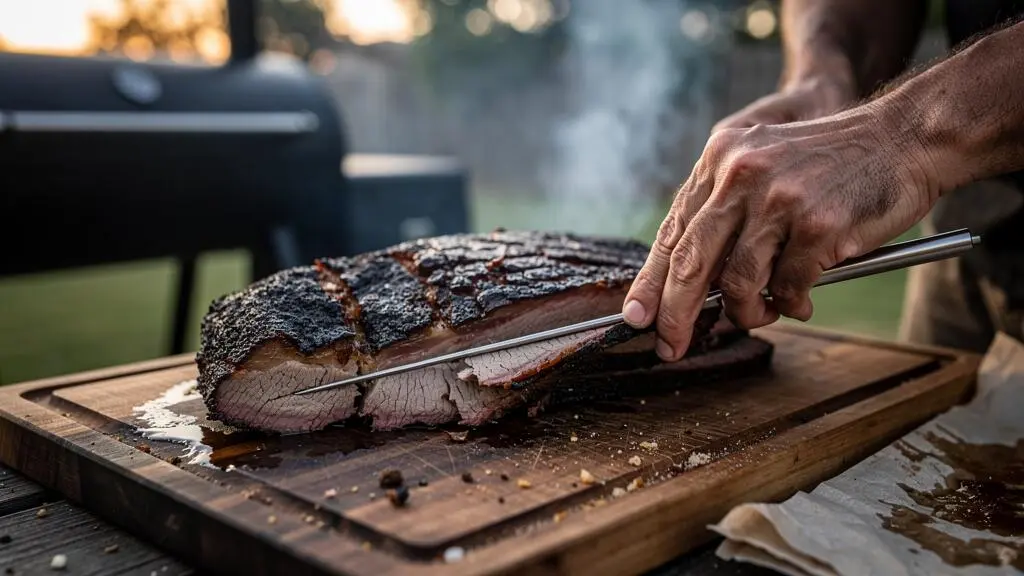
A brisket can reach 203°F (95°C) and still feel like rubber. Another can become beautifully tender before the thermometer ever displays that number. Neither result is mysterious once collagen breakdown is understood as a process rather than a temperature switch.
Collagen is a structural protein found in connective tissue. During prolonged cooking, some of that collagen denatures and gradually becomes soluble gelatin. Heat helps drive the process, but temperature alone cannot reveal how much conversion has occurred. Time, moisture, the cut’s structure, and its previous exposure to heat all influence the result.
That distinction changes how tough cuts should be cooked. Instead of chasing a single finishing temperature, a pitmaster can monitor how resistance changes throughout the meat, recognize when connective tissue still needs time, and stop before already-tender sections lose their structure.
The practical goal is not to abandon thermometers. It is to use temperature as context and physical tenderness as the finishing decision.
Collagen breakdown: what actually matters
- Time and temperature work together. Collagen does not suddenly turn into gelatin at 203°F; its transformation develops progressively during cooking.
- Probe several locations. The thick point, thinner flat, and center of a brisket can reach tenderness at different moments.
- Match the cut to the schedule. A smaller or thinner cut often offers a more realistic path to tenderness than forcing a full brisket through a short cooking window.
- How to Turn Tough Cuts Tender by Targeting Connective Tissue Without Overcooking the Meat
- Why Does Meat Stay Chewy Even When It Reaches the Right Internal Temperature?
- Why Doesn’t Collagen Break Down the Moment You Hit 203°F?
- Why Does Internal Temperature Stop Rising for 2 Hours During a Long Cook?
- How to Cook for Collagen Conversion Using 3 Milestones Instead of One Target Temp?
- More Time or More Heat: Which Fixes Tough Brisket Faster at the End of a Cook?
- The Probe-Tender Trap That Leaves One End Tough While the Other Turns Mushy
- When Should You Choose a Smaller Cut Because Collagen Needs More Time Than You Have?
How to Turn Tough Cuts Tender by Targeting Connective Tissue Without Overcooking the Meat
Tough cuts become tender when cooking gives connective tissue enough time to soften without excessively drying or breaking down the surrounding muscle. Collagen begins changing below typical barbecue finishing temperatures, with conversion becoming increasingly relevant during prolonged cooking around and above 160–170°F (71–77°C). That range is a useful reference, not a universal threshold. The real target is an acceptable balance between collagen softening, moisture retention, and muscle-fiber texture.
Two overlapping processes determine whether a slice of meat feels tender.
First, muscle proteins change as they heat. Myosin denatures relatively early, while actin changes substantially at higher temperatures. The fibers contract, redistribute water, and can become firmer or drier as cooking progresses. This explains why a naturally tender, lean steak is usually not improved by prolonged high-temperature cooking.
Second, connective tissue responds differently. Collagen initially contracts and can contribute to toughness. With sufficient heating and time, some collagen becomes soluble and contributes gelatin to the surrounding juices. That process can make collagen-rich cuts easier to bite and chew even while the muscle fibers themselves become more cooked.
Experimental evidence supports the importance of both variables. A Meat Science study on cooking time, temperature, and collagen solubility examined buffalo semimembranosus muscle under controlled cooking conditions. Greater cooking intensity within the tested temperature and duration ranges increased collagen solubility and was associated with lower shear-force measurements and improved tenderness scores. Because the experiment used buffalo muscle rather than smoked beef brisket, its findings establish a useful relationship, not a brisket finishing formula.
Cut selection adds another layer. A brisket contains substantial connective tissue, including collagen-rich structures around and between muscle groups. A shoulder clod contains multiple muscles with different characteristics. A membrane or strip of silverskin may remain unpleasantly chewy even when nearby meat has softened, particularly when it contains relatively heat-stable connective-tissue components.
For practical cooking, identify what kind of resistance remains. A springy, rubbery center may need further connective-tissue softening. A dry, crumbly section has a different problem. Neither can be diagnosed accurately by a thermometer reading alone.
The most useful finishing test is mechanical: insert a thin probe into the meat, feel for gentle resistance that yields smoothly, and check whether the surrounding tissue springs back firmly. Meat that offers almost no abrupt resistance is usually closer to the desired texture than meat that visibly rebounds around the probe.
Once those competing changes are understood, a stubbornly chewy brisket becomes easier to diagnose: the important question is no longer what temperature it reached, but what texture its cooking history produced.
Why Does Meat Stay Chewy Even When It Reaches the Right Internal Temperature?
Meat can remain chewy at its expected finishing temperature because internal temperature measures its current thermal state, not the amount of collagen that has become soluble. A brisket at 203°F (95°C) may still contain resistant connective tissue, especially if its center heated rapidly. Conversely, meat cooked more gradually may have developed acceptable tenderness at a lower final reading. Temperature is a measurement, not a tenderness guarantee.
A thermometer cannot reconstruct the entire thermal history of a cut from one reading. Imagine two otherwise similar briskets in a hypothetical comparison. One has spent a long period heating gradually through the upper barbecue temperature ranges; the other has reached the same internal temperature more quickly. Their collagen exposure histories differ, even though the displayed numbers match.
Moisture also matters. Collagen conversion takes place within a changing meat structure containing water, fat, proteins, and connective tissue. Humid cooking conditions and wrapping can influence water loss and heat transfer, while pressure cooking changes the temperatures that can be reached in a moist environment. Those methods cannot be treated as interchangeable simply because they eventually produce the same thermometer reading.
Even after sufficient connective-tissue softening, slicing technique changes perceived tenderness. Cutting across the muscle grain shortens the fibers a diner must separate while chewing. Cutting with the grain leaves longer strands and can make an otherwise acceptable brisket seem unnecessarily stringy.
The critical diagnostic is to distinguish undercooked connective tissue from overcooked or dried muscle fibers.
| Observation | Likely interpretation | Practical response |
|---|---|---|
| Springy, rubbery resistance when probed | Connective tissue may not have softened sufficiently | Continue controlled cooking and test again |
| Fibers separate easily but feel dry and stringy | Moisture loss or excessive cooking may dominate | Avoid more high heat; slice carefully and serve with retained juices |
| Soft sections collapse when sliced | The structure may have weakened too much | Stop cooking and consider chopped or pulled applications |
| Probe feels tender but slices chew excessively | Grain direction or uneven texture may contribute | Check slicing direction and compare different regions |
These are practical clues, not laboratory diagnoses. Toughness, dryness, and collagen resistance can coexist, particularly in a large cut with uneven thickness.
The number 203°F is therefore useful as a reminder to assess texture, not as proof that a brisket has completed its transformation. Understanding where that number came from makes the distinction clearer.
Why Doesn’t Collagen Break Down the Moment You Hit 203°F?
Collagen does not suddenly break down at 203°F (95°C) because its conversion into soluble gelatin is a gradual, temperature-dependent process rather than a single melting event. The familiar 203°F finishing target is a practical barbecue convention, not a scientifically established universal chemical threshold. The meat’s previous exposure to heat, its moisture environment, and the structure of its connective tissue matter as much as the temperature displayed at that moment.
Collagen is made of protein chains organized into a strong triple-helical structure. As cooking progresses, heat destabilizes portions of that structure. With continuing exposure, susceptible collagen can become more soluble, contributing to the gelatin-rich texture associated with properly cooked brisket.
The rate and extent of these changes depend on several conditions. Temperature and duration are central, but collagen characteristics, local moisture, and chemical conditions such as pH can influence behavior. Not every collagen structure in meat responds identically.
A brisket also heats unevenly. The surface encounters the smoker’s heat before the center does. By the time the center reads 203°F, outer layers have already experienced a longer period at elevated temperatures. Those layers may be substantially softer—or drier—than the muscle around the thermometer tip.
This thermal history explains why 203°F is not a reset point. The collagen has already been changing during the climb toward that temperature. The reading marks one moment in an ongoing process.
Resting and holding add another complication. Once a brisket leaves the smoker, residual heat does not disappear instantly. Its internal temperature may briefly continue rising before falling, and heat-dependent changes can continue while the meat remains sufficiently warm. However, a progressively cooling rest does not provide unlimited additional tenderization.
The meat itself matters as well. A richly marbled brisket point and a lean flat differ in fat distribution, muscle arrangement, and eating texture. Greater marbling does not automatically mean more collagen, but it can affect perceived juiciness and how forgiving a section feels after prolonged cooking.
A better finishing strategy is to begin checking tenderness around the expected finishing range, then use resistance—not the attainment of exactly 203°F—to determine whether further cooking is justified.
That process can continue even when the thermometer appears to stop moving. The barbecue stall is a particularly useful example of why a temperature graph should never be mistaken for a direct measurement of collagen conversion.
Why Does Internal Temperature Stop Rising for 2 Hours During a Long Cook?
Internal temperature can remain nearly unchanged for two hours during a long barbecue cook because evaporating moisture cools the meat’s surface while the smoker supplies heat. When those effects temporarily approach a balance, the temperature increase slows dramatically. This barbecue stall is primarily a heat-transfer and evaporation phenomenon, not evidence that collagen conversion has stopped. Its duration varies with the cut, cooking environment, and airflow.
As moisture reaches the meat’s surface and evaporates, it carries away energy. The effect resembles the cooling produced by perspiration: energy that might otherwise raise the meat’s temperature is used to evaporate water.
Specialist experiments reported in AmazingRibs‘ barbecue-stall experiments illustrate the mechanism. A water-saturated sponge experienced a prolonged temperature plateau, while a comparison involving beef fat behaved differently. The observations support evaporative cooling as a principal explanation for the stall rather than collagen conversion or melting fat.
Two hours is a possible stall duration, not a fixed stage every brisket must experience. Surface moisture, smoker humidity, airflow, the size and shape of the meat, and cooking temperature influence how pronounced the plateau becomes.
Three common responses produce different trade-offs.
| Strategy | Potential benefit | Main trade-off |
|---|---|---|
| Leave the brisket unwrapped | Continued bark development and surface drying | Greater evaporative cooling and potentially longer cooking |
| Wrap in foil or butcher paper | Reduced surface evaporation and potentially faster heating | Foil can soften bark considerably; paper may retain more bark texture but is not a moisture-tight seal |
| Raise smoker temperature moderately | Increased heat input and a potentially shorter cook | Faster surface heating and a greater risk of uneven drying or overcooking |
Wrapping does not directly establish that collagen is ready. It alters the cooking environment, often helping the meat move through the stall while connective tissue continues responding to sustained heat.
In one experiment described by AmazingRibs, a pork butt was divided into portions and cooked at approximately 230°F (110°C). A foil-wrapped portion heated faster than the unwrapped comparison. That supports wrapping as a technique for reducing evaporative cooling, but it does not establish an identical time saving for every brisket or smoker.
The decision to wrap should consider bark development, surface dryness, and the remaining cooking schedule. If the meat still offers pronounced resistance, additional cooking may be worthwhile regardless of whether the temperature graph is flat or rising. If multiple regions already feel appropriately tender, extending the cook simply to escape a numerical plateau is unlikely to improve the result.
Instead of waiting for a particular number to resume climbing, it is more useful to follow observable changes in the brisket. Three practical milestones can organize those observations into a repeatable cooking method.
How to Cook for Collagen Conversion Using 3 Milestones Instead of One Target Temp?
Cooking for collagen conversion is more reliable when divided into three milestones: entering the prolonged tenderization phase, detecting the first meaningful reduction in probe resistance, and confirming consistent tenderness across the cut. Each milestone calls for a different decision. The first requires patience, the second requires repeated testing, and the third determines when cooking should stop. A thermometer guides the process without dictating its endpoint.
Milestone 1: The connective-tissue softening phase begins. As a tough cut heats through the ranges commonly associated with prolonged barbecue cooking, collagen changes become increasingly important. Around 160–170°F (71–77°C), the cook may also encounter the stall, although neither event is a universal temperature checkpoint.
At this stage, the brisket often still feels firm or elastic when probed. The priority is maintaining a controlled cooking environment and allowing sufficient exposure time. Wrapping may be appropriate once the bark has developed, but there is no requirement to wrap at one exact internal temperature.
Milestone 2: The first regions become noticeably tender. A probe begins sliding more easily through part of the meat. This is useful progress, not proof that the entire brisket is finished.
Compare resistance in several areas rather than repeatedly testing one convenient location. A thinner region may respond differently from a thick point or a dense central section. Continue cooking if major regions remain springy, while monitoring portions that already feel soft.
Milestone 3: Tenderness is consistent enough for the intended serving style. A thin probe should pass through the important sections with little abrupt resistance, often described as sliding into warm butter. That comparison is tactile rather than an exact mechanical measurement.
For sliced brisket, the meat should still retain enough structure to cut cleanly. For pulled beef or very soft burnt ends, greater breakdown may be desirable. The endpoint depends partly on how the meat will be served.
Five checks before declaring a brisket finished
- Record the cooking conditions. Note the current smoker temperature, internal temperature, and approximate elapsed cooking time in a simple cook log.
- Identify the current milestone. Write down whether the meat is still firm, beginning to soften, or approaching even tenderness.
- Probe multiple regions. Check the point, flat, and central areas, recording each as resistant, yielding, or very soft.
- Choose the next action. Note whether to continue unwrapped, wrap, make a modest heat adjustment, or remove the brisket based on its texture and condition.
- Confirm the endpoint. Record a final multi-zone tenderness assessment and the intended serving style before moving into a safe rest or hold.
This sequence remains useful when a smoker runs cooler than expected, a brisket is thicker than anticipated, or wrapping changes the rate of heating. The specific clock time and temperature may shift, but the decision process stays consistent.
Thermometers still have important jobs: monitoring cooking conditions, detecting unusual heating behavior, and verifying safe holding temperatures. They simply cannot measure collagen solubility directly.
The remaining challenge is deciding what to do when the final milestone is taking too long. Near the end of a cook, the choice between additional time and increased heat can determine whether the brisket improves or dries out.
More Time or More Heat: Which Fixes Tough Brisket Faster at the End of a Cook?
More time at an appropriate cooking temperature is usually the safer response when brisket remains rubbery near the end of a cook. Increasing smoker heat can accelerate warming and may speed heat-dependent changes, including collagen conversion, but it also increases the risk of drying or overcooking already-hot regions. The decision should follow a multi-zone tenderness check, not frustration with a slow thermometer.
Heat and time are not independent substitutes. Higher temperatures can make collagen-related changes progress faster under suitable conditions, but they cannot guarantee uniform tenderness throughout a large cut. A quick rise in internal temperature may occur before tougher regions have developed the desired texture.
When time allows, continued moderate cooking gives connective tissue further exposure while limiting the additional thermal gradient between the surface and center.
Increasing heat can be useful when the smoker is running unusually cool or the cooking schedule is genuinely constrained. However, aggressive increases may harden or dry exposed edges, accelerate moisture loss, and leave the cook with an impressive thermometer reading but disappointing slices.
A sensible recovery process begins with diagnosis.
- Test several zones. Determine whether resistance is widespread or concentrated in one muscle.
- Check surface condition. Look for an already-dark bark, exposed dry edges, or signs that the flat is deteriorating.
- Consider wrapping. If the bark is established and moisture loss is a concern, a suitable wrap can reduce evaporative cooling.
- Adjust heat conservatively if needed. A modest increase may help maintain progress, but repeated tenderness tests remain necessary.
- Use an oven or safe hot hold when appropriate. An oven can provide controlled finishing heat. A hot hold can preserve a finished brisket and may allow additional softening, but it cannot reliably rescue severely undercooked connective tissue.
For an illustration from a documented cook, ThermoWorks‘ smoked-brisket temperature and wrapping comparison reported an unwrapped brisket taking approximately 16 hours. Both point and flat were assessed as exceptionally tender at around 200°F (93°C). That result is a practical example, not a universal cooking duration or finishing temperature.
Observed brisket cook: temperature and tenderness did not replace each other
In the ThermoWorks comparison, the thinner brisket flat entered the stall before the thicker point, demonstrating different heating trajectories within one cut.
The unwrapped brisket required approximately 16 hours in that specific cooking setup. The final assessment combined temperature measurements near 200°F with physical tenderness checks of both muscles. The observation supports multi-zone verification but cannot establish a general cooking-time formula.
A prolonged hold can also help manage service timing. A brisket that is nearly tender may soften further while maintained at an appropriate hot-holding temperature. But the hold must remain food-safe: for example, FDA Food Code guidance for hot holding generally specifies 135 °F (57°C) or above for applicable foods. Local requirements and the equipment’s ability to maintain temperature matter. An unheated cooler should not be assumed to maintain safe temperatures for hours without verification.
Importantly, a resting cooler is not a substitute for active cooking when a brisket remains markedly rubbery. And if the flat is already fragile, additional time can make it harder to slice even while the point improves.
When one section needs further cooking but another is already soft, treating the brisket as a single uniform piece becomes the next major mistake to avoid.
The Probe-Tender Trap That Leaves One End Tough While the Other Turns Mushy
A brisket can feel probe-tender in one location while remaining tough—or becoming mushy—elsewhere because the point and flat differ in thickness, fat distribution, and muscle structure. Heat does not reach every region at the same rate, and each region has a different cooking history. Testing only one spot can therefore produce a false finishing decision. Reliable assessment requires probing several areas and matching the result to the intended serving texture.
A whole packer brisket contains two major muscles with noticeably different characteristics. The point is generally fattier, while the flat is leaner. Fat distribution affects perceived juiciness and the tolerance of different regions to prolonged cooking.
The temperature differences are not purely theoretical. The ThermoWorks brisket comparison described earlier recorded different temperature behavior in the thinner flat and thicker point. That observation illustrates why a single thermometer location cannot represent the entire cut.
Probe resistance can also be misleading when the tip enters a fat seam or a soft gap between muscles rather than the muscle itself. A reading from that location may feel effortless even when nearby connective tissue remains resistant.
A better approach is to test the thick point, the lean flat, and representative central areas. Insert the probe into the meat itself, compare the resistance, and distinguish gentle yielding from springy toughness or nearly collapsing structure.
When the point remains resistant but the flat is already very soft, continued cooking of the whole packer becomes a compromise. The point may benefit from additional heating while the flat loses moisture and structural integrity.
The reverse can also occur. A seemingly tender point does not guarantee that a denser section of flat is ready for slicing.
The intended serving style should guide the compromise. Clean slices require enough structural strength to survive cutting. Burnt ends or chopped brisket can accommodate softer, more fragmented meat.
Practical adjustments begin before the cook. Positioning the thicker point toward a known hotter region of the smoker may help balance heating, provided the pit’s actual hot spots are understood. Rotating the brisket can also address uneven exposure, although the benefit depends on smoker design.
If the mismatch becomes substantial, separating the point and flat can allow different finishing times. This sacrifices some simplicity and may change bark development, but it avoids forcing both muscles through the same final cooking period.
Once a region has become mushy, more heat will not restore its original structure. Redirecting that portion into chopped beef or burnt ends is generally more realistic than trying to make it slice like a firm flat.
For cooks who repeatedly struggle to bring every region to tenderness before service, the simplest improvement may begin at the butcher counter rather than at the smoker.
Key takeaways before choosing your next cut
- Estimate the time available for actual cooking, resting, and service separately; the entire window cannot be spent waiting for collagen to soften.
- Thickness and muscle structure matter alongside weight, so a smaller or separated cut may be more manageable than a whole packer.
- Plan for a safe holding window when possible, but do not expect holding or a higher smoker setting to erase a serious cooking-time shortfall.
When Should You Choose a Smaller Cut Because Collagen Needs More Time Than You Have?
Choose a smaller or thinner cut when the time available cannot realistically accommodate prolonged connective-tissue softening, final tenderness checks, and a safe rest or hold. A whole packer brisket is a poor match for a tightly restricted six-hour cooking window under conventional low-and-slow conditions. Smaller brisket sections, country-style ribs, or appropriately divided shoulder cuts can be more manageable, although none comes with a guaranteed finishing time.
The important planning variables are not simply pounds and smoker temperature. Thickness, connective-tissue distribution, starting temperature, cooking conditions, and the shape of the cut all influence how long it takes to achieve tenderness.
A large cut with a thick center requires heat to travel farther than a thinner piece. Dividing a cut can reduce that distance and create more predictable portions, although it also changes surface exposure, bark formation, and moisture loss.
Cut selection must also account for the character of the meat. Texas A&M Meat Science explains these differences in its Texas A&M Meat Science explains these differences in its Texas A&M Meat Science barbecue meat-selection resource. Brisket has substantial connective tissue and generally benefits from extended low-temperature cooking. Shoulder clod contains muscles with differing tenderness characteristics, and some can become acceptably tender at lower internal temperatures than brisket.
However, choosing shoulder clod is not automatically a shortcut. Whole shoulder clods can be considerably larger than briskets. Buying a smaller portion and understanding which muscle it contains are more useful decisions than relying on the cut name alone.
| Cut | Why consider it | Limitation |
|---|---|---|
| Whole packer brisket | Provides both point and flat with their different textures | Large, variable thickness and potentially demanding cooking schedule |
| Brisket flat or point alone | Allows more focused cooking of one muscle | The lean flat may dry more readily; a thick point can still need extended cooking |
| Smaller shoulder portion | Offers connective-tissue-rich meat in a more manageable size | Muscle selection and thickness strongly affect results |
| Country-style pork ribs | Smaller portions can offer a practical route to tender pork | Products differ in anatomical origin, fat, and connective-tissue content |
| Divided pork shoulder | Shorter heat-transfer distances than a whole shoulder | Additional exposed surfaces can change moisture retention and bark |
When the schedule is limited, buying a smaller cut is often a more dependable adjustment than aggressively increasing the cooking temperature. A hotter smoker can shorten heating time, but it does not guarantee that connective tissue will soften evenly before the outside becomes excessively cooked.
There is also a false shortcut worth avoiding: lowering the smoker temperature does not make a collagen-rich cut finish sooner. It generally slows the delivery of heat. Dividing the meat may reduce heating time, but even that cannot guarantee tenderness by a specific deadline.
Consider a hypothetical Saturday cook with six hours between lighting the smoker and serving dinner. Starting a whole packer brisket and counting on exactly 203°F creates a substantial scheduling risk. Selecting a smaller cut and allowing a buffer for tenderness testing produces a more credible plan, though actual cooking time remains uncertain.
For a longer schedule, a planned hot hold offers useful flexibility. A brisket can finish before the meal and remain hot until service when suitable equipment maintains safe temperatures. That is generally easier to manage than arranging for the final tenderness milestone to happen at the exact moment guests arrive.
But the order matters: finish the essential cooking first, then hold. A covered cooler or insulated container is not automatically a safe or adequate substitute for controlled cooking or verified hot holding.
Before the next barbecue, select the cut around the actual serving deadline, reserve time for an uncertain finish and safe hold, and record how probe resistance changes during the cook. That habit will teach more about collagen breakdown than memorizing another finishing temperature.
Does collagen continue turning into gelatin while brisket rests?
Collagen-related changes can continue while the meat remains sufficiently hot, especially during a controlled hot hold. However, a cooling rest progressively reduces the rate of heat-dependent changes. Resting is useful for managing temperature and serving quality, but it cannot be relied upon to finish a brisket whose connective tissue remains severely resistant. Maintain safe temperatures during any prolonged hold.
Does wrapping brisket make collagen break down faster?
Wrapping primarily reduces surface evaporation and changes the meat’s heating and moisture conditions. Because it can help internal temperature rise more quickly through the stall, it may indirectly change the rate at which collagen-related processes progress. Wrapping itself does not provide a universal conversion rate or guarantee tenderness. Foil and butcher paper also have different effects on bark and moisture retention.
Can a brisket be tender below 200°F?
Yes. A brisket can reach an acceptable texture below 200°F (93°C), depending on its connective tissue, thickness, moisture conditions, and cooking history. Temperature readings should trigger physical checks rather than determine the finish automatically. If the important regions are tender and the meat has enough structure for its intended serving style, there is no reason to force it to 203°F solely to match a conventional target.
Is gelatin the same thing as rendered brisket fat?
No. Gelatin is derived from collagen, a connective-tissue protein. Rendered fat comes from the melting and movement of lipids within the meat. Both can influence the eating experience, but they are chemically different and respond to cooking through different mechanisms. A richly marbled brisket may feel juicy without all its collagen having softened adequately.
Can collagen-rich meat become too tender to slice?
Yes. Prolonged cooking can weaken the structure of meat to the point that slices crumble or collapse. Collagen softening is only one part of that change; muscle-fiber behavior and moisture loss also matter. When a section becomes excessively soft, chopping, pulling, or using it for burnt ends may be more suitable than attempting clean slices. The best endpoint depends on the intended serving texture.