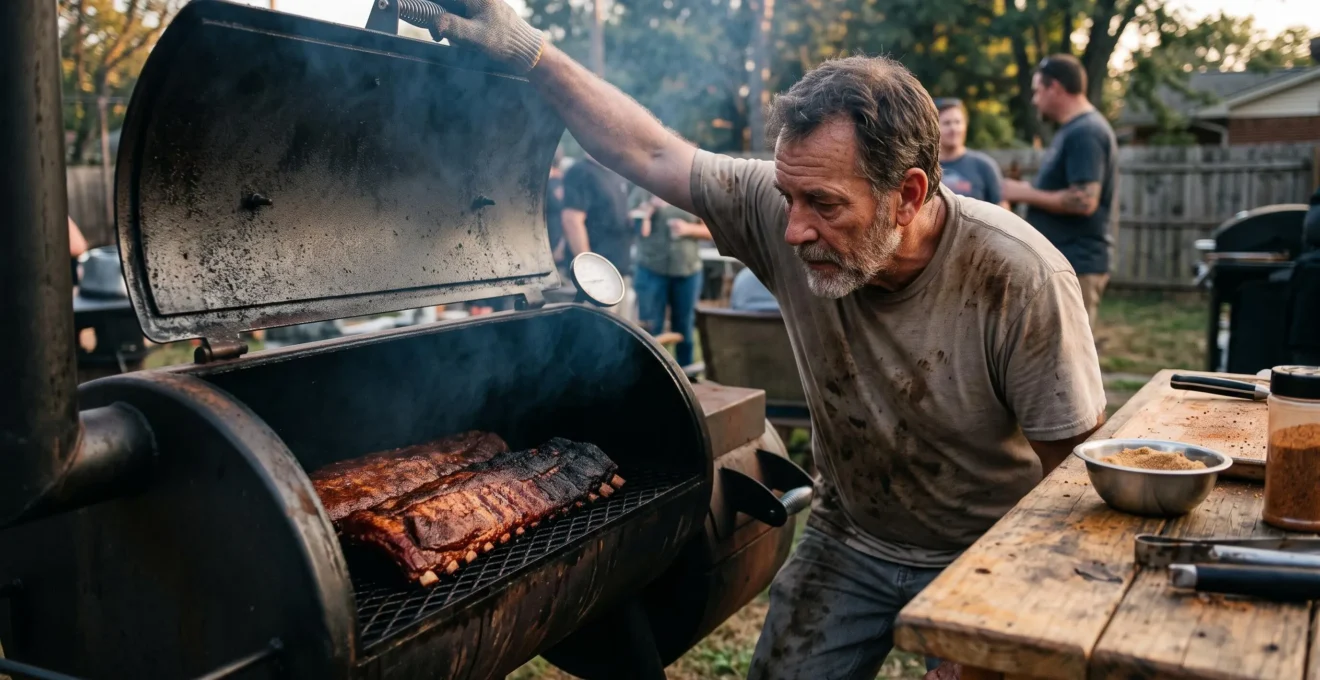
At 275°F (135°C), brown sugar can give barbecue a deep mahogany finish without producing a bitter, scorched crust. The problem is that there is no scientifically established maximum dose that works for every cut, smoker and cooking time. A small amount exposed to heat for hours can produce a very different result from the same amount applied near the end.
For ribs, a practical starting approach is to build the bark with a predominantly savoury rub, then apply a light, even dusting of brown sugar during the final glazing stage. The aim is a subtle sweetness that supports the meat rather than a thick, candied coating. Treat the often-recommended final 30 minutes as a trial window, not a guaranteed safe interval.
Surface moisture, radiant heat, smoke quality and sugars already present in sauces all influence the result. Understanding those variables is more useful than choosing a fixed number of tablespoons without considering how the barbecue is actually cooking.
Brown sugar at 275°F: the practical rules
- Start with less sugar: develop a savoury bark first and add only enough brown sugar to create a thin finishing layer.
- Watch the surface: apply sugar to tacky bark and stop heating the glaze if it darkens rapidly or develops an acrid smell.
- Manage the whole cook: account for sweet sauces, moisture loss, direct radiant heat and smoke quality before blaming the sugar alone.
- Why Does Brown Sugar Burn So Fast Even When Your Pit Is Only 275°F ?
- How to Add Brown Sugar in the Final 30 Minutes Without Turning It Bitter ?
- Light or Dark Brown Sugar: Which Is Less Likely to Burn on Ribs ?
- The Sugar-and-Dirty-Smoke Mistake That Creates a Bitter Crust
- When Should You Stop Adding Sugar and Fix Balance Another Way ?
- How to Add Brown Sugar in the Final 30 Minutes Without Turning It Bitter ?
- Why Does Bark Taste Too Sweet After 6 Hours Even When You Barely Used Sugar ?
- How to Build a Savoury Bark That Stays Firm After 8 Hours Without Going Too Sweet
Why Does Brown Sugar Burn So Fast Even When Your Pit Is Only 275°F ?
Brown sugar can develop an unpleasantly dark, bitter barbecue crust at a pit setting of 275°F because the thermometer reading does not describe every condition at the meat’s surface. Sugar composition, prolonged heating, moisture loss and exposure to hotter radiant surfaces all matter. Importantly, pure sucrose does not normally begin caramelising below 275°F under standard conditions.
That distinction separates caramelisation from the broader process of bark development. Pure sucrose caramelises at approximately 320 °F (160°C), while fructose can caramelise at approximately 230°F (110°C), according to Yale‘s Chemistry of Cooking unit on caramelisation. Brown sugar is predominantly sucrose with molasses, so it should not be treated as a single pure compound with one universal burning temperature.
Barbecue browning also involves reactions between meat proteins and reducing sugars. The Maillard reaction creates colour and flavour independently of straightforward sucrose caramelisation. Prolonged heating can therefore produce dark bark without proving that the brown sugar itself has reached the usual caramelisation temperature.
Why the grate thermometer cannot tell the whole story
A thermometer showing 275°F measures temperature at its sensing position. It does not directly measure the exposed meat surface, the hottest edge of a rib rack or the thermal effect of radiation from a nearby firebox.
While water evaporates from meat, evaporative cooling can keep the surface cooler than the surrounding air. As surface moisture becomes less available, that cooling effect decreases and the surface temperature can rise. The American Meat Science Association‘s Cooking Technology paper explains this transition in meat cooking, although its experiments do not establish sugar-burning thresholds for domestic barbecue smokers.
At a stable 275°F in a predominantly convective cooking environment, an evaporatively cooled surface can remain below the air temperature. It does not automatically exceed 320°F simply because the meat dries. However, stronger radiant heat or locally hotter airflow can create different surface conditions, particularly close to a firebox.
This makes crust appearance a useful warning signal rather than an exact thermal measurement:
- Amber: a developing glaze that may still need time to set.
- Mahogany: a common target colour for finished pork ribs, provided the flavour remains balanced.
- Nearly black: a reason to inspect the surface and taste for bitterness, rather than assuming the colour proves sugar has burnt.
Light and dark brown sugar also behave differently as ingredients because their molasses content changes flavour, moisture and initial colour. A dark-looking crust can therefore reflect the chosen sugar, the meat’s browning reactions or smoke deposits rather than one specific reaction.
The important question is not simply whether 275°F is safe for brown sugar. It is how much sugar is exposed, for how long and under which surface conditions. That leads to a more controllable method: keeping most of the cook savoury and introducing sugar only when the bark is ready.
How to Add Brown Sugar in the Final 30 Minutes Without Turning It Bitter ?
To add brown sugar during the final 30 minutes, begin with a sugar-free or very low-sugar rub and allow the bark to establish its colour and structure. Once the surface is slightly tacky, distribute a thin layer of brown sugar without clumps. Finish over gentle indirect heat, checking the glaze frequently rather than automatically cooking for the entire half-hour.
The method works by separating two objectives. The first stage develops the savoury crust through protein browning, drying and spice adhesion. The second introduces a controlled amount of sweetness and a glossy finish, without making sugar responsible for the entire bark structure.
This is a practical technique rather than a timing protocol established by controlled barbecue experiments. Its success depends on the cut, smoker, glaze thickness and condition of the surface.
Get the surface moisture right
Timing is less useful than judging whether the bark can hold and dissolve a small dusting of sugar. A completely dry crust may leave visible grains, while a heavily wet surface can dissolve the sugar into liquid that runs off or pools in low spots.
Look for a surface that feels slightly tacky rather than dripping wet. The rub should remain in place when touched gently with a clean utensil, and there should be no obvious puddles of sauce or fat. If the bark is very dry, a minimal amount of unsweetened liquid may help the sugar adhere.
The quantity should be governed by coverage rather than an unsupported maximum in grams. Spread the sugar so the existing bark remains visible through the dusting. Avoid mounds along rib edges or between bones: concentrated deposits dissolve and heat unevenly, making the finished glaze harder to control.
A practical late-sugar sequence
- Cook with a predominantly savoury rub until the bark has developed the desired colour and no longer wipes away easily.
- Inspect the surface. If it is wet, allow excess moisture to settle; if completely dry, lightly moisten only where necessary.
- Apply a small, evenly distributed dusting of brown sugar without obscuring the bark.
- Return the meat to indirect heat and inspect regularly for a uniform sheen, visible undissolved grains or rapid darkening.
- Stop heating the glaze when it looks cohesive and tastes balanced, even if the full 30 minutes have not elapsed.
Thick clumps create a particular failure mode: the outer sugar can darken considerably while the centre remains wet or grainy. Extending the cook to dissolve those centres may overcook the thinner areas. An even coating reduces that unevenness.
Five checks before finishing sugar-glazed ribs
- Check the bark: confirm that the savoury crust stays attached when lightly touched; the result is a stable surface ready for finishing.
- Check moisture: identify a tacky surface without visible pools; the result is an even base for adhesion.
- Check distribution: inspect the rack for sugar clumps and spread them out; the result is a thin, consistent coating.
- Check heating: move the ribs away from aggressive radiant heat and monitor the colour; the result is a controlled glazing stage.
- Check completion: look for a cohesive sheen and taste a small sample where practical; the result is a clear stop point based on flavour and appearance.
Thirty minutes is a useful planning interval, not a mandatory exposure period. A smaller coating may finish sooner, while a wetter surface may take longer to develop a cohesive glaze. The next decision is which type of brown sugar makes that process easier to control.
Light or Dark Brown Sugar: Which Is Less Likely to Burn on Ribs ?
Light brown sugar is generally the more conservative choice when trying to produce mildly sweet ribs, because it contributes less molasses flavour and typically starts with a lighter colour. Dark brown sugar provides a stronger, deeper molasses character, but there is insufficient direct evidence to claim that it always burns faster on ribs at 275°F.
According to the University of Illinois Extension‘s explanation of brown sugar composition, light brown sugar contains approximately 3.5% molasses by weight, compared with approximately 6.5% in dark brown sugar.
3.5% vs 6.5%
Approximate molasses content by weight in light and dark brown sugar, respectively. These figures describe ingredient composition, not measured burning rates on barbecue meat.
University of Illinois Extension, What Makes Brown Sugar Brown?, 2020.
Dark brown sugar therefore contains roughly 1.9 times as much molasses as light brown sugar under those approximate compositions. That is a substantial difference in molasses proportion, not a doubling of total sugar concentration or a proven doubling of scorch risk.
Molasses contributes its own flavour compounds, minerals and moisture. These make the sugars noticeably different in taste and appearance, but do not establish a simple one-to-one relationship between molasses percentage and the onset of bitterness.
For barbecue cooks, the useful distinction is how each sugar fits the intended flavour and cooking method.
| Decision factor | Light brown sugar | Dark brown sugar |
|---|---|---|
| Molasses content | Approximately 3.5% | Approximately 6.5% |
| Flavour contribution | Milder sweetness and lighter molasses character | Stronger molasses flavour |
| Long savoury cooks | A practical starting choice when sweetness should remain restrained | Use sparingly if a pronounced molasses flavour is not desired |
| Short finishing glaze | Useful when the spice crust should remain dominant | Useful when a deeper molasses note is intentionally required |
| Burn-risk evidence | No established universal safe exposure time | No proven universal faster-burning rate on ribs |
Existing ingredients matter as much as the sugar variety. Sweet barbecue sauce, honey or a sugar-heavy commercial rub may already provide enough sweetness. Paprika contributes colour and flavour, but ordinary unsweetened paprika should not be counted as equivalent to a sugar-rich ingredient.
Coarse raw sugars such as turbinado introduce another variable: crystal size. Larger grains may take longer to dissolve into a relatively dry bark, leaving uneven texture. For a finishing dusting, finer, evenly distributed sugar is easier to monitor. This is a practical handling consideration rather than evidence that coarse sugar necessarily burns more slowly or quickly.
For a restrained UK-style barbecue finish, start with light brown sugar and add dark brown sugar only when its distinctive flavour is needed. Neither variety compensates for an unstable fire or contaminated smoke, which can make even a carefully measured glaze taste unpleasant.
The Sugar-and-Dirty-Smoke Mistake That Creates a Bitter Crust
A bitter black barbecue crust is not necessarily burnt sugar. Poor combustion can expose meat to heavy smoke, soot and harsh-tasting deposits, while a sugary glaze creates an adhesive surface on which some deposits may remain. Sugar darkening and dirty smoke can therefore contribute to the same unpleasant result, even though the precise contribution of each cannot be diagnosed from colour alone.
Clean fire management is especially important when finishing glazed ribs in an offset smoker. Oxygen-starved combustion, unsuitable fuel and repeated smouldering can produce dense, unpleasant smoke. Adding more sugar will not correct those combustion problems.
It is also a mistake to assume that every visible trace of smoke indicates contamination. Smoke appearance changes with conditions, and even relatively clean combustion may produce visible vapour. Thin, lightly coloured smoke is a useful practical target, but visual appearance alone is not a laboratory measure of smoke composition.
For a glazed rack, look for changes that coincide with fire management. A sudden increase in heavy smoke followed by harsh surface flavour suggests combustion should be investigated, even when the brown sugar quantity has not changed.
Separate a sugar problem from a smoke problem
Burnt sugar often contributes an aggressively dark, bitter sweetness. Dirty smoke can introduce an acrid, sooty or ashy impression. However, these descriptions overlap and are not definitive chemical tests. Meat spices, overheated fat and excessive bark development can also influence bitterness.
A simple controlled comparison can help. During a future cook, prepare two otherwise similar rib portions with the same savoury rub. Apply the finishing brown sugar to only one portion, while keeping their placement and cooking conditions as comparable as possible.
Hypothetical diagnostic cook: two rib portions
Imagine two similarly sized rib portions cooked side by side at a nominal 275°F. Both receive the same unsweetened seasoning. One receives a late brown sugar dusting; the other remains sugar-free.
If both develop an acrid taste, smoke quality, seasoning and heating conditions deserve investigation. If only the sugared portion tastes harsh, its sugar application and local heating become stronger suspects. This comparison is illustrative, not a documented experiment, and unequal heat exposure could still confound the result.
On an offset smoker, practical corrective actions include using suitably seasoned wood, maintaining adequate airflow, avoiding a persistently smouldering fire and preventing the food from receiving excessive direct radiant heat. Smaller fuel additions can make combustion easier to manage in some fireboxes, provided the fire remains established.
Do not add more glaze while trying to solve a smoke problem. A thicker sugary coating may disguise a minor flavour imbalance temporarily, but it cannot remove existing soot or reverse harsh smoke exposure.
Once combustion quality is under control, sugar becomes easier to use predictably. The remaining question is whether the finished bark needs more sweetness at all, or whether another flavour adjustment would achieve better balance.
When Should You Stop Adding Sugar and Fix Balance Another Way ?
Stop adding brown sugar when the bark has the colour and sweetness you want, or when further application would make the crust sticky, excessively dark or one-dimensional. If the meat already tastes sweet enough but lacks balance, adjust savoury, acidic or spicy elements instead. More sugar is rarely the correct response to a crust that is already sufficiently coloured.
Brown sugar can contribute sweetness, colour and glaze texture, but those roles should remain separate. A rib rack may have an attractive mahogany surface before any finishing sugar is added. In that case, the sugar should be used only if the flavour genuinely needs it.
The same principle applies to sauces. A sweet barbecue sauce brushed over a sweet rub already combines multiple sugar sources. Adding another layer of brown sugar may increase stickiness and sweetness without producing a proportionate improvement in colour.
Use the right lever for the flavour problem
- Too sweet: introduce a little unsweetened acidity, such as cider vinegar, through a finishing sauce or table condiment.
- Sweet but flat: consider whether a restrained amount of salt, mustard or savoury seasoning would provide greater definition.
- Rich and heavy: use vinegar or another acidic accompaniment to provide contrast without increasing the sugar load.
- Lacking warmth: introduce black pepper or chilli rather than trying to create more flavour through darker sugar.
- Already bitter: stop darkening the glaze and investigate heat exposure, seasoning and smoke quality.
These adjustments affect flavour perception rather than reversing chemical burning. A vinegar-based finishing sauce may make a sweet rack more pleasant, but it cannot turn a severely scorched surface back into unburnt bark.
Labels help reveal hidden sweetness. Check the ingredients of commercial rubs, bottled glazes and marinades for sugar, honey, syrup and other sweeteners. If nutrition information is available, compare products on a consistent basis, remembering that label figures describe the packaged product rather than precisely how much sugar ultimately remains on the meat.
Keeping one element deliberately unsweetened is particularly useful. A savoury rub paired with a lightly sweet finishing sauce gives the cook more control than combining a sugary rub, sweet spritz and thick glaze from the beginning.
Once the decision to stop adding sugar is clear, attention can return to the finishing process itself. Whether the meat is wrapped, rested or returned to indirect heat changes how a thin sugar coating behaves.
How to Add Brown Sugar in the Final 30 Minutes Without Turning It Bitter ?
For a controlled final glaze, apply brown sugar only when the bark has set, then choose whether to finish with gentle indirect heat or use a wrapped resting stage. A tacky surface helps the sugar adhere; an excessively wet one encourages pooling. If the glaze darkens too quickly, reduce heat exposure rather than continuing towards a fixed 30-minute target.
Wrapping changes the behaviour of sugar because it changes the moisture environment. Foil retains more moisture and liquid than an uncovered smoker chamber, while butcher paper typically allows more moisture exchange than a tightly sealed foil wrap.
Neither wrapping method guarantees caramelisation. In a sufficiently moist wrap, the sugar may primarily dissolve into juices and form a syrup rather than develop the firm, roasted character associated with an exposed bark.
Sugar before wrapping or after wrapping?
Applying sugar before wrapping allows it to mix with the meat’s moisture and any added liquid. This may produce a softer, sweeter coating, particularly in foil. It can work when a tender, sauced finish is preferred, but is less suited to preserving a dry, firm bark.
Applying sugar after unwrapping gives the cook greater control over where the coating sits. The disadvantage is that a very dry surface may not dissolve it readily. In that case, slight surface moisture and gentle heat can help produce a uniform finish without forcing the sugar through a prolonged exposure.
| Finishing method | Main advantage | Main limitation |
|---|---|---|
| Sugar before foil wrapping | Moisture helps dissolve the coating | Can produce a softer, wetter bark |
| Sugar before butcher-paper wrapping | Some moisture exchange remains possible | Results depend on paper, liquid and wrap tightness |
| Sugar after unwrapping | Direct control over the finishing layer | Dry bark may leave undissolved grains |
| Sugar over gentle indirect heat | Allows visual monitoring of the developing glaze | Requires attention to hot spots and local radiation |
For ribs where firmness matters, finishing uncovered over indirect heat is generally the more controllable approach. Apply a thin coating, monitor the surface and remove the rack once the desired sheen is present.
If the glaze darkens faster than expected, move the ribs to a cooler area or remove them from the heat. If dryness is contributing to uneven sugar deposits, a small amount of unsweetened liquid can help redistribute the coating. Avoid aggressive brushing that would dislodge established bark.
Wrapping can also limit further direct exposure, but it should be chosen with the texture trade-off in mind. Trapped moisture may soften the crust, so it is not automatically the best rescue method when crisp, firm bark is the objective.
Resting is useful for allowing a warm glaze to settle and for normal meat-handling purposes. It should not be relied upon to create significant new caramelisation once the meat has left the heat. A resting rack also needs appropriate food-safe handling and temperature control.
The preferred sequence depends on the desired texture, not only the clock. A coating that looks controlled after a short finish may become excessively sweet or soft when repeatedly layered throughout a longer cook.
Why Does Bark Taste Too Sweet After 6 Hours Even When You Barely Used Sugar ?
Bark can taste excessively sweet after six hours because the brown sugar added by hand may represent only a small part of the total sweetener used. Sugar-containing rubs, marinades, spritzes and sauces can all contribute. As surface water evaporates, remaining soluble ingredients may become more concentrated, making sweetness more prominent even without another sugar application.
The first step is to reconstruct the entire cook rather than counting only the brown sugar sprinkled onto the meat. A commercial seasoning might already contain sugar near the beginning of its ingredients list. A bottled sauce or sweetened spritz can introduce another dose later.
These additions do not necessarily accumulate in full. Some liquid drips away, some dissolves into rendered juices, and some remains on the meat. Nevertheless, multiple applications create opportunities for sweetness to build beyond the intended level.
Why time changes the balance
During a long cook, moisture moves out of the surface and the bark develops. If dissolved sugar remains behind as water evaporates, its concentration within the remaining surface moisture increases. This can intensify local sweetness and stickiness without requiring any additional sugar.
That does not mean sugar is created or that sweetness must rise continuously. Some material can be lost through dripping, wrapping or other processes, while browning reactions may alter the flavour. The final result depends on how much sweetener remains and how it interacts with the meat and seasoning.
Fatty cuts add another sensory dimension. Rendered fat can coat the surface and change how sweetness, salt, smoke and spices are experienced. On pork belly or a fatty brisket point, a sweet coating may seem particularly rich and persistent. Fat itself should not be described as chemically dissolving sucrose: sugar is primarily water-soluble, while fat influences texture, coating and flavour perception.
Long exposure also makes early sugar application harder to control. A sugar-rich rub sits through the entire period of bark development, while a late dusting is exposed for only a fraction of that time.
Consider a hypothetical cook in which a small amount of brown sugar is added at the end, but a sweet rub was applied at the start and a sweetened spritz was used repeatedly. Blaming the final dusting alone would overlook the previous applications. A sugar-free spritz and a more savoury base rub would provide a clearer test of the finishing sugar’s contribution.
For the next cook, note each sweet ingredient, its application stage and whether it produces a visible coating. This simple record is more informative than attempting to infer sugar quantities from the colour of the finished bark.
The longer the cook, the stronger the case for building bark around savoury seasoning and using sweetness sparingly. That approach also helps preserve the firm texture expected from a well-developed barbecue crust.
Key takeaways before building a savoury bark
- Separate structure from sweetness: let meat browning, drying and savoury seasoning establish the bark before relying on sugar for a finishing effect.
- Choose the desired texture: repeated sweet glazes and moisture-retaining wraps can produce a softer finish than an uncovered savoury crust.
- Evaluate the complete cooking system: cut thickness, moisture, heat exposure and existing sweet ingredients matter more than a universal brown sugar limit.
How to Build a Savoury Bark That Stays Firm After 8 Hours Without Going Too Sweet
Build a savoury bark for an eight-hour barbecue cook by making salt, pepper and other unsweetened spices the foundation, with brown sugar either omitted or reserved for a very light finishing application. Maintain controlled indirect heat and avoid repeatedly wetting the surface. Firmness depends on surface drying, protein and spice crust development, and moisture management during wrapping and resting.
Sugar is not necessary for meat to develop a brown crust. The Maillard reaction occurs through reactions involving amino acids and reducing sugars already present in food. The university guidance in Texas A&M’s Barbecue Science resource describes this browning mechanism, although it does not prescribe a specific rub formula or sugar percentage.
A savoury rub therefore gives the cook a useful starting point. Salt seasons the meat, black pepper contributes pungency and texture, while paprika can add colour and a complementary flavour. Other dry spices can be used according to the cut, but they should support rather than conceal the meat’s character.
Keep sugar subordinate to the savoury ingredients
There is no evidence-backed universal brown-sugar-to-salt ratio that guarantees a firm bark after eight hours. The proportions should reflect the meat’s surface area, thickness, existing seasoning and intended finishing method.
For a first controlled cook, keep the primary rub free from added sugar. If the resulting meat needs a little sweetness, test a light finishing dusting on part of the rack rather than reformulating the entire rub around sugar.
This approach makes the outcome easier to interpret. If the sugar-free section already has excellent colour and savoury flavour, extra sugar may not improve it. If the sugared section develops a pleasant gloss without excessive stickiness, that result provides a practical reference for future cooks on the same equipment.
Firmness also depends on more than sugar content. Moisture-retaining wraps, frequent spraying and humid holding conditions can soften a bark even when no brown sugar is present. Conversely, excessive drying can make the surface hard or unpleasantly tough. The objective is a cohesive crust with a satisfying bite, not maximum dehydration.
Sucrose and molasses-containing ingredients can contribute to a sticky surface under humid conditions. However, sucrose is not the sole determinant of bark texture, and the claim that sugar alone causes a soft eight-hour bark would overstate the available evidence.
Adjust the method to the cut
Ribs, pork shoulder and brisket do not behave identically. Their fat distribution, thickness, cooking duration and surface exposure differ. A sugar quantity that gives a restrained finish to one rack of ribs may be excessive on a smaller portion, while a large pork shoulder presents a different surface-to-mass relationship.
The same applies to equipment. An offset smoker with significant radiant heat from the firebox creates different local conditions from a well-controlled pellet smoker. The nominal 275°F setting is therefore only one part of the cooking environment.
Assess the finished meat through several independent signs:
- Colour: an even brown to mahogany surface without unwanted scorched patches.
- Texture: a coherent bark that does not immediately dissolve into a sticky coating.
- Flavour: a dominant savoury character with smoke, salt and spice in balance.
- Sweetness: a subtle supporting note rather than the main impression.
- Repeatability: a method that can be reproduced by recording the rub, finishing stage and heat-management decisions.
Eight hours is not itself a target for every cut. Cooking time should follow the meat’s characteristics, doneness requirements and the intended texture. A well-developed bark is valuable, but it does not replace safe cooking or appropriate internal-temperature checks.
On the next barbecue cook, begin with a savoury base rub, keep the smoke clean and reserve brown sugar for a small finishing test only if the meat needs it. Record the colour, texture and flavour of the result. That comparison will establish a more useful personal sugar limit than an unsupported universal tablespoon measurement.
Can brown sugar burn at a smoker temperature of 275°F?
Yes, an unpleasantly dark or bitter sugar-containing crust can develop during a cook at a nominal 275°F, particularly where local heat exposure, prolonged drying or smoke conditions differ from the thermometer reading. However, pure sucrose generally caramelises at approximately 320°F, so a 275°F air reading does not by itself establish that sucrose has reached its caramelisation temperature.
Is there a safe number of tablespoons of brown sugar per rack of ribs?
No universal maximum is established by the cited evidence. Rack size, sugar distribution, existing sweeteners, cooking duration and local heating conditions all affect the outcome. For a restrained finish, begin with a thin, even dusting that leaves the underlying bark visible and adjust through controlled comparisons.
Can muscovado sugar replace ordinary brown sugar in a barbecue rub?
Muscovado can be used when a pronounced molasses character is desired, but its moisture, flavour intensity and handling properties may differ from those of ordinary light brown sugar. The supplied evidence does not establish a safe substitution ratio or comparative burning threshold for muscovado on ribs. Test a small amount before using it across a whole rack.
Will brown sugar make barbecue bark crispy?
Not reliably. Sugar can contribute to a glossy coating and may harden under some conditions, but moisture and concentrated sweet glaze can also create a sticky or soft surface. For a firm savoury bark, focus on controlled drying, spice-crust development and limiting excessive moisture during wrapping and finishing.
Should brown sugar go on ribs before or after wrapping?
Adding sugar before wrapping tends to favour dissolution into retained moisture, which may suit a softer, sauced finish. Adding it after unwrapping gives greater control over the exposed finishing layer, provided the bark is slightly tacky. Neither sequence has a universally validated advantage at 275°F; the preferred method depends on the desired texture.